
Oct 5, 2026 · @Som Bentur
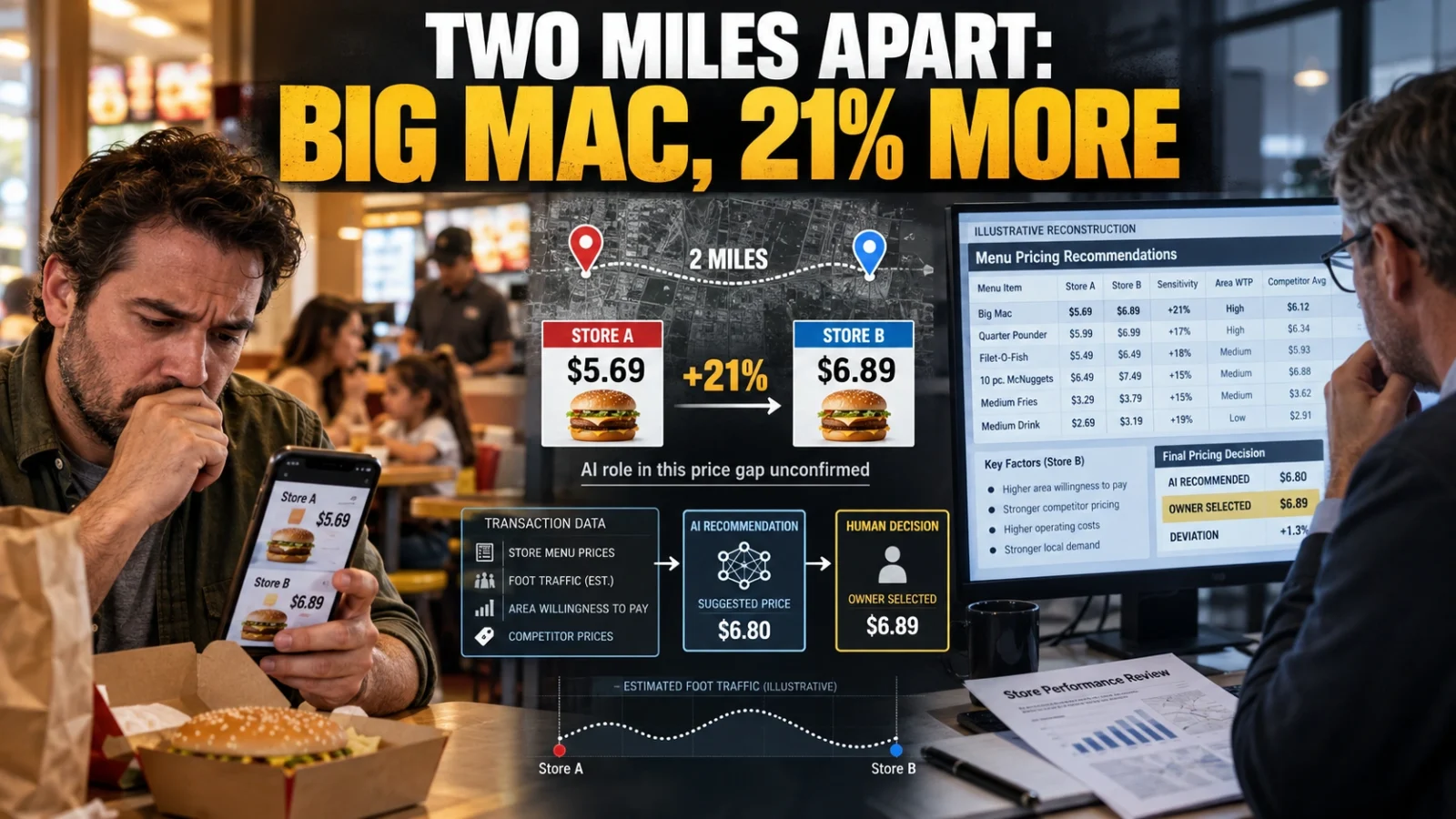
McDonald’s runs a machine-learning “pricing engine” that chews through millions of daily transactions across its nearly 14,000 U.S. restaurants and recommends what the company calls “the optimal price” for every menu item at every location, . One input the AI has supercharged, according to screenshots reviewed by the news agency, is an estimate of how much each store’s customers are willing to pay. The result shows up on the app: a company-run store in Fresno, California, listed a Big Mac at $5.69 in September while another company-run store two miles away listed it at $6.89, a 21 percent premium.
The report matters now because McDonald’s has spent 2026 promising affordability to customers who have been walking away. Foot traffic at U.S. McDonald’s has fallen year over year in every full month since March, according to Placer.ai estimates cited by Reuters. In January, the company began requiring franchisees to “constructively engage” with its approved pricing consultant and tools, and a June document shows it logs in detail when owners stray from the recommendations.
Who is affected: the millions of Americans for whom McDonald’s is the default cheap meal, the franchisees who own the large majority of U.S. locations, five of whom told Reuters they were pressured to follow the tool, and the workers in those stores who take the heat when a customer asks why the price went up. McDonald’s says the portal is “a tool, not a mandate,” that franchisees are “always free to determine the final price,” and that Reuters recast “a standard business practice as something controversial.”
What the reporting shows
Reuters built its account on screenshots of the franchisee pricing portal taken in August and interviews with nine people with first-hand knowledge. The portal tells an owner things like “Your restaurant is showing MEDIUM SENSITIVITY to Price,” a rating based partly on “customer willingness to pay in your area.” It also pulls public menu prices from nearby Wendy’s and Burger King locations. Both rivals told Reuters they do not use AI in pricing decisions.
The engine is operated by Tiger Analytics, a data-science contractor, with McDonald’s setting the rules it works within, two former Tiger employees told Reuters. Examples they described: concentrate increases on items that have not gone up in at least two years; raise an item only if at least 30 percent of stores have recently raised it; leave ice cream and drinks alone in summer. McDonald’s has used some form of AI pricing tool since at least 2019, and in 2023 CEO Chris Kempczinski told investors the company had built proprietary tools to evaluate pricing at individual restaurants.
Three franchisees said the engine has widened existing price gaps between stores, including between neighborhoods in the same area. Reuters said it could not confirm whether the Fresno gap came from the engine or from other factors, and McDonald’s said stores a few miles apart can sit in distinct markets with different costs. That caution matters: the engine recommends, and owners decide. But a June franchisee document shows McDonald’s records deviations in detail, and Kempczinski told investors in August that “pricing non-compliance in certain cases” is now part of franchisee business reviews, according to Technology.org’s summary of the Reuters story.
Three kinds of pricing, and which one McDonald’s admits to
The day after the story ran, McDonald’s global chief impact officer Jon Banner posted on X: “AI does not set Big Mac prices, make automatic price changes, or determine what individual customers pay. @Reuters got it wrong. Franchisees set menu prices,” according to . That denial is narrower than it sounds. Reuters did not report that the AI sets prices automatically or charges individuals differently; it reported that the AI recommends a price per store, that the company tracks who ignores it, and that willingness to pay is one input.
It helps to separate three practices. Personalized pricing shows different prices to different people for the same item, based on their data; McDonald’s says it does not do this, and nothing in the Reuters report says it does. Surge or time-of-day pricing raises the price when the restaurant is busy; McDonald’s has not announced this. Location-based price optimization sets a different price for the same Big Mac at each store, informed by what nearby customers have shown they will tolerate. That is what the engine does, and it is what McDonald’s defends as “a standard business practice.”
The human effect of the third practice is the one customers notice least and pay for most. A family in one neighborhood pays more than a family two miles away not because beef costs more there, but because a model estimated they would keep coming anyway. Franchisees told Reuters the engine recommended large increases during and after the pandemic as inflation soared; more recently, some say, it has suggested smaller increases or even cuts. At its September 23 investor day in Chicago, McDonald’s called the pricing engine “industry-leading” and central to its affordability push, and said franchisees see the need for cheap menu items to win back low-income customers.
The $18 Big Mac and the Wendy’s lesson
The engine’s most famous output is the Big Mac meal priced at about $18 at a Connecticut turnpike rest stop in 2023. Franchisee George Michell says in a lawsuit that McDonald’s pricing tools suggested that price, and that the company later tried to push him out of the system for discriminatory reasons; McDonald’s disputes the suit and says Michell repeatedly breached his franchise agreements, according to Reuters. The price went viral and became shorthand for fast-food inflation. A December filing by the franchisee says it “caused no loss of sales” at that location, which, if accurate, is exactly the kind of signal a willingness-to-pay model is built to find.
The industry’s cautionary tale is Wendy’s. In February 2024, CEO Kirk Tanner told analysts the chain would test “dynamic pricing” on new digital menu boards. Within days the plan was being described as surge pricing, and the backlash was immediate. Wendy’s said its comments were misconstrued, that it would not raise prices at busy times, and later told Reuters it never implemented the system. Instacart ended a limited test of AI tools that showed different grocery prices to different shoppers in December 2025 after a study exposed it, and now says it will never use personal data to set item prices.
McDonald’s appears to have drawn two lessons: keep the word “dynamic” out of public statements, and keep the algorithm one step removed from the menu board by routing it through franchisees. The engine’s internal guardrails, like protecting ice cream and drinks from summer increases, read as a recognition that some price moves are too visible to risk.
The numbers behind the pricing push
| Measure | Figure | Source |
|---|---|---|
| Big Mac, two company-run Fresno stores two miles apart (Sept. 2026) | $5.69 vs. $6.89 (21% gap) | Reuters app check |
| Big Mac meal at Connecticut turnpike stop (2023) | about $18 | Franchisee lawsuit, via Reuters |
| U.S. restaurants covered by the pricing engine | nearly 14,000 | Reuters |
| AI pricing tool in use since | at least 2019 | Reuters |
| U.S. comparable sales, Q2 2026 | +0.8%, with guest counts down | McDonald’s Q2 results |
| Sales lost from lower-income customers, Q2 2026 | about $310 million | Restaurant Business, via Inkl |
| U.S. foot traffic | down year over year every full month since March 2026 | Placer.ai estimates, via Reuters |
| Franchisee requirement to “constructively engage” with pricing tools | since January 2026 | Internal communication, via Reuters |
The pattern is the one that worries both franchisees and investors: checks are going up while visits go down. McDonald’s grew U.S. same-store sales in the second quarter only because the average order got more expensive, offsetting fewer customers. A pricing engine tuned to willingness to pay is good at the first half of that equation. The affordability menu it is now supposed to serve is an attempt at the second.
What it means for customers, workers and franchisees
For customers, the practical change is that the Big Mac has quietly stopped being a national price. It is a neighborhood price, and the neighborhood’s tolerance is part of the math. Brooklyn resident Diane Bezucha told Reuters it is reasonable for a company to know where demand is, but if the technology is used to raise prices “simply because of more demand, that doesn’t really help me as a customer.” McDonald’s own data shows who is leaving: Kempczinski said in early 2024 that customers earning under $45,000 had pulled back, and the $310 million in lost lower-income sales last quarter suggests the gap has not closed.
For franchisees, the engine changes the relationship with headquarters. McDonald’s earns rent and royalties as a percentage of store sales, so a higher price that does not drive customers away is pure upside for the company, while the owner bears the cost of the ones who stop coming. Five owners told Reuters they felt pressured; a document logs their deviations; and non-compliance can now surface in business reviews. McDonald’s says the tool exists to help owners “deliver value for customers and make informed business decisions.”
For crew members, the price is something they did not set and cannot explain. The portal also carries a warning that owners “may be competitors” and should mind antitrust law, Reuters reported, an acknowledgment that routing a shared pricing recommendation to thousands of nominally independent businesses is legally delicate. That is a corporate risk, but if regulators ever act on it, the disruption would land on the stores and the people working in them.
Where regulators are heading
The Federal Trade Commission voted 2-0 on August 19, 2026, to propose an , saying that where consumers expect one price for everyone, a business that varies prices based on personal data without clear disclosure is likely violating Section 5 of the FTC Act. Chairman Andrew Ferguson said the agency cannot ban the practice outright. Comments closed September 25. The policy targets individual-level pricing, which McDonald’s says it does not do; store-level optimization is not its focus.
The second track is antitrust. Courts and regulators are examining whether shared pricing algorithms can facilitate illegal coordination among competitors, a theory already being tested against rent-setting software. Franchisees are sometimes treated as competitors of one another, which is why McDonald’s own portal warns owners about antitrust prohibitions. No regulator has accused McDonald’s of wrongdoing, and the company says it has designed the tool as a recommendation, not a mandate.
States are moving faster than Washington on surveillance pricing. New York requires a disclosure when an algorithm uses personal data to set a price; Maryland, Connecticut and New Jersey enacted bans in 2026 covering groceries and other sectors; and Seattle passed the first city-level grocery ban on September 22. None of those laws reaches location-based menu pricing at a restaurant chain, which is why McDonald’s strategy sits, for now, in the gap between what the public dislikes and what the law restricts.
What happens next
McDonald’s reports third-quarter results in early November; the two numbers to watch are U.S. guest counts and whether the engine’s “affordability” recommendations show up as lower prices on the app. Wells Fargo cut its price target after the investor day, calling the pricing and value message “hard to digest,” according to Stocktwits. The FTC has not set a date for finalizing its personalized-pricing policy.
The Michell lawsuit in Connecticut remains the one place where the engine’s recommendations could be examined under oath, though its claims center on discrimination rather than pricing. And the January franchisee standard requiring engagement with the pricing tools means the next round of business reviews will show whether “a tool, not a mandate” holds up in practice.
Editorial note: Reuters could not confirm that the Fresno price gap came from the pricing engine, and McDonald’s disputes the characterization of its tool. The headline’s framing of an AI that estimates what a neighborhood will pay reflects the “customer willingness to pay in your area” language in portal screenshots Reuters reviewed. Allegations in the Michell lawsuit are the franchisee’s; McDonald’s denies them. Claims about franchisee pressure come from five owners interviewed by Reuters and are disputed by the company.
Sources
Reuters via KSL, “Inside McDonald’s push to have artificial intelligence price your Big Mac” — https://www.ksl.com/article/51629878/inside-mcdonalds-push-to-have-artificial-intelligence-price-your-big-mac
Reuters via CNBC, “Inside McDonald’s push to have AI price your Big Mac” — https://www.cnbc.com/2026/09/29/inside-mcdonalds-push-ai-price-big-mac.html
Restaurant Business, “McDonald’s has another pricing-related headache” — https://www.restaurantbusinessonline.com/financing/mcdonalds-has-another-pricing-related-headache
Technology.org, “How McDonald’s AI Estimates What Your Area Will Pay for a Big Mac” — https://www.technology.org/2026/10/01/mcdonalds-ai-pricing-engine-big-mac/
The Motley Fool, McDonald’s Q2 2026 earnings call transcript — https://www.fool.com/earnings/call-transcripts/2026/08/11/mcdonalds-mcd-q2-2026-earnings-call-transcript/
TradingKey, “McDonald’s Q2 2026 Earnings: Revenue Grows as Comparable Sales Slow” — https://www.tradingkey.com/news/earnings/262075999-tradingkey
Stock Analysis, McDonald’s Investor Day 2026 transcript — https://stockanalysis.com/stocks/mcd/transcripts/746101-investor-day-2026/
Inkl, “McDonald’s Is Undergoing a Massive New Growth Strategy” (citing Restaurant Business) — https://inkl.com/news/mcdonalds-is-undergoing-a-massive-new-growth-strategy-can-it-win-back-consumers
Fortune, “McDonald’s is promising ‘attention to affordability’ after the price of Big Mac meals hits $18” — https://fortune.com/2024/02/06/mcdonalds-ceo-chris-kempczinski-focus-on-affordability-q4-sales
Axios, “Wendy’s says it will not use ‘surge pricing'” — https://www.axios.com/2024/02/28/wendys-pricing-plans-digital-boards
Fortune, “Wendy’s says ‘dynamic pricing’ is different from ‘surge pricing'” — https://www.fortune.com/2024/02/29/wendys-dynamic-pricing-criticism-alienating-customers
FTC, “FTC Seeks Comment on Enforcement Policy Statement Regarding Personalized Pricing” — https://www.ftc.gov/news-events/news/press-releases/2026/08/ftc-seeks-comment-enforcement-policy-statement-regarding-personalized-pricing
AI Laws by State, surveillance pricing law tracker — https://www.ailawsbystate.com/tools/surveillance-pricing-tracker
NW Labor Press, “Seattle to ban ‘surveillance pricing’ of groceries” — https://nwlaborpress.org/2026/10/seattle-to-ban-surveillance-pricing-of-groceries
Stocktwits, “McDonald’s Stock Draws Fresh Target Cuts” — https://stocktwits.com/news-articles/markets/equity/mc-donald-s-stock-draws-fresh-target-cuts-wells-fargo-says-analyst-day-message-is-still-hard-to-digest/cZDpUq1RBjR




Leave a Reply