
Oct 8, 2026 · @Som Bentur
On September 25, 2026, the final day of the Federal Trade Commission’s comment period, the National Fair Housing Alliance (NFHA) and The Leadership Conference on Civil and Human Rights filed a letter on behalf of 27 organizations asking the agency to ban surveillance pricing outright, according to three days later. The signers range from the Electronic Frontier Foundation and Consumer Federation of America to LULAC, UnidosUS, the Service Employees International Union and Asian Americans Advancing Justice.
The filing answers an FTC proposal from August 19 that would treat undisclosed personalized pricing as a likely violation of Section 5 of the FTC Act, but would permit it when companies tell consumers it is happening. The coalition’s reply is that a disclosure fixes nothing when the algorithm behind the price is a black box that even the company may not fully understand, and when the person being charged has no way to contest it.
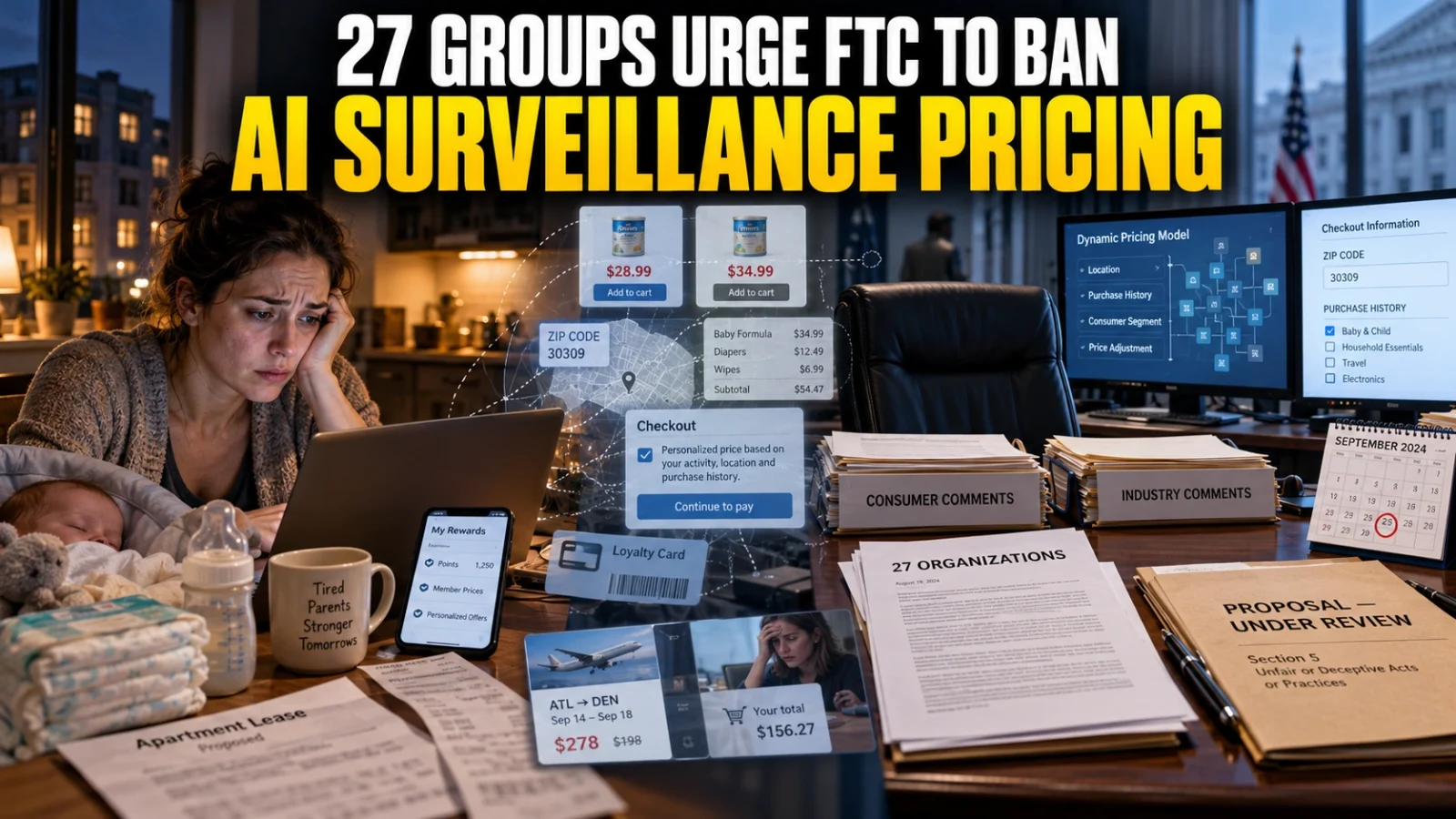
Who is affected: anyone whose zip code, purchase history or late-night shopping could be read by a model as a willingness, or a desperation, to pay more. The coalition’s examples are a parent buying for a newborn at 2 a.m., a traveler booking a flight to a sick relative, and a renter whose neighborhood stands in for their race. The FTC has not responded to the comments, and the record it is weighing includes industry filings urging it to go no further than disclosure.
What the coalition actually asks for
The to Chairman Andrew Ferguson leads with a legal argument: the FTC already has the power to prohibit surveillance pricing under the “unfairness” prong of Section 5, and does not need Congress. A practice is unfair if it causes substantial injury that consumers cannot reasonably avoid and that is not outweighed by benefits. The coalition says a higher price is a concrete injury, and that an opaque algorithm is by definition something a shopper cannot avoid.
If the commission will not ban the practice, the letter asks for five safeguards. Companies should have to explain why a price was set, including the data and inferences used, the way a lender must explain a credit denial. Consumers should get a way to challenge the price. Disclosure should happen twice, when data is collected and again at checkout. Joining a loyalty program should never count as consent to personalized pricing. And a personalized “discount” should be measured against what other customers pay for the same item at the same moment, not against a list price the seller can inflate.
The filing also points at the FTC’s own August 7 announcement that it will under the FTC Act. Twelve days later, the agency proposed a personalized-pricing policy whose examples describe prices turning on religion, identity and sexual orientation. “As AI makes pricing more personalized, the Commission is narrowing its own tools for policing discrimination,” said Dr. Michael Akinwumi, NFHA’s chief AI officer. “It should be doing the opposite.”
What the FTC proposed, and why disclosure is the fight
The commission voted 2-0 on August 19 to seek comment on an saying that where consumers reasonably expect one price for everyone, a business that varies prices based on personal data without clearly disclosing the fact, the basis and the type of data used is likely violating Section 5. The statement acknowledges that some personalized pricing may be unfair even when disclosed, citing higher prices charged to homebound people or mourners. But its remedy is transparency. Ferguson has said the agency lacks authority to ban the practice outright.
The coalition’s objection is practical. A notice that reads “this price was set by an algorithm using your personal data” tells a shopper nothing about which data, what inference was drawn, or what everyone else paid. Working families, the letter argues, do not have time to comparison shop, use privacy tools and route around price manipulation the way wealthier consumers might. Consumer Reports’ Grace Gedye made the same point to : the policy throws the burden of avoiding inflated prices onto the consumer.
The commission is not deciding in a vacuum. House Oversight Chairman James Comer asked for a staff briefing on the proposal in September, and a Senate hearing earlier this year produced bipartisan hostility; Sen. Josh Hawley called AI surveillance pricing “spying on people, ripping them off, and taking away jobs.” Whether that sentiment translates into a ban, or stops at disclosure, is the question the comment record now puts to the agency.
Why housing is the coalition’s test case
The letter singles out rental housing because the pricing there is already algorithmic and already hidden. Rents set by AI revenue-management software can change weekly or daily on factors tenants never see, the coalition writes, which makes it “profoundly difficult” for a prospective renter to understand why they were quoted a given rate. The Government Accountability Office reported rents rose 24 percent over three years as that software spread, a figure the letter cites from a Senate Banking Committee hearing.
The legal record on rent algorithms has moved fast in the past month. On September 10, the Justice Department announced a settlement with Pinnacle, leaving RealPage itself as the only defendant in the federal case that has not settled, according to . On September 30, a federal judge in North Carolina issued a 71-page opinion refusing to dismiss the parallel case brought by nine state attorneys general, finding a plausible conspiracy to share confidential data and align rents, . RealPage and the landlords deny the allegations, and nothing has been proven at trial. A separate $359.9 million class settlement with 37 landlords faces a fairness hearing October 15.
The coalition’s deeper point is about proxies. A zip code, a purchase history or a device fingerprint can stand in for race without any system ever naming it. The letter cites a that found significantly higher fares in neighborhoods with larger non-white populations. NFHA calls the result “digital redlining.” Whether a pricing model that produces such patterns violates fair-housing or credit law without intent is exactly the question the FTC’s August disparate-impact decision made harder to bring.
Key dates
| Date | Event |
|---|---|
| January 17, 2025 | FTC publishes interim findings from its surveillance pricing study of eight intermediaries |
| August 7, 2026 | FTC announces it will no longer bring disparate-impact claims under the FTC Act |
| August 19, 2026 | FTC proposes personalized-pricing enforcement policy built on disclosure |
| September 10, 2026 | DOJ settles with Pinnacle; RealPage is the last unsettled federal defendant |
| September 25, 2026 | Coalition of 27 files its comment; FTC comment period closes |
| September 30, 2026 | Judge denies RealPage’s and landlords’ motions to dismiss the states’ case |
| October 15, 2026 | Fairness hearing on the $359.9 million RealPage class settlement |
| January 29, 2027 | Claim deadline in the RealPage class settlement |
What it means for renters, shoppers and families
The practical stakes are in the examples both sides use. The FTC’s own statement describes charging more to a homebound person or someone arranging a funeral. The coalition adds the parent shopping at midnight for a newborn and the traveler rushing to a sick relative, behaviors a model can read as urgency and price accordingly. Citing the AFL-CIO’s union-label department, the letter says working families can end up paying “hundreds or even thousands more each year” than someone else for the same goods, a figure that is an advocacy estimate rather than a measured average.
Loyalty cards are the quiet channel. The letter points to a WIRED reporter who obtained a 515-page file from McDonald’s rewards program containing predictions about how often he would visit, how much he would spend and how likely he was to quit. It also cites the Texas attorney general’s lawsuit alleging that an Allstate subsidiary, Arity, collected driving data through fuel-rewards apps on roughly 45 million Americans and sold it to insurers who used it to raise premiums or drop coverage. Those are allegations in a pending case; Allstate has disputed them. The coalition’s point is that a shopper who signs up to save a few cents a gallon cannot trace that data to a higher insurance bill, let alone contest it.
For renters the harm is less visible and larger. A $50 difference in monthly rent set by software is $600 a year, repeated across a lease, and the tenant never sees the number their neighbor was quoted. The coalition notes a second front it says is less discussed: employers using the same kinds of data and AI to set individual wages, which it argues can suppress and destabilize pay.
The other side of the record
Industry has not been silent, and neither has the agency’s own leadership. Ferguson told the commission cannot ban personalized pricing in every instance, only discipline businesses that fail to tell consumers how their data sets a price. In a 2025 concurrence he called the term “surveillance pricing” an “unfortunate exercise in question begging,” and the proposed statement takes care to say that personalized discounts, loyalty rewards and broadly available promotions are not the target.
The standard business case is that data-driven pricing can lower prices for price-sensitive shoppers, that discounts offered through apps are a form of personalization consumers like, and that a federal ban would sweep in ordinary coupons. The Open Markets Institute, in its own , tried to split that difference, urging the FTC to adopt disclosure while making clear it does not shield unfair pricing, to distinguish surveillance pricing from transparent sales, and to ask Congress for an outright prohibition.
The civil rights coalition’s answer is that the comparison that matters is not list price versus discount but what two customers pay for the same thing at the same time. If one pays more because of inferences about who they are, calling the gap a “discount” for the other does not change the math. The FTC’s statement already concedes that a personalized “discount” can be a disguised markup; the coalition wants that concession written into the enforcement standard.
What happens next
The FTC will review the comment record before deciding whether to finalize, revise or drop its policy statement; it has set no deadline. A final statement built on disclosure would give the agency a basis to bring deception cases against companies that personalize prices in secret, but not against companies that personalize openly. A ban is possible only if the commission reverses Ferguson’s reading of its own authority, or if Congress acts on bills that have so far not advanced.
States are not waiting. New Jersey, Maryland, Connecticut and New York have enacted prohibitions or disclosure rules, and bills are pending in California and Colorado, the coalition notes. In housing, the next dates are concrete: the October 15 fairness hearing on the RealPage class settlement, the January 29, 2027 claim deadline, and the continuing state case in North Carolina now headed toward discovery.
For a renter or shopper, the immediate tools are the ones the coalition says are inadequate but real: New York’s required notice that a price was set by an algorithm using personal data, state privacy laws that let residents opt out of data sales, and, for tenants, the RealPage settlement claim process. Whether a federal rule ever tells them why their price was different from their neighbor’s is now the FTC’s call.
Editorial note: The coalition’s characterizations of surveillance pricing as discriminatory and predatory are advocacy positions. Claims about RealPage and Arity are allegations in pending litigation; the companies deny wrongdoing, and the $359.9 million class settlement includes no admission of liability. The Chicago ride-hail study found correlation with neighborhood demographics, not proof of intent. The “hundreds or thousands” figure is an AFL-CIO estimate cited by the coalition.
Sources
National Fair Housing Alliance, press release on the 27-organization coalition letter, September 28, 2026 — https://nationalfairhousing.org/national-fair-housing-alliance-and-the-leadership-conference-lead-coalition-of-27-organizations-calling-for-a-ban-on-surveillance-pricing/
Coalition comment letter to the FTC, September 25, 2026 (PDF) — https://nationalfairhousing.org/wp-content/uploads/2026/09/Civil-Rights-Coalition-FTC-Comment-Letter-v2.pdf
Davis Vanguard, “Civil Rights Coalition Calls on FTC to Ban AI Surveillance Pricing in Housing and Consumer Markets” — https://davisvanguard.org/2026/09/coalition-urges-ftc-ai-pricing-ban/
FTC, “FTC Seeks Comment on Enforcement Policy Statement Regarding Personalized Pricing,” August 19, 2026 — https://www.ftc.gov/news-events/news/press-releases/2026/08/ftc-seeks-comment-enforcement-policy-statement-regarding-personalized-pricing
FTC, announcement ending disparate-impact claims, August 7, 2026 — https://www.ftc.gov/news-events/news/press-releases/2026/08/ftc-ditches-disparate-impact
FTC, Surveillance Pricing 6(b) study interim findings, January 17, 2025 — https://www.ftc.gov/news-events/news/press-releases/2025/01/ftc-surveillance-pricing-study-indicates-wide-range-personal-data-used-set-individualized-consumer
Chairman Ferguson, concurrence on the surveillance pricing 6(b) study — https://ftc.gov/system/files/ftc_gov/pdf/surveillance-pricing-6b-ferguson-concurrence.pdf
CBS News, “FTC says ‘personalized pricing’ based on consumer data could violate the law” — https://www.cbsnews.com/news/ftc-personalized-pricing-warning-consumers/
The American Prospect, “FTC Says It Will Enforce Surveillance Pricing. It Won’t.” — https://prospect.org/2026/08/21/ftc-says-it-will-enforce-surveillance-pricing-it-wont/
Open Markets Institute, comment to the FTC on surveillance pricing — https://www.openmarketsinstitute.org/publications/ftc-comment-crack-down-on-surveillance-pricing
Multifamily Dive, “DOJ, Pinnacle reach settlement in RealPage case” — https://www.multifamilydive.com/news/doj-pinnacle-settlement-realpage-lawsuit/830108/
North Carolina Department of Justice, court denies RealPage motion to dismiss, October 2, 2026 — https://ncdoj.gov/court-sides-with-attorney-general-jeff-jackson-in-realpage-case-antitrust-lawsuit-over-rent-pricing-to-continue/
Federal Register, United States et al. v. RealPage, proposed final judgment — https://www.federalregister.gov/documents/2026/07/16/2026-14345/united-states-of-america-et-al-v-realpage-inc-et-al-proposed-final-judgment-and-competitive-impact
Open Class Actions, RealPage states’ case ruling and class settlement dates — https://openclassactions.com/news/realpage-states-antitrust-motion-to-dismiss-denied.php
Pandey and Caliskan, “Disparate Impact of Artificial Intelligence Bias in Ridehailing Economy’s Price Discrimination Algorithms” (ACM) — https://dl.acm.org/doi/10.1145/3461702.3462561
Hazard Herald, “U.S. House committee backs FTC’s probe into AI surveillance pricing” — https://www.hazard-herald.com/news/national/u-s-house-committee-backs-ftcs-probe-into-ai-surveillance-pricing/article_b3ef41a5-b586-5539-bb22-fede04310162.html
Washington Informer, “Civil Rights Groups Warn AI Could Become the Next Front in the Fight Against Discrimination” — https://www.washingtoninformer.com/advocates-fight-ai-bias/
Texas Attorney General, petition against Allstate and Arity (PDF) — https://www.texasattorneygeneral.gov/sites/default/files/images/press/Allstate%20and%20Arity%20Petition%20Filed.pdf




Leave a Reply