
Oct 8, 2026 · @Som Bentur
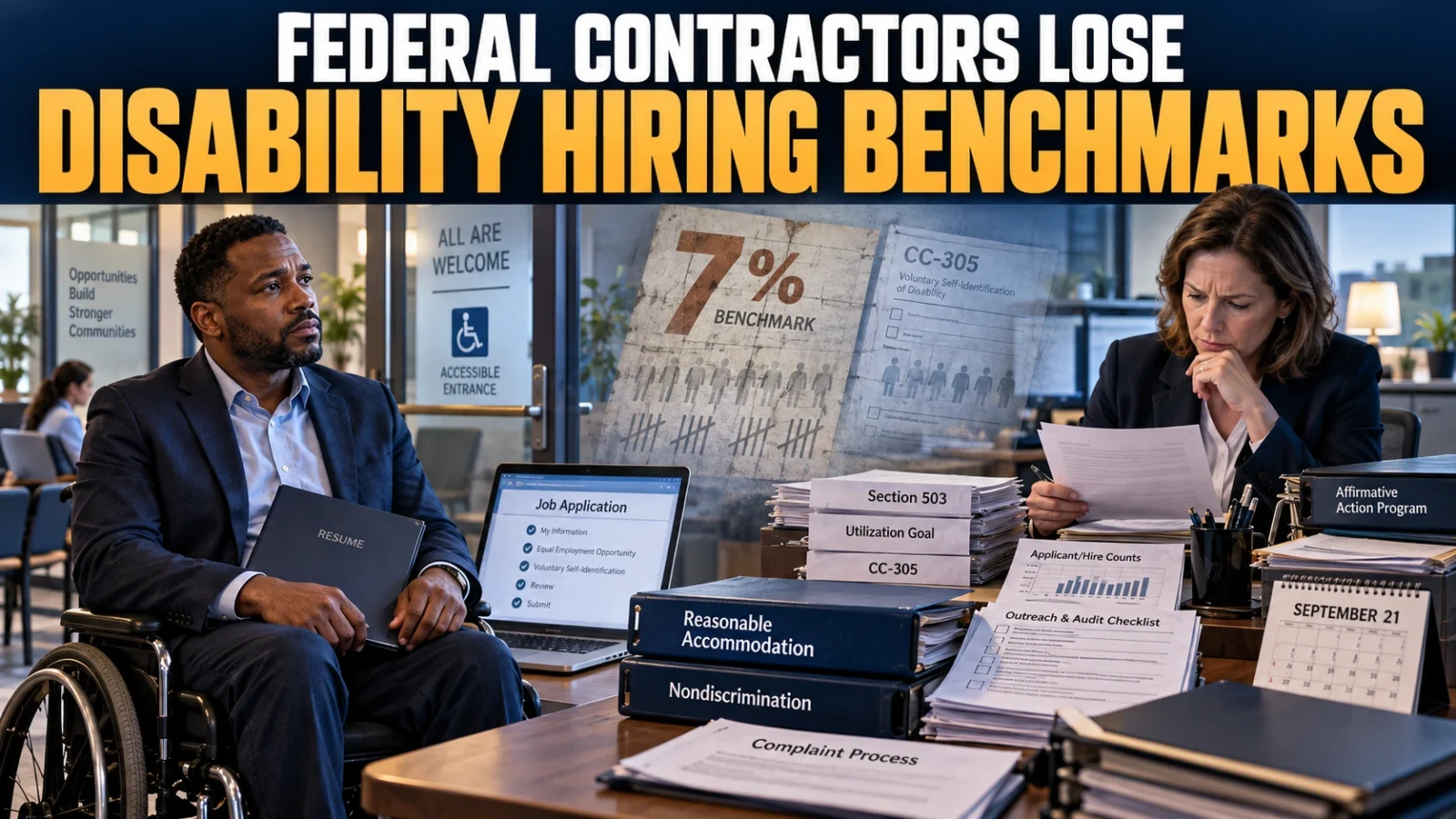
A Labor Department rule that took effect September 21 ended the 7 percent disability hiring benchmark that has guided companies with federal contracts since 2014. It also ended the requirement that those companies invite applicants and employees to say whether they have a disability. The Office of Federal Contract Compliance Programs (OFCCP) published the final rule in the on August 21, 2026, carrying out two executive orders President Trump signed in early 2025.
The change reaches well beyond Washington. The department’s own budget documents have said federal contractors employ more than 20 percent of the American workforce. Only 22.8 percent of people with disabilities were employed in 2025, compared with 65.2 percent of people without disabilities, according to the . Disabled job seekers, disabled employees and the HR teams that recruit them are the people most directly affected. The rule covers contractors, not hiring inside federal agencies, despite some headlines.
The Labor Department says the change is about legality and paperwork. Disability groups say it removes the yardstick that showed whether outreach was working. Both sides agree that Section 503 of the Rehabilitation Act, the 1973 law requiring contractors to take affirmative action to hire and advance disabled people, and the ban on disability discrimination remain in force. What is disputed is whether those duties will mean as much without the measuring tools.
What changed, and what didn’t
The rule, published at 91 Federal Register 54482, rescinds three things that anchored Section 503 compliance for more than a decade. They are the 7 percent utilization goal and the annual analysis comparing each job group to it, the requirement to invite applicants and employees to self-identify as disabled, and the related data collection on applicants and hires. The federal self-identification form, CC-305, was . The rule also raises the basic coverage threshold from $15,000 to $20,000 to match an inflation adjustment.
The 7 percent figure was a benchmark, not a quota. DOL acknowledges in the rule that missing it was not itself a violation. Contractors that fell short, however, had to look for barriers and set action plans.
Much remains. Contractors still cannot discriminate on disability, must still provide reasonable accommodations, and those with 50 or more employees and a $50,000 contract must still keep written affirmative action programs with outreach and audit systems. Complaint procedures also remain. The rule says contractors no longer have to weigh counts of disabled applicants and hires when judging their outreach. Protected-veteran self-identification and the veteran hiring benchmark were untouched, according to . A separate rule rescinding the regulations for Executive Order 11246, which covered race and sex, takes effect October 26.
Why the Labor Department says it acted
DOL’s central argument is legal. The Americans with Disabilities Act (ADA) bars employers from asking applicants before an offer whether they have a disability, and it limits such questions to employees. DOL concluded that even a “voluntary” invitation is an employer inquiry, so the old rule required what the ADA forbids. It also said the goal could push contractors toward quotas despite the ban on them. In its view, the analyses became unworkable after Executive Order 11246 was revoked in January 2025, because they relied on that order’s job groupings.
DOL also pointed to cost and enforcement. It estimated annualized savings of about $80 million and expects roughly 29,904 contractors to spend about 10 hours each updating HR systems. It noted that since fiscal 2020 it had issued more than 75 violations to contractors that skipped the analysis or ignored shortfalls. In its view, contractors faced real enforcement risk over the paperwork even though missing 7 percent was not a violation.
Some commenters and practitioners agree with the agency. One commenter who identified as disabled called the process box-checking. A Proskauer partner told that contractors struggled with the requirements and that the data was unreliable because many employees won’t disclose.
The legal ground is contested. EEOC guidance had long allowed voluntary self-identification for affirmative-action purposes, and a federal appeals court upheld the 2013 rule in 2014. DOL says that decision rested on Chevron deference, which the Supreme Court overruled in 2024, and it declined to defer to the EEOC. Of the 651 comment submissions, many opposed the change, and DOL called the concerns about weakened protections unfounded.
Why disability groups call it a loss of visibility
The American Association of People with Disabilities (AAPD) argues that without the data, disparities simply stop being visible. In a , the group said “recent gains in disability employment are no accident.” The National Organization on Disability called the goal and data collection essential to the spirit of the ADA.
Some evidence supports the idea that the framework shaped contractor behavior. A found federal contractors were more likely than other companies to use six of eight inclusive recruitment and hiring practices. Fewer than half used five of the eight, and contractors looked similar to other firms on retention and advancement. A DOL-funded Cornell study, as cited by the Center on Disability, found large majorities of contractors used self-identification data to track progress, 90 percent for the 7 percent goal. DirectEmployers, an employer association, said its members reported real improvements in outreach and a minimal added burden.
None of these surveys isolates the goal’s effect on hiring. They show what contractors did, not whether more disabled people got jobs. The employed share of people with disabilities did rise from 21.3 percent in 2022 to 22.8 percent in 2025, but a changing post-pandemic labor market makes it impossible to credit any one rule.
The people behind the numbers
| Year | Employed share, with disability | Employed share, no disability | Unemployment, with disability | Unemployment, no disability |
|---|---|---|---|---|
| 2023 | 22.5% | 65.8% | 7.2% | 3.5% |
| 2024 | 22.7% | 65.5% | 7.5% | 3.8% |
| 2025 | 22.8% | 65.2% | 8.3% | 4.1% |
| Sept. 2026 (one month) | 22.8% | 64.9% | 7.5% | 3.8% |
BLS cautions that half of people with disabilities are 65 or older, which pulls the overall ratio down. Among ages 16 to 64, the 2025 employed share was 38.1 percent for disabled people and 74.8 percent for others. Disabled workers were nearly twice as likely to work part time, at about 30 percent versus 17 percent. Black disabled workers faced an 11.8 percent unemployment rate in 2025.
Alicia Deal, a disability advocate, told the federal benchmarks were a lifeline toward financial independence. “Providing accommodations and hiring us is not a handout or special treatment,” she said. She warned the rollback could ripple across the private sector, which is a prediction, not a finding. A frequently cited 2015 found employers expressed interest in applicants who disclosed a disability about 26 percent less often, though it covered only accounting jobs.
Who is watching now?
A DOL staffer told , “We continue to actively enforce Section 503 through the complaint process.” But the agency doing the enforcing has shrunk. OFCCP’s full-time headcount fell more than 82 percent between September 2025 and January 2026, to 80 employees, according to federal workforce data cited by . Congress still funded the agency at about $101 million for fiscal 2026. The president’s fiscal 2027 budget again proposes defunding OFCCP and moving Section 503 enforcement to a new Office of Civil Rights at the Labor Department.
Complaint-based enforcement puts the burden on individuals. The rule notes that contractors, not DOL, held the self-identification data, which OFCCP examined only in compliance reviews. Advocates worry that with the data gone and audits thinner, patterns of exclusion become harder to prove. DOL says contractors can still run barrier analyses, make hiring systems accessible and partner with disability employment organizations.
The change also fits a wider pattern, critics say. In July 2025, DOL to phase out subminimum wage certificates for disabled workers, concluding it lacked authority to do so by rule. Democratic lawmakers later called the Labor Secretary’s actions the most significant retreat in disability employment protections in decades. No source reviewed shows employers deliberately targeting disabled workers. The documented concern is reduced accountability, not retaliation.
What happens next
The Section 503 changes are already in effect. The Executive Order 11246 rescission takes effect October 26, and the removal of the old administrative-procedure regulations takes effect December 21. No court challenge to the rule had been reported as of early October.
Contractors may keep some practices voluntarily, but lawyers differ on how much room they have. reads the rule as barring proactive disability invitations absent a separate ADA-compliant purpose. Others note the rule adds no new prohibition, and DOL says it is “simply no longer” requiring the questions. Congress will also weigh OFCCP’s fate in the fiscal 2027 budget.
The first full-year BLS disability figures covering the post-rule period are likely in early 2027, since the 2025 figures came out March 3, 2026. They will show whether the gap moves, but they will not by themselves show why. Disabled workers keep their rights to accommodation and nondiscrimination. They can still file complaints with OFCCP or bring ADA charges to the EEOC, and filing deadlines apply.
Editorial note: Statements that the rule puts disabled workers “at risk” are projections by advocates and are attributed as such. DOL disputes them and says the rule neither repeals the ADA nor Section 503. No allegation of illegality or discriminatory intent by any employer or agency is made here. The brief’s “first corporate targets” framing was not adopted because no source documents employers targeting disabled workers; the article frames the concern as lost accountability.
Sources
Federal Register, Section 503 final rule (91 FR 54482) — https://www.federalregister.gov/documents/2026/08/21/2026-17115/modifications-to-the-regulations-implementing-section-503-of-the-rehabilitation-act-of-1973-as
GovInfo, official PDF of the final rule — https://www.govinfo.gov/content/pkg/FR-2026-08-21/pdf/2026-17115.pdf
DOL, Voluntary Self-Identification of Disability Form notice — https://www.dol.gov/agencies/ofccp/self-id-forms
SHRM, “DOL Rolls Back Federal Contractor Affirmative Action Rules” — https://www.shrm.org/topics-tools/employment-law-compliance/dol-rolls-back-federal-contractor-affirmative-action-rules
HR Brew, “Department of Labor changes disability hiring rules” — https://www.hr-brew.com/stories/department-of-labor-changes-disability-hiring-rules-for-federal-contractors
USA TODAY via Yahoo, “Trump rolls back federal hiring rules. Are disabled workers at risk?” — https://www.yahoo.com/news/politics/articles/trump-rolls-back-federal-hiring-090310597.html
Disability Scoop via NOD, “DOL Rescinds 503 Disability Hiring Mandate” — https://nod.org/news/disability-scoop-dol-rescinds-503-disability-hiring-mandate/
NOD, “Impending Changes to Section 503” — https://nod.org/news/impending-changes-to-section-503-of-the-rehabilitation-act/
AAPD, Labor Day statement — https://www.aapd.com/labor-day-2026-dol-regulations-statement/
DirectEmployers, OFCCP Section 503 final rule — https://directemployers.org/2026/08/21/ofccp-section-503-final-rule-disability-self-id-utilization-goal/
Seyfarth Shaw, “DOL Rescinds Section 503 Disability Utilization Goal” — https://www.seyfarth.com/news-insights/dol-rescinds-section-503-disability-utilization-goal-and-data-collection-requirements.html
HR Works, “OFCCP Ends Disability Goal & Self-Identification Requirements” — https://hrworks-inc.com/blog-post/ofccp-ends-disability-goal-self-identification-requirements/
Federal News Network, “Many of the disability-compliance measures federal contractors rely on are going away” — https://federalnewsnetwork.com/workforce/2026/09/many-of-the-disability-compliance-measures-federal-contractors-rely-on-are-going-away/
BLS, “People with a Disability: Labor Force Characteristics — 2025” — https://www.bls.gov/news.release/pdf/disabl.pdf
BLS, Employment Situation, September 2026 — https://www.bls.gov/news.release/archives/empsit_10022026.htm
DOL ODEP, Disability Employment Statistics — https://www.dol.gov/agencies/odep/research-evaluation/statistics
BLS, employment-population ratio for people with a disability, 2023 — https://www.bls.gov/opub/ted/2024/employment-population-ratio-for-people-with-a-disability-increases-to-series-high-in-2023.htm
DOL FY 2025 Congressional Budget Justification (OFCCP) — https://www.dol.gov/sites/dolgov/files/general/budget/2025/CBJ-2025-V2-10.pdf
DOL ODEP, Survey of Employer Policies: federal contractors vs. non-contractors — https://www.dol.gov/resource-library/survey-employer-policies-employment-people-disabilities-implementation-disability?lang=ja
Cornell Yang-Tan Institute, “Initial Impact of Section 503 Rules” — https://ecommons.cornell.edu/entities/publication/8049263c-ab97-4437-b008-9f725be73f71
Center on Disability, comments on proposed Section 503 changes — https://centerondisability.org/2025/08/28/center-on-disability-statement-on-section-503-proposed-revisions/
DCI Consulting, “OFCCP Restructured Amid Staffing Changes” — https://blog.dciconsult.com/ofccp-restructured-amid-staffing-changes
Berkshire Associates, President’s FY 2027 budget and OFCCP — https://www.berkshireassociates.com/blog/presidents-fy-2027-budget-proposal-moves-enforcement-of-section-503-vevraa-to-a-new-office-of-civil-rights-at-dol
Federal Register, Section 14(c) proposed rule withdrawal — https://www.federalregister.gov/documents/2025/07/07/2025-12534/employment-of-workers-with-disabilities-under-section-14c-of-the-fair-labor-standards-act-withdrawal
Sen. Warren’s office, Democratic lawmakers’ letter to the Labor Secretary — https://www.warren.senate.gov/newsroom/press-releases/warren-duckworth-dingell-simon-lead-democrats-in-pressing-labor-secretary-to-explain-elimination-of-key-protections-programs-for-workers-with-disabilities
Syracuse BBI, Rutgers/Syracuse field experiment on hiring discrimination — https://bbi.syr.edu/2015/11/meera-adya-lisa-schur-and-douglas-kruse-featured-in-new-york-times-for-research-on-employment-discrimination
Vensure, “DOL Ends Section 503 Disability Utilization Goal” — https://vensure.com/employment-law-updates/federal/dol-ends-section-503-disability-utilization-goal
Contractors Perspective, “OFCCP Finalizes Sweeping Changes to Section 503” — https://www.contractorsperspective.com/ofccp/ofccp-finalizes-sweeping-changes-to-section-503-disability-affirmative-action-requirements/




Leave a Reply