
Oct 5, 2026 · @Som Bentur
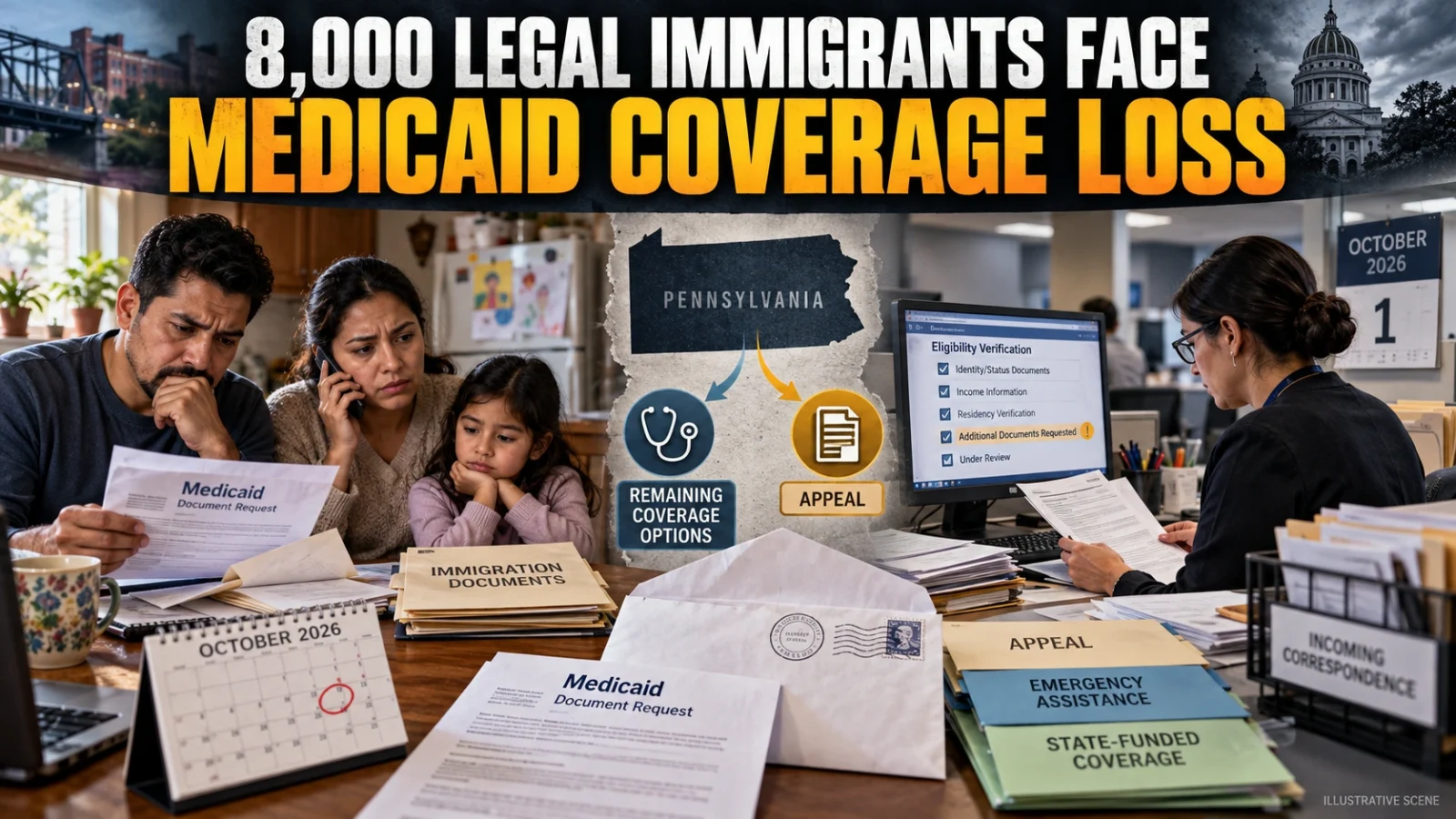
On Thursday, October 1, 2026, federally funded Medicaid ended for refugees, asylees, trafficking survivors and other lawfully present immigrants who do not hold a green card. In Pennsylvania, roughly 8,000 people were at risk of losing coverage, according to published September 29. The cutoff is written into H.R. 1, the budget law President Trump signed on July 4, 2025.
Nationally, the scale is larger than Congress was told. The Congressional Budget Office projected about 100,000 more uninsured immigrants by 2034. asked states for their own counts and found more than 281,000 people in nine states and Washington, D.C., expected to lose Medicaid this month alone.
Who is affected is the point. These are people the federal government admitted after years of vetting. An Afghan man injured while helping U.S. forces. An Algerian math professor whose wife is a doctor and whose child has autism. A 25-year-old Syrian refugee in New Jersey who had intestinal surgery paid for by Medicaid. Whether they keep any coverage now depends on letters, deadlines and appeals.
What the law changed
Before October 1, federally funded Medicaid in Pennsylvania was open to refugees, asylees, trafficking survivors, Afghan and Iraqi special immigrants, people granted withholding of removal, and several other groups, according to the (PHLP). As of October 1, it is limited to green card holders who have cleared the five-year wait, Cuban and Haitian entrants, Compact of Free Association migrants, lawfully present children, and pregnant or postpartum women.
Everyone else is out, regardless of how they arrived. Emergency Medicaid remains for life-threatening conditions. People who get Supplemental Security Income keep coverage in Pennsylvania, but the state pays without federal matching funds, WHYY reported.
One correction is worth stating plainly. Undocumented immigrants were never eligible for regular federal Medicaid, KFF Health News noted; a describing the bill as removing “illegals” from the program was misleading. The people losing coverage on October 1 are here legally.
Where the paperwork purge begins
The termination itself is a change in law, not a paperwork failure. But the way it is carried out puts a stack of forms between lawfully present people and the coverage some of them still qualify for.
Federal guidance required states to run every “potentially affected” enrollee through immigration databases first, . The main one, the Department of Homeland Security’s SAVE system, gives a “point in time” answer and does not update when someone’s status changes. A refugee who became a green card holder last year may still show up as a refugee. When the database cannot confirm status, the state mails a letter asking for documents.
Pennsylvania’s County Assistance Offices began sending those letters at the end of June, PHLP reported. Recipients had to send proof of citizenship, a green card or one of the other qualifying statuses by a stated deadline. Miss the deadline, and the termination proceeds. KFF found some states did not begin mailing notices until September.
Why the letters themselves are a barrier
KFF reviewed notices from 16 states and found wide variation. Most listed who stays eligible; fewer explained who loses coverage. Some named acceptable documents, others did not. Only a few were available in another language. Reading levels ranged from fourth grade to tenth grade.
The people receiving them are, by definition, recent arrivals, often with limited English. Kyle Fisher, managing attorney at PHLP, told WHYY that the eligibility and documentation rules for appeals and state coverage are complex enough that “no one’s figuring that out without help from legal aid.” He expects many immigrants to have some lapse in coverage.
The last national test of mass Medicaid paperwork ended badly. During the post-pandemic “unwinding,” more than 25 million people were disenrolled, and 69 percent lost coverage for procedural reasons such as missing forms, not because they were found ineligible, according to .
The appeal that keeps coverage alive
Pennsylvania offers two fallback programs, and getting into either runs through an appeal. An appeal postmarked by October 1 kept federal Medicaid in place while the state reviewed the case, Maripat Pileggi of told WHYY. “Most of the time, an appeal has merit,” she said. Late appeals can still be filed, but coverage may lapse in the meantime.
The first fallback, Emergency Medical Assistance, covers only treatment for an emergency condition, though PHLP notes a person does not need to be in an emergency room to qualify. The second, state-funded Medicaid, provides full benefits but has strict limits: under $425 a month in income for someone 59 or older or a parent of a child under 21, or under $205 a month for a person with a disability or a caregiver. Domestic violence survivors and people in addiction treatment qualify, with a nine-month lifetime cap.
Pennsylvania’s Department of Human Services has said it will review everyone affected for state-funded coverage. Legal experts told WHYY those decisions will not be immediate.
| Date | What changes |
|---|---|
| July 4, 2025 | H.R. 1 signed into law |
| Late June 2026 | Pennsylvania County Assistance Offices begin mailing notices |
| October 1, 2026 | Federal Medicaid ends for refugees, asylees and other lawfully present adults; appeal postmark deadline to keep coverage during review |
| December 31, 2026 | States must submit updated Medicaid plan amendments to CMS |
| January 1, 2027 | ACA marketplace subsidies and Medicare narrow to the same groups |
Families on the receiving end
Tammy Lam, a community resources coordinator at the Southeast Asian Mutual Assistance Association Coalition in Philadelphia, described telling the Algerian family they would likely lose coverage. The father now drives for a ride-share company; the mother stays home with their autistic child. “He looked at me, and he was like, ‘But why?'” Lam told WHYY. “‘Why did I even come here? I did everything right.'” They cried together, she said.
In New Jersey, Ahin, the Syrian refugee, applied for permanent residency soon after arriving in October 2024. A resettlement director told KFF Health News that green cards used to take about six months and now take well over a year. Had hers arrived on the old timeline, she would have kept Medicaid. “She is stuck in the middle and has no control,” the director said.
Thoai Nguyen, CEO of the Philadelphia coalition, told WHYY that most clients are embarrassed to use public benefits at all. “They’re willing to work to their bone to support themselves,” he said.
The next cliff is January
Medicaid is the first cut, not the last. On January 1, 2027, subsidies for marketplace plans, called Pennie in Pennsylvania, and Medicare eligibility narrow to the same three groups: green card holders, Cuban and Haitian entrants and COFA migrants. CBO estimates about 1 million lawfully present immigrants will lose marketplace subsidies by 2034 and roughly 100,000 will lose Medicare.
Until then, PHLP says, a person losing Medicaid can get Pennie subsidies only if their income is above the federal poverty level, about $1,330 a month for one person. That leaves a gap for anyone earning more than the state-funded Medicaid limit but less than the poverty line. After January, unsubsidized marketplace plans remain available at full price, which KFF describes as likely unaffordable.
The strain on the people processing the paperwork
States are carrying out these changes at the same time they implement Medicaid work requirements, which begin in January, and six-month eligibility checks for expansion adults, KFF notes. Pennsylvania alone is about work requirements. CMS has not yet issued final guidance on how to handle people enrolled in both Medicare and Medicaid, or on identifying SSI recipients, leaving states to guess.
Caseworkers verifying immigration status for thousands of people are the same caseworkers who will field hundreds of thousands of work-requirement forms three months from now. Advocates at a September 24 rally at Philadelphia City Hall argued that errors are inevitable in that environment. CMS Administrator Mehmet Oz has described implementing the law as a statutory responsibility.
What happens next
Final counts of how many Pennsylvanians actually lost coverage will not be available until later this fall, KFF Health News reported. People who received a termination notice can still appeal through their County Assistance Office or call PHLP’s helpline at 1-800-274-3258 or the state customer service line at 1-877-395-8930.
California is spending $365 million to cover its roughly 148,000 affected residents through July 2027; New York and New Mexico have similar plans. Pennsylvania has not announced new funding beyond its existing, narrow state-funded program. Work requirements take effect in January, and the ACA and Medicare restrictions follow on the same day.
Editorial note: The 8,000 figure is an estimate reported by WHYY and attributed to local advocates and state data; Pennsylvania has not published a final count. The 281,000 figure reflects state projections collected by KFF Health News, not confirmed terminations. Statements that the law is intended to discourage immigration are advocates’ characterizations; the administration describes the law as reserving taxpayer-funded programs for citizens and qualifying residents.
Sources
WHYY, “About 8,000 lawfully present Pennsylvania immigrants face Medicaid health insurance terminations on Oct. 1” — https://whyy.org/articles/immigrants-medicaid-health-insurance-terminations/
KFF Health News / The Washington Post, “US Poised To Boot Legal Immigrants From Medicaid, Including Refugees and Sex-Trafficking Victims” — https://kffhealthnews.org/medicaid/immigrants-kicked-off-medicaid-refugees-asylum-seekers-trump-big-beautiful-bill-cbo-2/
KFF, “Implementation of Medicaid Immigrant Eligibility Restrictions Under the 2025 Reconciliation Law: Issues to Consider” — https://www.kff.org/immigrant-health/implementation-of-medicaid-immigrant-eligibility-restrictions-under-the-2025-reconciliation-law-issues-to-consider/
Pennsylvania Health Law Project, “Immigrant Health Coverage in PA: One Month Until Changes Take Effect” — https://www.phlp.org/en/news/immigrant-health-coverage-in-pa-one-month-until-changes-take-effect
Pennsylvania Department of Human Services, Medicaid noncitizen notice letter — https://www.pa.gov/content/dam/copapwp-pagov/en/dhs/documents/medicaid/hr1-related/cm-0713-medicaid-noncitizen-letter.pdf
CMS, State Health Official letter SHO 26-001 on immigrant eligibility — https://www.medicaid.gov/federal-policy-guidance/downloads/sho26001.pdf
Center for Medicare Advocacy, “Groups of Lawfully Present Immigrants Lose Medicaid Coverage Under HR1 Starting Today” — https://medicareadvocacy.org/big-ugly-bill-strips-coverage-from-legally-eligible-people-starting-today/
WHYY, “‘Open your mail’: Pennsylvania begins notifying over 700,000 Medicaid enrollees about work requirements” — https://whyy.org/articles/pennsylvania-medicaid-work-requirements-awareness/
KFF, Medicaid Enrollment and Unwinding Tracker — https://kff.org/medicaid/issue-brief/medicaid-enrollment-and-unwinding-tracker/
KFF, “State Health Coverage for Immigrants and Implications for Health Coverage and Care” — https://www.kff.org/racial-equity-and-health-policy/state-health-coverage-for-immigrants-and-implications-for-health-coverage-and-care/
Community Legal Services of Philadelphia, “Medicaid rules in Pennsylvania are changing” — https://clsphila.org/public-benefits/medicaid-rules-in-pennsylvania-are-changing/
NewsNation via KLAS, “Legal immigrants begin losing Medicaid under new law” — https://www.8newsnow.com/news/national-news/legal-immigrants-begin-losing-medicaid-under-new-law/
White House release, May 2025 (cited for the claim KFF Health News describes as misleading) — https://www.whitehouse.gov/releases/2025/05/one-big-beautiful-bill-protects-medicaid-by-removing-illegals-from-the-program/




Leave a Reply