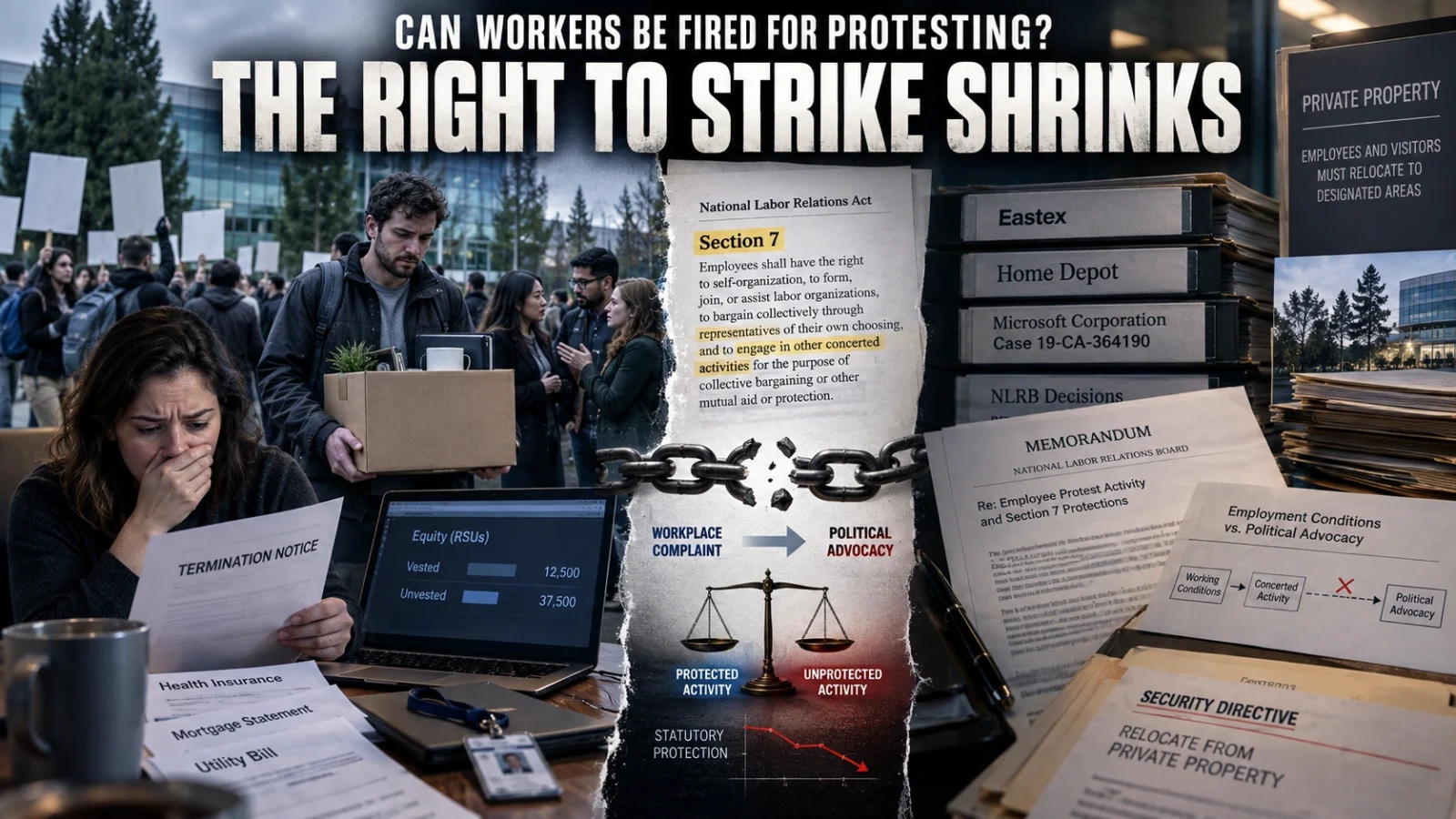
In an administrative decision that substantially narrows the legal boundaries of employee dissent, the National Labor Relations Board’s Division of Advice concluded that Microsoft Corporation acted lawfully when it terminated workers who organized an on-campus demonstration protesting foreign military cloud contracts1. The formal memorandum in Microsoft Corporation (Case 19-CA-364190) affirmed that workplace demonstrations addressing geopolitical conflicts and commercial client relationships lack a sufficient statutory nexus to working conditions2. By classifying these demonstrations as unprotected political advocacy, the agency has established an operational precedent that effectively insulates corporate leadership from organized internal dissent1.
This administrative posture arrives at a precarious moment for the American labor force, particularly as hundreds of thousands of technology, logistics, and service workers increasingly question how their labor and artificial intelligence software are deployed2. The decision signals a sharp retreat from recent precedents that extended labor law protections to socially conscious employees protesting racial and economic justice issues on the job2. For millions of private-sector employees, the ruling establishes that conscientious workplace advocacy no longer carries federal immunity against summary termination1.
The human consequences fall directly upon rank-and-file employees, workplace organizing committees, and their families1. Workers who stage collective walkouts or publicly challenge corporate ethics now face the immediate loss of livelihood, health coverage, and unvested equity without recourse to back pay or statutory reinstatement1. As federal labor authorities align procedural protections strictly with conventional bargaining topics, ordinary employees are left structurally defenseless against coordinated employer discipline1.
The Redmond Walkout and the Anatomy of an Unprotected Action
The Azure Contract Petition and the Campus Demonstration
The underlying dispute originated inside Microsoft’s software engineering and cloud infrastructure units, where rank-and-file workers circulated an internal petition demanding that leadership sever its commercial Azure contracts with the Israeli military2. Months after the petition gained internal visibility, two employee organizers coordinated an unauthorized on-campus gathering at Microsoft’s corporate headquarters in Redmond, Washington2. The demonstration was structured as an extensive four-part event featuring a walkout, an outdoor vigil, an educational speaker series, and an external charitable fundraiser2.
While digital invitations circulated across company communication channels contained an indirect link to the earlier petition, the event announcement itself did not state any workplace-specific goals2. The published schedule emphasized external geopolitical developments, humanitarian solidarity, and opposition to international military operations2. By focusing primarily on corporate customer relationships rather than terms of employment, the organizers unintentionally created a critical vulnerability under federal labor law2.
Security Directives, Disciplinary Action, and Immediate Discharges
Before the planned demonstration commenced, Microsoft corporate security personnel intervened and issued clear written directives to the organizers1. Security officials explained that company property regulations prohibited unauthorized gatherings sponsored by outside groups and instructed the employees to relocate their demonstration to nearby public property1. Management repeatedly offered offsite alternatives, warning the employees that remaining on private corporate grounds would violate core facility access rules1.
When the organizers disregarded repeated managerial warnings and proceeded with the on-campus demonstration, Microsoft terminated both individuals for insubordination and company policy infractions1. The discharged workers promptly filed unfair labor practice charges with the NLRB, arguing that their dismissals were unlawful retaliation against concerted activity under Section 7 of the National Labor Relations Act2. Microsoft maintained that the terminations were lawful disciplinary responses to clear property and security violations rather than suppression of employee speech1.
Dissecting the Advice Memo: The Severed Nexus to Working Conditions
Statutory Boundaries of Mutual Aid or Protection
In the formal Advice Memorandum issued on July 10, 2026, and publicly released on August 30, 2026, the NLRB Division of Advice directed its regional office to dismiss the unfair labor practice charges2. Section 7 of the NLRA grants workers the statutory right to engage in concerted activities for collective bargaining or other mutual aid or protection3. However, the Division emphasized that decades of settled labor law require that concerted activity must seek to improve employees’ lot as employees in order to retain statutory protection2.
The Division determined that the Redmond demonstration failed this fundamental legal test2. Even though the demonstration notice contained an indirect hyperlink to the prior petition, that earlier document included only an isolated reference to internal employee discussion forums2. The agency concluded that referencing a months-old workplace complaint was insufficient to establish that improving working conditions was a genuine objective of the protest itself2.
The Rejection of Attenuated Financial Chains
During administrative proceedings, the discharged employees argued that Microsoft’s controversial foreign defense contracts posed severe reputational risks that could impair company revenues and indirectly reduce employee compensation2. They asserted that challenging corporate contracts was therefore directly tied to protecting their long-term economic security and benefits packages2. Management countered that such broad business objections cannot transform external sociopolitical demonstrations into protected workplace disputes1.
The Division of Advice decisively rejected the employees’ economic argument, ruling that the asserted chain of causation was far too attenuated to fall within Section 72. The agency reasoned that allowing speculative financial harm to justify workplace protests would stretch federal labor protections over virtually every managerial business decision2. By closing this causal avenue, the Board effectively stripped knowledge workers of the ability to link corporate ethics to their personal financial well-being2.
Dismantling the ‘Logical Outgrowth’ Standard and the Threat to Home Depot
Distinguishing the Apron Symbolism Precedent
The Division of Advice carefully distinguished the Microsoft dispute from the National Labor Relations Board’s 2024 ruling in Home Depot USA, Inc.2. In Home Depot, the Board ruled that an employee’s refusal to remove a “Black Lives Matter” slogan from a store apron was protected because it represented a logical outgrowth of workplace discussions regarding racial harassment2. The Board concluded in that case that employee action remains protected as long as an objective touches working conditions, even if political or social objectives predominate2.
In the Microsoft memorandum, the Division held that the Redmond walkout failed to satisfy even this flexible standard2. Unlike the retail employee who directly tied civil rights messaging to daily working conditions inside the store, the Microsoft organizers built an entire program around international state actions and corporate commerce2. The agency found that incidental references to internal speech could not convert an overarching foreign policy demonstration into protected concerted activity2.
General Counsel Carey’s Campaign for Precedential Reversal
While distinguishing the case, the Division revealed a more aggressive institutional objective within the NLRB General Counsel’s office2. The memorandum explicitly noted that General Counsel Crystal Carey disagrees with the legal holding of Home Depot and intends to urge the full Board to overturn it at the earliest appropriate opportunity2. Carey’s stated position signals an intent to eradicate the “an objective” standard entirely, returning to a restrictive doctrine where mixed-motive protests receive zero federal protection5.
This looming jurisprudential reversal poses an immediate threat to modern workplace activism across the country5. If the Board officially overturns Home Depot, workers will no longer be able to raise broader societal concerns alongside workplace safety or discrimination grievances2. Labor advocates warn that such a shift will force workers to sanitize all public speech, depriving union movements of moral urgency and community solidarity1.
Evolution of Legal Precedent on Workplace Protest and Employee Speech
The administrative guidance issued in the Microsoft memorandum marks a decisive transition in how federal regulators evaluate the boundary between protected collective bargaining and unprotected social protest2. The following comparative analysis illustrates how statutory protections for employee speech have evolved across landmark administrative and judicial rulings2.
| Legal Milestone & Case Citation | Target Subject of Employee Action | Applicable Standard on Working Conditions | Administrative Treatment of Mixed Motives | Direct Consequence for Rank-and-File Workers |
|---|---|---|---|---|
| Eastex, Inc. v. NLRB (1978, U.S. Supreme Court)3 | Distribution of union political leaflets covering minimum wages and right-to-work legislation3 | Broad economic nexus permitted; protects workers as an economic class3 | Protected when legislative and political goals bear directly upon employee statutory interests3 | Broad federal immunity against employer retaliation for political labor education3. |
| Home Depot USA, Inc. (2024, 373 NLRB No. 25)2 | Display of civil rights messaging on company uniforms following workplace bias disputes2 | Protected if conduct is a logical outgrowth of prior employee complaints2 | Protected so long as an objective addresses workplace conditions, even if social goals lead2 | Moderate protection; shielded workers raising mixed social and workplace grievances2. |
| Microsoft Corporation (Case 19-CA-364190, 2026)2 | On-campus walkout, vigil, and fundraiser protesting foreign defense contracts2 | Strict nexus required; indirect references and attenuated economic claims rejected2 | Unprotected; incidental workplace complaints cannot shield predominantly political events2 | Zero federal protection; employers may immediately fire organizers under neutral policies1. |
This structural comparison reveals how administrative interpretations have steadily narrowed the zone of permissible employee dissent2. While early precedents recognized the broad socio-economic interests of workers as a class, modern guidance demands an immediate, concrete tie to workplace terms2. This restrictive framework places the full risk of collective action onto individual employees, creating significant obstacles for modern labor organizing1.
The Human Cost: Chilling Worker Conscience and Tech Whistleblowing
Economic Vulnerability and the Loss of Severance Protections
The human fallout from the NLRB’s advice memo extends far beyond legal theory into the daily lives of American working families1. When a workplace demonstration is stripped of Section 7 protection, employees lose all statutory safeguards against immediate retaliatory discharge1. Discharged workers are denied mandatory reinstatement, back pay, and accrued seniority, often forfeiting their health benefits and severance allowances overnight1.
In the high-technology sector, the penalty of termination is compounded by the immediate cancellation of unvested stock options and equity grants1. Engineers and technical workers who have invested years of specialized labor can see substantial portions of their deferred compensation wiped out in a single disciplinary hearing1. This severe financial penalty forces workers to weigh personal ethical convictions against the basic material security of their households1.
Corporate Neutrality Policies and State-Level Preemption
Management-side employment attorneys have swiftly embraced the advice memo as a defensive playbook for corporate human resources departments1. Legal advisories urge employers to draft and enforce strict, content-neutral policies governing facility access, working hours, and guest attendance1. By consistently citing property violations and security directives rather than employee speech, corporations can lawfully terminate dissenting workers while neutralizing claims of unlawful viewpoint discrimination1.
This corporate strategy also circumvents state-level labor protections designed to safeguard employee political freedoms1. In states like California, Labor Code Sections 1101 and 1102 expressly forbid employers from coercing or discharging employees based on political activity1. However, when companies ground terminations in neutral facility policies and insubordination directives, workers face immense hurdles proving unlawful political motive in court1.
What Happens Next
The dismissal of unfair labor practice charges in the Microsoft case establishes immediate operational guidance for regional NLRB directors across the country2. Because Division of Advice memoranda direct regional offices to dismiss similar complaints, workers facing retaliation for political demonstrations will find federal doors closed3. However, the broader legal doctrine remains contested, as advice memos represent prosecutorial policy rather than binding judicial precedent5.
General Counsel Carey is expected to actively pursue a formal test case to present before the full Board to officially overturn the Home Depot standard2. Any such Board ruling will trigger immediate appeals to federal circuit courts, setting up a high-stakes legal battle over the scope of the National Labor Relations Act in the modern workplace5. Until federal appellate courts or Congress intervene, employees organizing around issues of corporate ethics, artificial intelligence, and war must operate with full awareness that federal labor law will not protect their jobs1.
Proskauer Rose LLP – https://www.proskauer.com/blog/when-is-a-protest-in-the-workplace-not-a-workplace-protest-nlrb-backs-microsofts-termination-of-employees-who-organized-gaza-demonstration
CDF Labor Law LLP – https://www.cdflaborlaw.com/blog/when-a-workplace-protest-isnt-protected-nlrb-advice-memo-gives-guidance
Sheppard Mullin – https://www.sheppard.com/insights/blogs/when-does-a-political-protest-lose-workplace-protection-new-nlrb-advice-memo-says-when-improving-working-conditions-isnt-a-goal
Labor Relations Update – https://www.laborrelationsupdate.com/2026/09/when-is-a-protest-in-the-workplace-not-a-workplace-protest-nlrb-backs-microsofts-termination-of-employees-who-organized-gaza-demonstration/
HR Law Watch – https://www.hrlawwatch.com/2026/09/16/nlrb-division-of-advice-employee-gaza-protests-are-not-protected-activity/
Westlaw Today – https://today.westlaw.com/Document/If8ea5ce0b95a11f18305aa4b8c359510/View/FullText.html?transitionType=CategoryPageItem&contextData=(sc.Default)
National Labor Relations Board (Advice Memos) – https://www.nlrb.gov/guidance/memos-research/advice-memos
National Labor Relations Board (The Right to Strike) – https://www.nlrb.gov/strikes
Works cited
When a Workplace Protest Isn’t “Protected”: NLRB Advice Memo,
When Is a Protest in the Workplace Not a “Workplace … – Proskauer,
Advice Memos – National Labor Relations Board,
NLRB Division of Advice: Employee Gaza Protests are Not Protected,
When Does a Political Protest Lose Workplace Protection? New,
The Right to Strike – National Labor Relations Board,
When Is a Protest in the Workplace Not a … – Labor Relations Update,
Memos & Research – National Labor Relations Board,

Leave a Reply