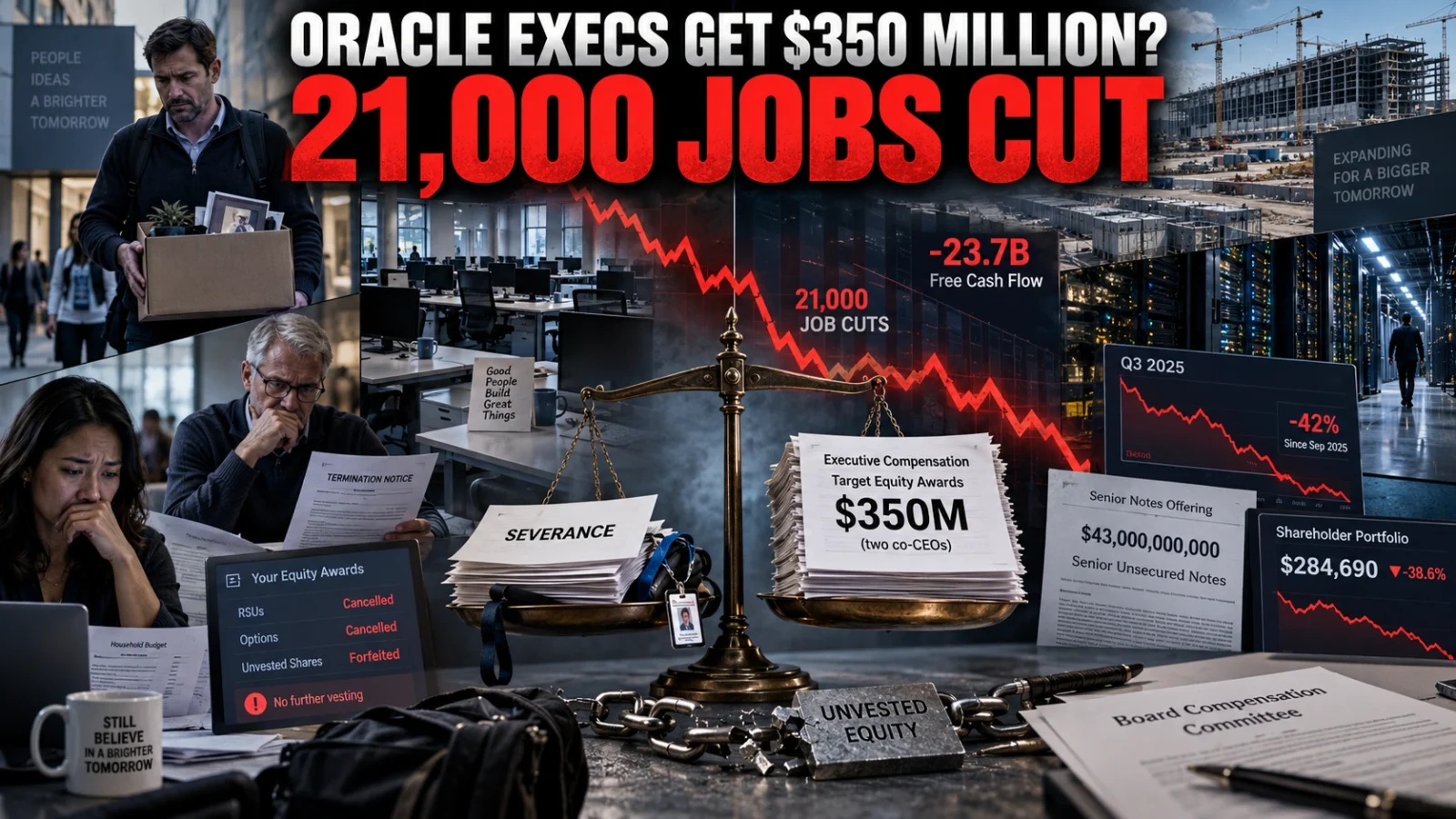
On September 22, 2025, Oracle Corporation elevated Clayton Magouyrk and Michael Sicilia to serve as co-chief executive officers, granting them landmark equity packages with an initial target value of $350 million1. Exactly twelve months later, the company’s stock had collapsed by roughly 58%, shedding hundreds of billions of dollars in market valuation as investors balked at escalating infrastructure debt1.
The collapse underscores a stark governance disconnect at the height of the generative artificial intelligence boom1. While top executives secured historic compensation packages and millions in cash bonuses, the financial downside was transferred directly onto corporate balance sheets and public markets1. The company reversed years of positive cash generation, plunging free cash flow to negative $23.7 billion as capital expenditures outpaced returns1.
The human toll has fallen squarely on rank-and-file workers and retirement-fund shareholders1. During fiscal year 2026, Oracle eliminated approximately 21,000 employees, abruptly terminating unvested stock options and enforcing strict caps on severance payouts1. Families and mid-career engineers who built the company’s cloud foundations were left to absorb sudden career disruptions while leadership remained shielded by lucrative corporate pay structures1.
The Nine-Figure Windfall in an Aggressive AI Transition
When longtime chief executive Safra Catz stepped into the role of executive vice chair of the board in September 2025, Oracle turned to the engineers behind its cloud infrastructure to steer the company1. The compensation committee awarded Magouyrk an equity grant with a target value of $250 million, while Sicilia received an award targeted at $100 million1. Corporate filings justified these massive outlays by pointing to an intensely competitive market for executive talent during a high-stakes transition to generative AI1.
Under standard financial accounting rules, Magouyrk’s grant-date fair value reached an unprecedented $621.7 million, pushing his total reported fiscal 2026 compensation to $627.5 million1. That figure represented 6,623 times the median Oracle employee compensation of $94,7401. Sicilia’s reported pay similarly reached 2,709 times the median worker benchmark1.
The windfalls were not limited to the new co-CEOs alone3. Founder, Chairman, and Chief Technology Officer Larry Ellison collected total compensation of $131 million, supported by an increased base salary of $950,000 and a $4.9 million cash bonus3. Both Magouyrk and Sicilia received identical $4.9 million cash bonuses, ensuring substantial liquidity even before any equity performance milestones were evaluated3.
Market Reckoning and the Capital Spending Spiral
Initial market enthusiasm for Oracle’s cloud transformation quickly gave way to severe skepticism as capital expenditures multiplied1. On the day the co-CEOs were appointed, Oracle stock closed at $328.151. One year later, the equity had plunged by more than half, hovering around $137 to $144 per share as investors questioned the sustainability of debt-funded data center expansion1.
The company reported fiscal 2026 revenue of $67.4 billion and highlighted a contractual sales backlog of $638 billion, yet quarterly capital spending surged from $8.5 billion to $28.5 billion1. Projections indicating that annual capital expenditures would reach between $90 billion and $95 billion pushed free cash flow deeply into negative territory1. To fund this spending, Oracle issued $43 billion in senior notes and sold $20 billion in discounted stock, driving bond yields toward 8% and triggering record highs in credit default swaps2.
Corporate filings acknowledged this severe divergence, attributing the stock decline to sector-wide investor skepticism surrounding artificial intelligence software returns1. However, broader technology indexes continued to advance while Oracle lagged significantly behind1. Shareholders who relied on Oracle equity as a core defensive holding suffered immense portfolio depreciation1.
Executive Windfalls Versus Operational Reality
The disparity between top executive rewards and overall enterprise stability is evident across core operational metrics1. While leadership noted that option awards remain technically underwater due to the stock drop, executives continued to draw multi-million dollar cash stipends and personal perks1. The comparative metrics demonstrate how risk was distributed across corporate stakeholders1.
| Metric & Stakeholder Group | Fiscal Year 2025 / Grant Benchmark | Fiscal Year 2026 / Performance Reality | Impact on Stakeholders and Workforce |
|---|---|---|---|
| Oracle Share Price | $328.15 (Grant date close, Sept 2025)1 | ~$137.00 – $144.44 (Sept 2026)1 | Public shareholders lost over half of equity market valuation1. |
| Co-CEO Target Equity Awards | 250M Magouyrk, $100M Sicilia)1 | $621.7M grant-date fair value for Magouyrk1 | Executive compensation reached 6,623x and 2,709x median worker pay1. |
| Executive Cash Bonuses | Traditional baseline bonuses3 | $4.9 million each for Ellison, Magouyrk, and Sicilia3 | Guaranteed executive liquidity isolated leaders from stock volatility1. |
| Free Cash Flow & Debt | Operational cash generation positive8 | -$23.7 billion free cash flow; $43B senior debt issued1 | Debt yields spiked toward 8%; credit default swaps hit record highs2. |
| Global Workforce Headcount | Regular operational headcount1 | 21,000 positions eliminated (~13% cut)1 | Restructuring costs hit $2.8B; global median worker pay fell to $94,7401. |
The board’s compensation structure placed approximately 80% of the award value into stock options struck at $308.46, with the remainder tied to reaching $100 billion in annual revenue1. Because shares tumbled below that strike price, Oracle noted in regulatory filings that the equity packages remain unearned, presenting this as evidence of pay-for-performance discipline1. Yet for employees and outside shareholders, no downside protections existed to soften the loss of income or equity value1.
The Human Cost: 21,000 Layoffs and Severance Limits
As capital expenditures drained corporate reserves, management moved aggressively to curtail operational payroll costs1. Over the course of fiscal year 2026, Oracle eliminated approximately 21,000 positions, shrinking its global workforce by roughly 13%1. Restructuring costs rose by $700 million to $2.8 billion as the enterprise cut staff across software engineering, customer support, and sales1.
The reductions eliminated an estimated 7,000 jobs in research and development, 6,000 in sales and marketing, and 3,000 in core cloud infrastructure operations1. Concurrently, median employee compensation across Oracle’s remaining global workforce fell from $98,899 to $94,7403. Chief Financial Officer Hilary Maxson informed staff that the company had to become far more selective in deploying human capital as AI infrastructure investments scaled1.
For dismissed personnel, exit terms offered minimal financial security1. Severance packages were restricted to four weeks of base salary for the first year of employment and one week for each subsequent year, subject to a strict 26-week maximum cap1. Furthermore, unvested restricted stock units and stock options were immediately extinguished upon termination, stripping departed employees of equity compensation they had earned over years of service1.
Dismantling Cloud Teams and the Impact on Older Workers
In September 2026, organizational downsizing directly hit the America Cloud Infrastructure division, terminating 546 technical specialists in a single round1. The dismissals eliminated 7.6% of the 7,185 employees in the unit, dismantling teams responsible for maintaining mission-critical data center systems1. Software developers comprised 17% of the reductions, with mid-level Software Developer III roles absorbing 57 individual job cuts1.
Management and operational leadership were similarly targeted, accounting for nearly one-quarter of the division’s job eliminations1. Sixty-one program managers were laid off alongside senior leaders, including the vice president and two senior directors of the Data Center Support Services unit1. This abrupt loss of experienced oversight raised immediate internal concerns regarding system reliability during ongoing data center construction1.
Mandated disclosures under the Older Workers Benefit Protection Act revealed that the vast majority of dismissed cloud specialists were over the age of 401. Approximately one in six affected workers was 60 years old or older, highlighting how veteran technologists bore a disproportionate share of the payroll cuts1. Many older professionals faced sudden unemployment in a tightening tech labor market after dedicating decades to building Oracle’s cloud architecture1.
Insider Liquidity and Governance Conflicts
Governance specialists have raised pointed questions regarding executive transactions and personal liquidity while share values foundered1. On September 22, 2026, co-CEO Mike Sicilia liquidated 22,562 shares under a pre-established Rule 10b5-1 trading plan, collecting $3.42 million in proceeds1. Although the transaction complied with regulatory trading standards, the sale occurred while public shareholders sustained deep losses and rank-and-file workers faced job cuts1.
Significant scrutiny has also centered on Larry Ellison’s extensive use of corporate shares as collateral for personal financial endeavors1. Filings reveal that Ellison, who holds a 38.2% ownership stake, had previously pledged 413 million shares and later pledged an additional $9.2 billion in Oracle stock to finance media acquisitions linked to his son David Ellison1. Major institutional investors view such massive stock pledging as a potential governance risk that compounds market volatility2.
Related-party transactions have added further complexity to board oversight1. Filings disclosed that entities affiliated with Ellison or his family purchased $32.2 million in Oracle products and services during fiscal 2026, including $21.97 million from the Ellison Institute1. Meanwhile, Oracle continues to contest an amended class-action lawsuit from shareholders alleging that executives issued misleading public statements regarding cloud performance and revenue margins1.
What Happens Next
The tension over corporate priorities will reach a formal turning point on November 18, 2026, when shareholders convene for the annual meeting and cast votes on executive compensation3. Institutional investor coalitions and proxy advisory firms that previously protested Oracle’s pay practices are preparing significant pushback against the compensation committee3. Although say-on-pay resolutions are advisory, a strong rebuke would heighten pressure on the board to rein in executive packages1.
Operationally, Oracle must demonstrate that its astronomical capital outlays can translate into viable free cash flow rather than spiraling debt1. The company faces significant logistical headwinds, including utility delays on its $165 billion Project Jupiter data center facility in New Mexico that recently triggered force majeure notices2. If debt burdens continue to mount while cloud margins compress, further restructuring may follow1.
The episode serves as a cautionary benchmark for the human consequences of the ongoing artificial intelligence spending boom1. When enterprise tech firms prioritize executive incentives and debt-heavy infrastructure over sustainable operations, ordinary workers and retail shareholders inevitably bear the cost1. For Oracle’s workforce, the golden parachute playbook has left behind an austere workplace shaped by downsizing and unfulfilled promises1.
CTech / Calcalist – https://www.calcalistech.com/ctechnews/article/clab37g3t
NDTV Profit – https://www.ndtvprofit.com/business/larry-ellison-oracles-co-ceos-got-nearly-1-billion-in-stock-options-what-went-wrong-12102840
CTech / Calcalist – https://www.calcalistech.com/ctechnews/article/6r5xfca22
CTech / Calcalist – https://www.calcalistech.com/ctechnews/article/1kwjft2um
CTech / Calcalist – https://www.calcalistech.com/ctechnews/article/1v9v8m3wx
CTech / Calcalist – https://www.calcalistech.com/ctechnews/article/bkvpla16w
The Economic Times – https://m.economictimes.com/news/international/us/why-is-oracles-debt-suddenly-flashing-warning-signs-its-8-bond-yield-raises-a-bigger-question-about-who-will-finance-the-trillion-dollar-ai-data-center-boom/articleshow/134507749.cms
Suara Garut – https://suaragarut.id/en/oracle-reports-massive-executive-pay-stock-drops
Phemex Academy – https://phemex.com/academy/clay-magouyrk-oracle-co-ceo-backlog
Works cited
Oracle’s co-CEOs got $350 million in equity awards. A year … – CTech,
Oracle Corporation Stock Price: Quote, Forecast, Splits … – Perplexity,
Larry Ellison, Oracle’s Co-CEOs Got Nearly $1 Billion In Stock Options,
Who Is Clay Magouyrk? Meet Oracle’s New Co-CEO and His $638B,
Oracle Reports Massive Executive Pay as Share Price Drops 56,
Why is Oracle’s debt suddenly flashing warning signs? Its 8% bond,
Top Oracle execs Larry Ellison, Mark Hurd and Safra Catz failed to,
Oracle Stock and the $7 Billion Tencent AI Compute Deal, 2026,
As Oracle cuts jobs, its filing details millions in executive security,
Oracle’s co-CEOs got $350 million in equity awards. A year later, the,
Oracle Reduces Ellison’s Pay to $41.5 Million, Co-CEOs Cut,




Leave a Reply