
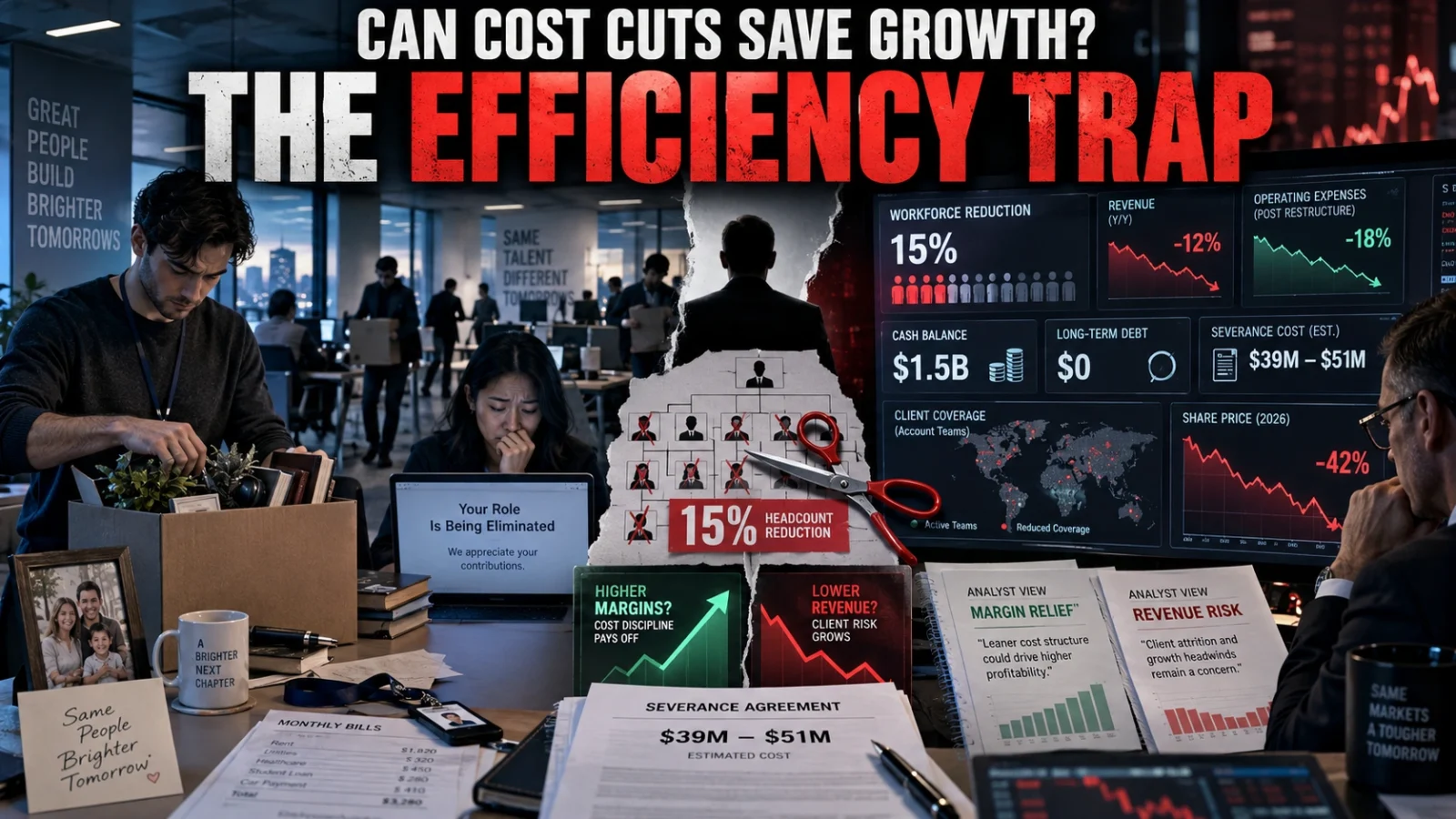
On September 4, 2026, digital advertising powerhouse The Trade Desk disclosed a restructuring plan to eliminate roughly 15% of its global workforce1. The announcement followed a steep second-quarter earnings miss and forward guidance projecting the company’s first year-over-year revenue contraction since going public in 20162. The decision immediately puts an estimated 575 software engineers, account managers, and operational specialists out of work across more than 20 countries2.
The drastic retrenchment has triggered an intense debate on Wall Street, exposing a widening philosophical rift between financial analysts who celebrate cost cuts and those who fear structural decline1. While Rosenblatt Securities cheered the layoffs as welcome margin relief, Jefferies sounded alarms that gutting frontline staff creates acute top-line risks heading into the critical holiday season1. The conflict illustrates the growing danger of the tech industry’s “efficiency trap,” where corporate executives attempt to engineer short-term accounting gains by sacrificing human talent1.
For the hundreds of workers suddenly cast into an unforgiving tech job market, the layoffs reflect a troubling corporate disconnect2. The Trade Desk is executing these deep labor cuts despite holding $1.5 billion in cash and maintaining zero long-term debt2. As working families bear the immediate emotional and financial fallout, the move demonstrates how swiftly tech employees are treated as disposable balance-sheet buffers5.
Wall Street Splits: Margin Expansion Versus Revenue Collapse
The reaction from institutional brokerages following the filing revealed fundamentally opposing views of corporate health1. Rosenblatt Securities maintained a Neutral rating, arguing that the workforce reduction provides constructive expense relief that will protect adjusted operating profit against consensus estimates1. Barton Crockett, an analyst at Rosenblatt, stated that the cuts merely reflect known revenue pressures rather than signaling a deteriorating commercial environment1.
Jefferies took an entirely different view, warning that slashing 15% of staff is a panicked reaction to a sudden revenue slump rather than a disciplined operational reset1. Jefferies analyst James Heaney maintained a Hold rating and a $12 price target, emphasizing that The Trade Desk relies on a high-touch sales model requiring intensive customer support1. Heaney cautioned that shedding client-facing teams will jeopardize customer relationships and depress revenue through the fourth-quarter holiday shopping period1.
Heaney also drew parallels to the fourth quarter of 2024, when an internal corporate reorganization contributed directly to a high-profile revenue miss1. When high-touch enterprise software firms dismiss client account leaders, advertising clients often pause or reallocate major programmatic ad campaigns1. This divergence captures the essence of the efficiency trap: cost models reward immediate payroll reductions, yet ignore the commercial damage caused by gutting relationship-driven teams1.
The Solvency Paradox: Cutting Staff While Hoarding Billions
The Trade Desk disclosed in its regulatory filing that it expects to incur between $39 million and $51 million in cash charges, primarily covering employee severance packages and transition benefits2. The company will partially offset these expenses through a $4 million to $5 million reversal of stock-based compensation, which occurs when departed workers forfeit unvested stock options2. Management stated that the restructuring is designed to improve operational effectiveness and build an agile, scalable enterprise2.
In a memo sent to employees, Chief Executive Officer Jeff Green emphasized that the cuts were not driven by financial insolvency or cash shortages2. Green explained that the company plans to reorganize remaining employees into smaller “pods” and “scrums” to accelerate product delivery and boost autonomy2. However, the official filing made no mention of macroeconomic headwinds, escalating competition from tech giants, or automation, leaving employees baffled by the rationale behind the sudden dismissals2.
The company’s audited balance sheet reveals approximately $1.5 billion in cash and liquid equivalents and zero outstanding debt, making the layoffs a discretionary corporate strategy rather than a fight for survival2. When tech firms use massive cash hoards to buffer equity valuations while eliminating working families’ livelihoods, the social contract of employment breaks down completely7. Labor becomes an elastic expense dial that leadership turns whenever quarterly projections stumble7.
Restructuring by the Numbers: The Trade Desk’s Tumultuous 2026
The scale of The Trade Desk’s retrenchment marks a dramatic reversal for an ad-tech pioneer that once dominated digital advertising growth tables2. A close examination of the company’s financial indicators, compensation structures, and valuation milestones illustrates the sharp divide between executive rewards and employee vulnerabilities1.
| Operational & Financial Indicator | Historical Baseline | Restructuring Reality (Sept 2026) |
|---|---|---|
| Global Full-Time Headcount | 3,843 employees (Dec 31, 2025)1 | ~15% cut (Estimated ~575 jobs lost)2 |
| Cash Restructuring Charges | Negligible in prior years2 | $39 million to $51 million2 |
| Stock-Based Comp Reversal Offset | Negligible2 | $4 million to $5 million credit2 |
| Liquid Cash & Equivalents | $1.5 billion2 | ~$1.5 billion with zero long-term debt2 |
| Q2 2026 Revenue Performance | Expected: $752.5 million2 | Reported: $715.1 million (+3% YoY miss)2 |
| Q3 2026 Revenue Guidance | Consensus: ~$804 million2 | Guided: “At least $650 million” (~12% decline)1 |
| CEO Jeff Green Compensation | $6.76 million (2024)1 | $27.43 million (2025) + 7M share option1 |
| Equity Market Index Classification | S&P 500 Component3 | Demoted to S&P SmallCap 600 (Sept 21)3 |
The data reflects a swift corporate reassessment after years of uninterrupted post-IPO expansion2. While leadership framed the reduction as an operational pivot toward high-priority initiatives, the financial figures highlight sharp deceleration across core programmatic advertising segments1.
The Human Consequences of Corporate Downsizing
Behind the percentages and restructuring charges are approximately 575 professionals facing sudden economic uncertainty2. The layoffs hit staff across 21 countries, abruptly cutting off health insurance, career trajectories, and stable incomes in an unforgiving job market2. Many affected tech workers had relocated or committed to long-term family expenses under the belief that the company’s pristine balance sheet offered job security2.
Compounding employee outrage is the stark disparity between rank-and-file layoffs and executive remuneration1. Jeff Green received total compensation valued at $27.4 million in 2025, nearly four times his pay from the prior year, despite the stock declining sharply1. Just ten days after announcing the layoffs, regulatory filings revealed that Green received an equity option covering 7 million shares, sparking fury across employee message boards over C-suite insulation1.
The disruption extends beyond those who were fired to the engineers and sales representatives who remain6. Workplace research shows that survivors of deep corporate downsizings frequently experience severe guilt, cognitive fatigue, and professional paralysis6. With smaller teams forced to shoulder identical workloads, surviving employees often choose to quietly search for new employment, sparking secondary waves of voluntary turnover6.
The Social Contagion of Tech Layoffs and the Efficiency Trap
The decision to cut 15% of the workforce reflects an industry-wide dynamic that organizational researchers call social contagion6. Jeffrey Pfeffer, a professor of organizational behavior at Stanford Graduate School of Business, argues that tech layoffs are largely imitative behaviors driven by herd mentality rather than empirical operational necessity6. Tech boards frequently pressure executives to downsize simply because industry peers are cutting jobs, creating an illusion of proactive management7.
Academic studies consistently demonstrate that mass layoffs rarely produce the cost savings or productivity gains promised to investors6. Severance packages, unemployment tax spikes, project delays, and eventual re-hiring costs frequently erase short-term balance sheet benefits6. Furthermore, customer satisfaction often drops sharply following mass job cuts as experienced support personnel vanish, prompting enterprise clients to rethink their vendor relationships6.
In the programmatic advertising space, shedding staff creates an opening for massive walled gardens like Alphabet, Meta, and Amazon to capture ad dollars3. When high-touch ad-buying platforms strip away human operational support, advertisers migrate toward automated self-serve giants1. In this manner, the efficiency trap springs shut: cutting staff to preserve margins degrades client service and triggers the exact revenue decline management sought to escape1.
Beyond corporate balance sheets, extensive public health research confirms that sudden job loss inflicts deep, enduring trauma on workers and their families7. Studies show that involuntary layoffs double the risk of clinical depression and suicide while increasing long-term cardiovascular mortality by up to 20% over subsequent decades7. When corporate executives dismiss hundreds of employees to defend quarterly metrics, the human health costs are externalized onto families and public systems7.
Market Backlash: S&P 500 Demotion and the Downward Valuation Spiral
Rather than igniting an equity rally, The Trade Desk’s job cuts cemented market concerns about structural weakness1. Shares fell roughly 4% immediately following the September 4 announcement and have cratered more than 68% year-to-date, hovering near 52-week lows between $12 and $131. Wall Street viewed the cuts as proof that management had lost control of its revenue trajectory rather than as a triumph of operational discipline1.
The collapse in market capitalization triggered immediate index penalties that exacerbated selling pressure3. On September 4, S&P Dow Jones Indices announced that The Trade Desk would be evicted from the S&P 500 and relegated to the S&P SmallCap 600, effective September 213. The index expulsion forced institutional index-tracking funds to dump their holdings, unleashing an estimated $680 million in automated passive selling that crushed the stock3.
The mechanical index dump illustrates how the financialization of corporate strategy can backfire on executive leadership16. Slicing headcount to please Wall Street analysts failed to stem institutional flight, ultimately reducing a former tech leader into a small-cap value trap3. Workers sacrificed their livelihoods for a financial maneuver that failed to stabilize the stock1.
What Happens Next
The Trade Desk now faces immediate operational milestones that will determine whether its shrunken organization can survive mounting competitive pressure3. On October 19, 2026, the company will convene a Special Meeting of Stockholders to vote on repricing underwater stock options for select operational personnel26. While leadership claims option repricing is necessary to stop key personnel from resigning, the proposal risks sparking broader shareholder backlash given the recent mass terminations1.
The ultimate test of the restructuring will arrive on November 5, 2026, when The Trade Desk is scheduled to report third-quarter earnings18. Investors and analysts will closely inspect whether revenue meets the guided $650 million floor and whether fourth-quarter bookings show severe damage from diminished sales coverage1. If Jefferies’ warnings prove prescient and client defection accelerates, The Trade Desk will stand as a textbook cautionary tale of the tech industry’s self-defeating efficiency trap1.
Sources
https://stocktwits.com/news-articles/markets/equity/ttd-stock-declines-as-wall-street-splits-rosenblatt-sees-cost-relief-jefferies-sees-top-line-risk-from-15-job-cuts/cZsD1t7RJDX
https://es.tradingview.com/news/stocktwits:bb2796b8e094b:0-ttd-stock-declines-as-wall-street-splits-rosenblatt-sees-cost-relief-jefferies-flags-top-line-risk-from-15-job-cuts/
https://www.sec.gov/Archives/edgar/data/1671933/000119312526382690/d118889d8k.htm
https://www.finalroundai.com/blog/trade-desk-layoffs
https://kalkine.com/news/earnings/trade-desk-stock-extends-slide-as-sp-500-exit-coincides-with-575-job-cuts
https://news.stanford.edu/stories/2022/12/explains-recent-tech-layoffs-worried
https://greatergood.berkeley.edu/article/item/how_layoffs_hurt_all_of_usand_what_companies_can_do_instead
https://www.cfodive.com/news/trade-desk-cuts-15-workforce/829838/
https://www.marketbeat.com/stocks/NASDAQ/TTD/earnings/
https://press.spglobal.com/2026-09-04-Bloom-Energy,-Illumina,-and-Everpure-Set-to-Join-S-P-500-Others-to-Join-S-P-100,-S-P-MidCap-400,-and-S-P-SmallCap-600
Works cited
TTD Stock Declines As Wall Street Splits — Rosenblatt Sees Cost,
Trade Desk Layoffs: 15% Cut With $1.5B Cash on Hand,
The Trade Desk, Inc. Stock Price: Quote, Forecast, Splits & News (TTD),
Trade Desk to Cut 15% of Staff, Book Up to $51 Million in Charges,
TTD Stock Declines As Wall Street Splits — Rosenblatt Sees Cost,
How Layoffs Hurt All of Us—and What Companies Can Do Instead,
What explains recent tech layoffs, and why should we be worried?,
The Trade Desk lays off 15% of staff despite having $1.5 billion in,
2026 Layoff Tracker | Real-Time Job Cuts | layoffhedge,
TTD: The Trade Desk – Full Company Report – Zacks.com,
What tech companies don’t want you to know about layoffs – Finshots,
Trade Desk Inc (TTD) Stock Price & News – Google Finance,
The Trade Desk makes major reset after brutal 70% decline,
The Trade Desk cuts 15% of workforce – CFO Dive,
THE TRADE DESK, INC.,
TTD – The Trade Desk Inc Class A Executives | Morningstar,
Trade Desk (TTD) Earnings Date and Reports 2026 – MarketBeat,
Is $TTD a Buy? (Sep ’26) Down 91%, Still Profitable – YouTube,
Bloom Energy, Illumina, and Everpure Set to Join S&P 500,
Is $TTD a Buy? (Sep ’26) Down 91%, Still Profitable – YouTube,
[Transcript] Dear Micro-Manager, Control Yourself,
Tech’s Loss Is Manufacturing’s Gain… At Least For Now,
Trade Desk (TTD) Stock Price, Quote, News & Events,
Cours THE TRADE DESK RG-A NASDAQ – Bourse – Boursorama,
The Trade Desk (TTD) investor relations material – Quartr,
Trade Desk (TTD) – Trefis,




Leave a Reply