
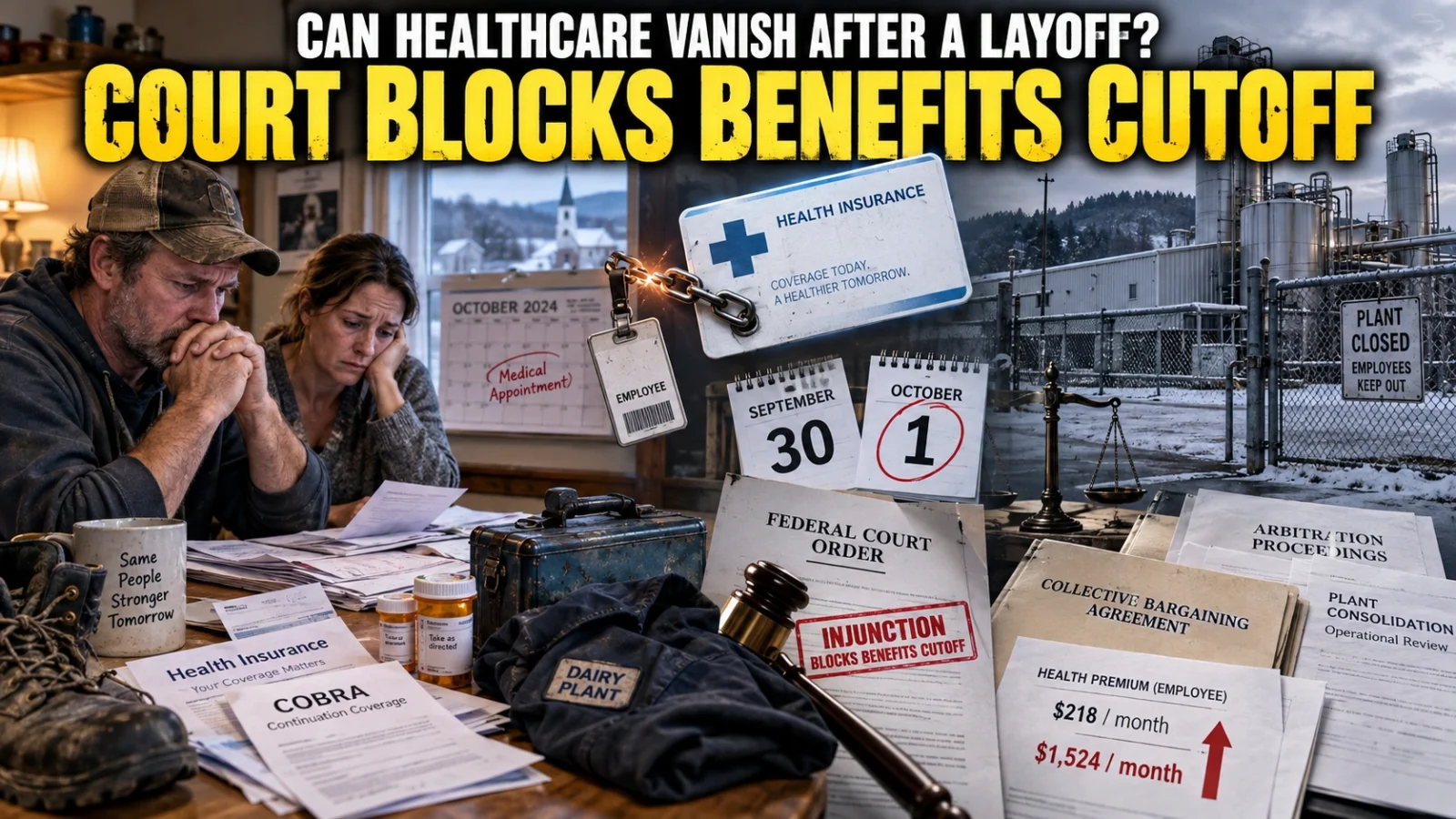
A federal judge in Vermont has blocked Dairy Farmers of America from terminating employer-subsidized healthcare coverage for roughly 80 dairy processing workers displaced by the sudden idling of the historic St. Albans Creamery1. U.S. District Court Judge William K. Sessions III ruled on September 28, 2026, that the multi-billion-dollar cooperative must continue paying its contractual share of medical premiums while the parties arbitrate whether the plant shutdown was lawful1. The judicial order prevented a planned benefits cancellation from taking effect on October 1, 2026, securing vital coverage for union members and their families1.
The emergency ruling directly confronts a recurring corporate pressure tactic known among labor advocates as “benefits blackmail,” where employers strip medical benefits during industrial disputes to compel union concessions4. By establishing that an abrupt loss of health coverage inflicts irreversible physical and emotional injury that cannot be compensated retroactively with money, the court drew a sharp legal line against leveraging medical survival in contract disputes1. The intervention establishes a prominent precedent for manufacturing workforces nationwide confronting plant closures, corporate consolidation, and mid-bargaining benefit terminations2.
The immediate beneficiaries of the federal injunction are the displaced members of Teamsters Local 597 in Franklin County, Vermont, many of whom faced monthly health bills jumping toward $2,500 under COBRA1. Affidavits submitted to the court revealed that multiple families faced immediate disruptions to scheduled surgeries, life-sustaining chronic disease care, and critical prescription regimens3. Without judicial intervention, workers who had already lost their livelihoods faced the immediate threat of medical bankruptcy or the forced abandonment of essential treatments3.
The St. Albans Injunction and the Threat of Immediate Harm
The legal conflict ignited when Dairy Farmers of America abruptly idled the century-old St. Albans processing plant on August 17, 2026, eliminating 80 union positions1. Under the existing collective bargaining agreement, DFA paid approximately 85 percent of health insurance premiums, leaving workers responsible for weekly deductions of roughly $801. Management informed the union that employer contributions would cease on September 30, 2026, requiring laid-off employees to shoulder the full cost of continuation coverage1.
Faced with the imminent deadline, Teamsters Local 597 filed an emergency motion for a preliminary injunction in U.S. District Court on September 22, 20263. Union leadership warned that terminating employer subsidies would inflict severe hardship on families coping with complex and debilitating health conditions4. President of Teamsters Local 597 Curtis Clough emphasized that no worker who had already endured job loss should be forced to choose between purchasing necessary medications and meeting basic household expenses4.
Judge Sessions determined that the union had met the stringent legal burden required for equitable relief by proving imminent, irreparable harm1. The court noted that multiple workers who had managed to find new employment faced standard 90-day waiting periods before new employer coverage would activate3. As a result, the federal order compelled DFA to maintain its contractual premium share effective October 1, 2026, shielding the workforce until grievance arbitration concludes1.
Anatomy of the Shutdown: Retaliation Claims and Business Rationales
The shutdown of the St. Albans creamery represents the culmination of escalating friction between the dairy cooperative and Local 5971. In the autumn of 2025, more than 60 facility workers staged a high-profile strike protesting mandatory overtime requirements that routinely resulted in grueling 12-hour shifts10. Although the union ratified a contract in October 2025, employees reported that management subsequently instituted rigid, unwritten operational rules that soured labor relations11.
When DFA announced in June 2026 that it would idle the St. Albans plant and close the adjoining retail supply store, the union characterized the decision as illegal retaliation for the 2025 strike7. The Teamsters filed formal grievances asserting that the cooperative breached its collective bargaining agreements by refusing to engage in mandatory decisional bargaining3. Outside the facility, prominent labor supporters including U.S. Senator Bernie Sanders condemned the closure as deliberate union-busting against a workforce that had served the regional dairy industry for generations13.
DFA leadership forcefully rejected allegations of retaliation, asserting that the shutdown was driven entirely by broader operational consolidation11. Cooperative executives maintained that the century-old facility suffered from severe operational inefficiencies and had become commercially unviable within DFA’s modern processing network1. Management described the closure as an ordinary private-sector business adjustment rather than a punitive action directed at union organizing1.
| Operational and Financial Metric | Collective Bargaining Baseline | Post-Closure Employer Default | Federal Injunction Requirement |
|---|---|---|---|
| Worker Weekly Healthcare Contribution | ~$79.55 to $80.001 | Full cost via COBRA3 | Maintained at ~$80.003 |
| Employer Premium Share | ~85% paid by DFA1 | 0% (terminated post-layoff)1 | ~85% paid by DFA pending arbitration1 |
| Monthly Family Coverage Cost | ~$320.00 to $345.001 | Up to $2,500.003 | Maintained at pre-closure rates1 |
| Facility Operating Condition | Fully operational3 | Idled on August 17, 20261 | Dismantling barred; held for arbitration1 |
| Covered Bargaining Workforce | ~80 active employees1 | 80 workers laid off1 | Full health protections preserved1 |
The Human Cost: Displaced Families and the COBRA Coverage Shock
The evidentiary filings submitted by Local 597 documented the immediate human toll that sudden healthcare termination inflicts on industrial workers3. Under the terms of the federal COBRA statute, employees separated from their jobs are entitled to maintain their existing health plans only if they pay 102 percent of the aggregate premium themselves3. For a household of six depicted in court records, monthly healthcare expenditures were slated to surge from roughly $320 under payroll deductions to nearly $2,500 under COBRA3.
Declarations submitted to Judge Sessions revealed acute medical vulnerabilities among the laid-off creamery staff1. One displaced worker disclosed that her husband was scheduled for essential surgery on October 7, 2026, and relied on monthly medications that cost $1,100 without insurance coverage3. Another employee noted daily prescriptions for hypertension and substance addiction recovery that would become financially unattainable once employer premium contributions lapsed3.
Jesse Case, Director of the Teamsters Food Processing Division, pointed out that several workers and their dependents suffered from severe illnesses requiring uninterrupted clinical management4. Case stated that allowing DFA to cancel health coverage would have stripped families of life-saving medical care through no fault of their own4. In rural agricultural communities with limited alternative employment options, absorbing thousands of dollars in sudden insurance costs represents an impossible economic hurdle3.
Legal Doctrine: The Reverse Boys Markets Exception and Irreparable Harm
To grant an injunction in a labor conflict, federal courts must navigate the strict jurisdictional limitations imposed by the Norris-LaGuardia Act of 19325. That statute largely withdrew federal jurisdiction to issue injunctions in labor disputes to prevent judges from breaking lawful strikes5. However, courts recognized an equitable exception in Boys Markets, Inc. v. Retail Clerks Union, which permits judicial intervention to enforce contractual arbitration clauses15.
Over time, federal appellate courts developed the reciprocal “reverse Boys Markets” doctrine to prevent employers from unilaterally rendering arbitration remedies hollow3. Under this legal framework, a union can secure an injunction maintaining the status quo when an employer’s unilateral act would make an eventual arbitral victory meaningless15. DFA argued that terminating healthcare contributions constituted a purely financial dispute that an arbitrator could remediate retroactively with back pay and expense reimbursements3.
Judge Sessions firmly rejected the employer’s contention, aligning with established Second and Third Circuit jurisprudence3. The court cited Whelan v. Colgan and United Steelworkers v. Fort Pitt Steel Casting, which held that the threat of denied medical care and emotional distress constitutes substantial, irreparable injury3. Because an arbitrator lacks the legal authority to heal bodily deterioration caused by missed treatments, preliminary injunctive relief was deemed appropriate and necessary1.
Consolidation Pressures Across the American Dairy Sector
The shutdown in St. Albans reflects deeper structural consolidation reshaping the agricultural economy across the United States7. Operating as a multi-billion-dollar marketing powerhouse, DFA generated $23.1 billion in net sales in 2025 and controls approximately 30 percent of total national raw milk production17. In recent years, corporate dairy cooperatives have systematically consolidated processing operations into massive, centralized industrial plants, closing smaller regional creameries7.
Franklin County has experienced significant industrial disruption, with the St. Albans idling following major layoffs at Franklin Foods and Perrigo, as well as the shutdown of HP Hood’s facility in Barre7. Local dairy farmers who voted to merge the historic St. Albans Cooperative Creamery into DFA in 2019 now face rising transportation fees as their raw milk is trucked out of state to plants in New York, Massachusetts, and Maine7. Because cooperatives routinely deduct hauling fees directly from farm milk checks, independent producers bear the logistical costs while regional manufacturing positions vanish17.
This concentration of processing power fundamentally shifts economic bargaining leverage away from local communities and plant workforces13. By operating extensive multi-state logistics networks, corporate processors can reroute fluid milk supplies away from unionized facilities during labor friction7. When an employer commands redundant regional capacity, the threat of closing a plant and cutting off family medical coverage becomes a powerful tool against local union units4.
Policy Battlegrounds: The Campaign to Ban Mid-Dispute Healthcare Cutoffs
The legal victory in Vermont arrives amid an intensifying legislative debate surrounding the vulnerability of employer-sponsored healthcare in labor conflicts4. In recent sessions of the U.S. Congress, lawmakers have championed the Striking Workers Healthcare Protection Act, which would make it an unfair labor practice for employers to cancel healthcare during strikes5. Reformers assert that tying basic physical survival to continuous employment allows corporations to punish workers who exercise their statutory right to organize5.
Employer organizations and corporate legal representatives have consistently resisted such legislative restrictions, defending healthcare decisions as essential management prerogatives15. Defense attorneys emphasize that forcing companies to fund expensive medical benefits for inactive workforces imposes severe financial burdens during structural reorganizations6. Furthermore, conservative legal challenges continue to contest federal administrative authority, urging courts to limit labor board intervention and judicial injunctions against private business decisions22.
Despite those broader legal headwinds, Section 301 of the Labor Management Relations Act provides federal judges with vital authority to enforce collective agreements16. The St. Albans ruling demonstrates that when unions negotiate comprehensive healthcare provisions linked to binding arbitration, courts will intervene to protect workers from sudden cancellations1. For labor organizations operating in dangerous, high-stress processing industries, preserving contractually secured health benefits remains essential to worker protection3.
What Happens Next
Under the preliminary injunction issued by Judge Sessions, DFA must maintain its contractual share of employee health premiums while the closure dispute proceeds to arbitration1. Both parties have mutually selected veteran labor arbitrator Sarah Garraty to decide whether the creamery closure violated the collective bargaining agreement or constituted unlawful anti-union retaliation1. Although the federal court denied the union’s petition to expedite the calendar, the parties are currently coordinating hearing schedules1.
Simultaneously, Local 597 negotiators and DFA representatives have entered formal bargaining sessions to negotiate comprehensive severance terms for the 80 displaced workers1. In an earlier stage of the litigation, DFA consented to refrain from taking irreversible steps to dismantle or sell off processing machinery at the St. Albans facility1. That restriction ensures that if the arbitrator concludes the closure was illegal, restoring operations remains physically possible1.
For the creamery workers and their families, the court order delivers immediate security against catastrophic medical bills while the arbitration proceeds1. The legal struggle in Vermont will serve as a prominent benchmark for how federal courts handle employer healthcare obligations when legacy industrial plants are shuttered2.
Court orders Dairy Farmers of America to keep paying its share of union employees’ health insurance after shuttering the St. Albans Creamery
https://law.justia.com/cases/federal/district-courts/vermont/vtdce/2:2026cv00281/41551/38/
https://www.prnewswire.com/news-releases/teamsters-secure-major-legal-victory-for-st-albans-creamery-workers-302893369.html
Federal court mandates health benefits at idled DFA plant
St. Albans dairy plant is temporarily spared from dismantling as a union fight plays out
https://www.dairyherd.com/news/dairy-farmers-america-closes-historic-vermont-milk-plant-cutting-80-jobs
https://teamster.org/2025/10/teamsters-strike-at-dfa-subsidiary/
https://www.spglobal.com/ratings/en/regulatory/article/-/view/type/HTML/id/3550079
For laid off St Albans Creamery workers, health insurance benefits run out next week. The union representing them is asking the courts to intervene
https://www.epi.org/publication/2022-work-stoppages/
Works cited
Court orders Dairy Farmers of America to keep paying its … – VTDigger,
dairy processing plant closure | Federal court mandates health benefits at idled DFA plant,
Teamsters Local Union No. 597 v. St. Albans Creamery, LLC et al, 2,
TEAMSTERS SECURE MAJOR LEGAL VICTORY FOR ST. ALBANS CREAMERY WORKERS,
Major strike activity increased nearly 50% in 2022,
Creamery Blocked From Cutting Off Workers’ Healthcare,
Dairy Farmers of America Closes Historic Vermont Milk Plant,
For laid off St Albans Creamery workers, health insurance benefits,
For laid off St Albans Creamery workers, health insurance benefits,
Teamsters Strike at DFA Subsidiary,
St. Albans dairy plant is temporarily spared from dismantling as a,
Workers charge ‘BS’ as strike at St. Albans dairy plant … – VTDigger,
Sanders Calls for the St. Albans Creamery to Reopen | Seven Days,
TEAMSTERS, SEN. SANDERS DEMAND ANSWERS ON ST,
1 2 3 4 5 6 7 8 9 10 11 12 13 14 15 16 17 18 19 20 21 22 23 24 25,
What’s the Law? – National Labor Relations Board,
The Great American Dairy Heist – Who Really Owns Your Milk,
Research Update: Dairy Farmers of America Inc. Up – S&P Global,
DFA St. Albans closure: the hauling math farms inherit – The Bullvine,
US Strike Activity Surged in 2022 as SCOTUS Workers’ Rights,
All bills – live.house.gov, U.S. House of Representatives,
NLRB Injunction – Watch Out! – National Labor Relations Advocates,
NLRB Must Satisfy Traditional Preliminary Injunction Standards To,
Second Circuit Labor Cases – Justia Dockets,
Miscellaneous things unions may freely do,

Leave a Reply