
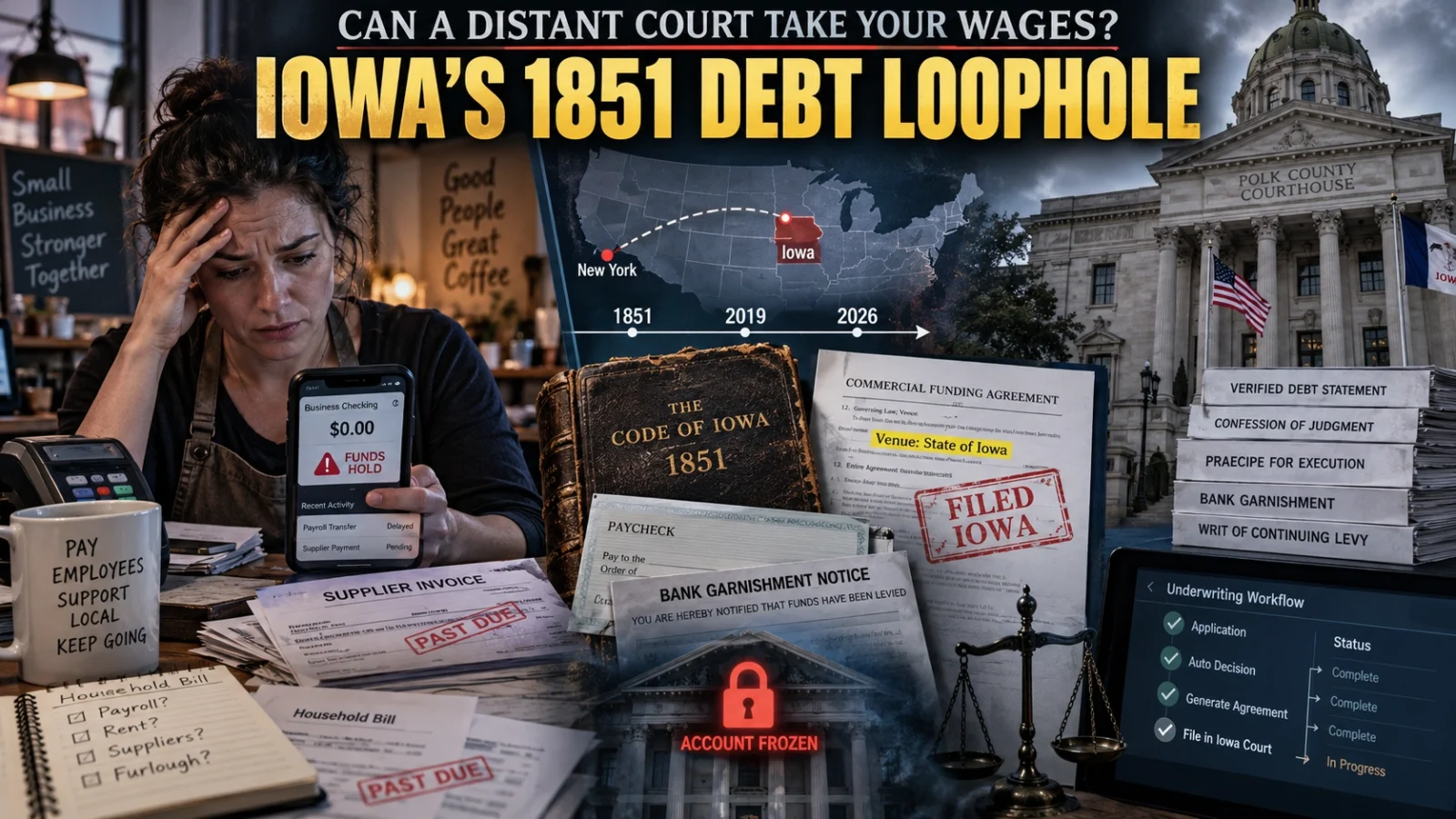
A Brooklyn-based commercial finance company has systematically routed hundreds of debt collection actions through Iowa state courts, using an archaic legal mechanism to seize money from borrowers who have never set foot in the state1. The cross-country collection push came to light following a September 29, 2026, investigative report by The Des Moines Register, which revealed that Fenix Capital Funding LLC filed hundreds of confession-of-judgment actions in Iowa’s Polk County1. While the company operates from New York, nearly all of the targeted small-business accounts and personal guarantors are located thousands of miles away1.
The maneuver exploits a pre-Civil War statute that allows lenders to obtain instantaneous court judgments without prior notice, a formal complaint, or an evidentiary hearing1. This legal arbitrage gained momentum after New York lawmakers closed their own state’s confession-of-judgment loophole in 2019, pushing aggressive funders to seek out receptive jurisdictions elsewhere1. By transferring their post-default filings to the Midwest, alternative lenders found a new avenue to bypass modern consumer and small-business protections1.
The consequences fall heavily on ordinary workers, independent operators, and families whose financial stability is tethered to small enterprises1. When lenders trigger these out-of-state judgments, sweeping asset freezes hit operational bank accounts and wage distributions without warning1. Business owners face immediate operational paralysis, while workers see paychecks interrupted and personal earnings siphoned off through unconditional personal guarantees1.
Reviving a Pre-Civil War Relic
At the foundation of this multi-state collection pipeline lies Iowa Code Chapter 676, a statutory framework that has governed confessions of judgment since the Iowa Code of 18511. Originally known in Anglo-American common law as a “cognovit note,” the mechanism allows a debtor to forfeit their day in court before a dispute even arises1. Under this system, a lender secures pre-authorization to file a conclusive money judgment directly with the court clerk the moment a contract breach is alleged1.
Under Iowa Code § 676.3, the statute requires only a concise, verified written statement from the defendant detailing the indebtedness and affirming that the sum claimed is justly due1. In the nineteenth century, lawmakers designed the law as an inexpensive way for local neighbors to settle undisputed claims without legal expenses1. Today, modern commercial funders have repurposed the statute into an assembly-line collection mechanism against out-of-state entities that rarely understand the filings1.
The New York Crackdown and the Migration West
For decades, New York was the national ground zero for confession-of-judgment enforcement, with predatory funders securing thousands of judgments against borrowers across the United States1. That industrial pipeline collapsed in August 2019 when the New York State Legislature amended Civil Practice Law and Rules § 3218 to bar confessions of judgment against non-residents1. The reform restricted valid filings strictly to the specific New York county where the borrower resided at the time the agreement was executed1.
Faced with the loss of their primary enforcement tool, alternative financing firms initiated a search for statutory loopholes across the country1. Iowa emerged as a primary destination because Chapter 676 had never been updated to include a residency requirement1. By embedding Iowa choice-of-venue clauses into digital funding agreements, lenders effectively circumvented New York’s strict consumer protections1.
The Human Cost: Frozen Payrolls and Siphoned Incomes
The practical impact of an out-of-state confession is swift and financially devastating for affected businesses and their workforces1. Once a judgment is entered by a court clerk in Des Moines, the lender files a praecipe for execution to issue formal garnishment and levy notices1. Sheriffs and collection attorneys then serve these orders on national banking institutions, merchant credit-card processors, and employers1.
Because commercial funding agreements almost universally demand personal guarantees, business debts instantly transfer to the owner’s household finances1. Wage payments are intercepted, personal checking accounts are emptied, and household savings disappear without prior notice1. For small employers, the abrupt loss of liquid capital forces immediate staff furloughs and unpaid supplier invoices, sending shockwaves through local communities1.
Comparing State Regimes: Procedural Safeguards versus Summary Seizure
The profound legal gap between New York’s restrictive protections and Iowa’s nineteenth-century statutes illustrates why financial firms choose forum shopping1. The contrasting statutory environments highlight how interstate arbitrage removes debtor defenses1.
| Statutory Element | New York Legal Standard | Iowa Enforcement Regime | Practical Consequence for Debtors |
|---|---|---|---|
| Confession Venue Rule | Limited to debtor’s home county (N.Y. CPLR § 3218, amended 2019)1. | No residency restriction under Iowa Code Chapter 676 (enacted 1851)1. | Non-resident merchants can be sued in Polk County without local ties1. |
| Notice and Process | Pre-judgment notice and service required for all non-residents1. | Ex parte entry by court clerk upon document presentation1. | Borrowers discover judgments only after bank accounts are frozen1. |
| Wage Garnishment Cap | Lesser of 10% of gross or 25% of disposable income (N.Y. CPLR § 5231)12. | Lesser of 25% of disposable earnings or excess over statutory floor (Iowa Code § 642.21)13. | Creditors capture significantly higher weekly wage deductions under Iowa law12. |
| Statutory Exemptions | Exemption floors linked to state or federal minimum wage (N.Y. CPLR § 5231)12. | Annual aggregate caps apply only to consumer debts, excluding commercial guarantors8. | Business owners guaranteeing commercial financing receive no annual dollar caps8. |
As the comparative framework reveals, Iowa law offers substantially less resistance to creditors seeking immediate asset execution1. While New York places an absolute block on out-of-state confessions and shields ordinary wages, Iowa’s framework allows creditors to capture up to a quarter of disposable income1. For debt buyers and cash advance lenders, this statutory contrast represents an enormous financial advantage1.
The Polk County Backlash: Inflated Debts on Trial
The unchecked use of Iowa’s confession machinery is now facing severe legal resistance within the state’s own judicial system1. In a landmark challenge, DreamTeam Development, LLC et al. v. Fenix Capital Funding, LLC (Case No. LACL164168), plaintiffs in Polk County have accused the lender of exploiting the statutory process17. The plaintiffs allege that Fenix systematically misrepresented the balances owed by borrowers, violating the strict statutory requirement that all confessed debts be justly due1.
In one documented instance presented in the filings, Fenix allegedly told the Polk County court that an out-of-state merchant owed approximately $330,000, despite transaction records showing a true balance between $180,000 and $190,0007. Borrowers also asserted that the lender continued to pull automated funds from their accounts weeks after securing judgments for the full amounts7. These balance discrepancies have triggered scrutiny from the bench, culminating in the withdrawal of Fenix’s initial legal counsel in early 20261.
Algorithmic Traps: Modern Underwriting Meets Frontier Law
The speed and scale of these cross-state seizures are accelerated by automated financial technology1. Modern alternative funders utilize algorithmic underwriting tools that continuously monitor borrower bank balances and daily sales volumes through automated clearinghouse connections1. When an algorithm identifies a slight dip in revenue or a delayed remittance, automated systems can trigger default notices automatically1.
Lenders can generate standardized confession documents and transmit them digitally to local Iowa attorneys in bulk1. By wedding predictive software with an 1851 legal code, collection entities bypass human evaluation and traditional court hearings entirely1. This convergence of technology and archaic law leaves workers and small enterprises deprived of their liquid funds before they even realize a dispute exists1.
What Happens Next
The legal viability of Iowa’s confession pipeline faces an unprecedented trial on November 12, 2026, in Polk County District Court17. The forthcoming proceeding in DreamTeam Development, LLC v. Fenix Capital Funding, LLC will directly examine whether distant confessions violate constitutional due-process protections1. A ruling invalidating the practice could void hundreds of existing judgments and dismantle the out-of-state collection model1.
Beyond the courthouse, affected business owners and personal guarantors are organizing to initiate broader class-action challenges and formal regulatory complaints1. State regulators, including the Iowa Attorney General’s Office and federal consumer protection authorities, are facing renewed calls to investigate whether these remote filings constitute deceptive collection practices1. Meanwhile, Iowa legislators are expected to consider statutory amendments during the upcoming legislative session to permanently close the 175-year-old loophole1.
Sources
https://www.desmoinesregister.com/
https://www.creditandcollectionnews.com/new-york-lender-exploits-iowa-laws-in-debt-collection-push/
https://fenixcapitalcase.com/meet-other-borrowers
https://www.legis.iowa.gov/docs/shelves/code/ocr/1931%20Iowa%20Code.pdf
https://law.justia.com/codes/iowa/title-xiii/chapter-537/section-537-5105/
https://www.alperlaw.com/asset-protection/garnishment-laws-by-state/
https://www.nolo.com/legal-encyclopedia/wage-garnishment-laws-iowa.html
https://www.debitura.com/debt-collection-agency/new-york
https://archive.org/details/gov.uscourts.nysd.652556
Works cited
New York Lender Exploits Iowa Laws In Debt Collection Push,
albert ho – WN,
Debt GOLG – The Latest Debt News and Information – Inksl.com,
The Des – Ready for Black Friday deals? Grab tomorrow’s paper,
@iabacon.bsky.social — Bluesky,
United States Court of Appeals – ACLU of Iowa,
I’M A LEGAL NERD + MCA VICTIM. I TRACK THESE CASES,
2026 Best Iowa Business Debt Settlement Companies,
MEET OTHER BORROWERS – Fenix Capital Case,
1958 Iowa Code Index,
Assignment and Negotiation: A Violation of Due Process,
Debt Collection Agency in New York · No Cure, No Pay – Debitura.com,
Garnishment Laws by State: Wage Garnishment Limits and Bank,
Wage Garnishment Laws in All 50 States – The Motley Fool,
Iowa Wage Garnishment Laws and Limits – Nolo,
Wage Garnishment Limits by State for Consumer Debt (2026),
Fenix Capital Funding Iowa Confession of Judgment Trial May Be,
Champagne v. Linebarger Goggan Blair & Sampson, LLP,
STATE OF COLORADO OFFICE OF THE ATTORNEY GENERAL,



Leave a Reply