An Opening Observation: The Virtual Panopticon
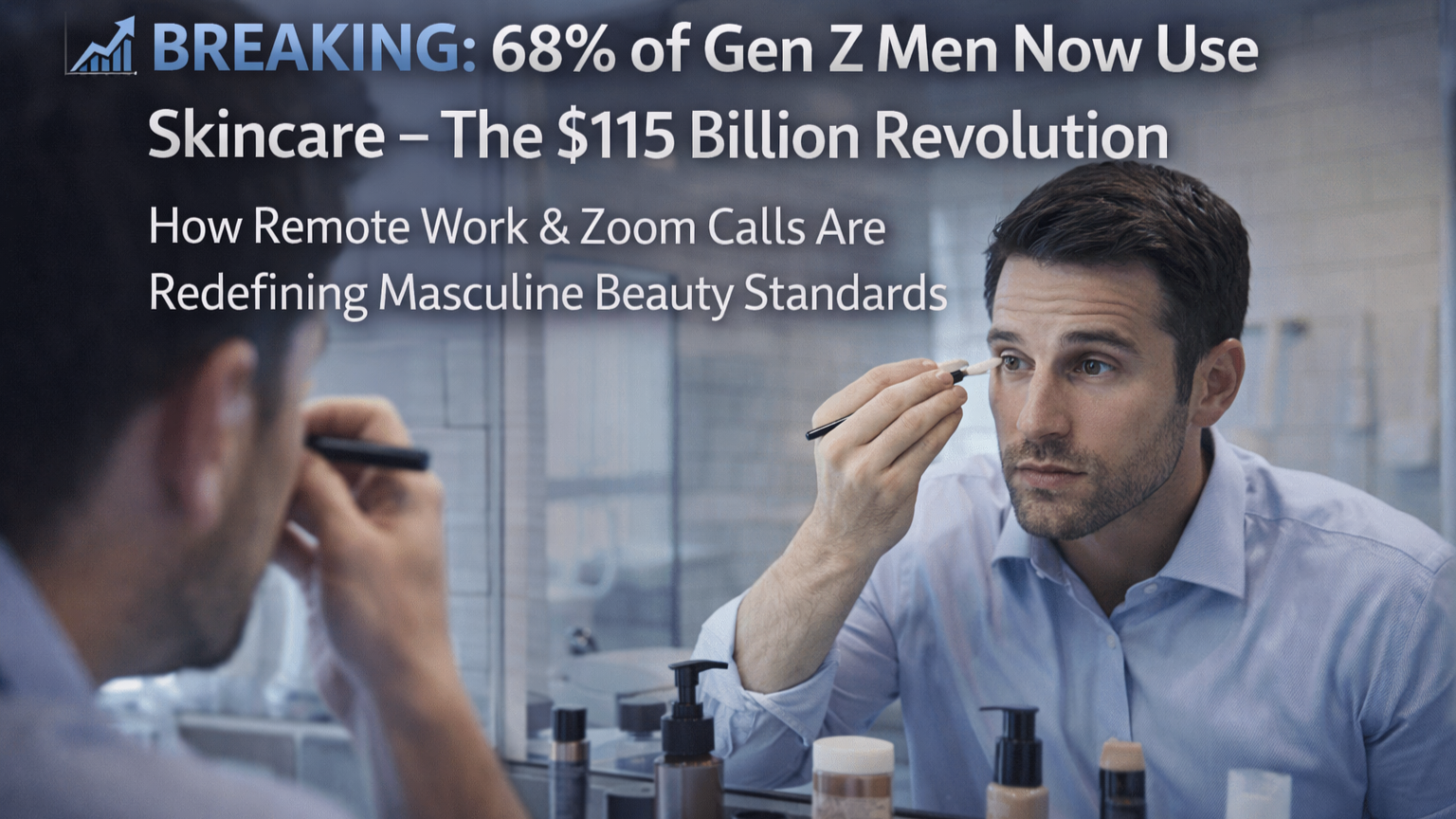
Before the morning markets open, Ben Dixon, a 42-year-old realtor, sits in front of a high-definition webcam. Distracted by the discoloration and bags under his eyes on a routine video call, he does not reach for a cup of coffee; instead, he applies a carefully color-matched, $18 concealer designed explicitly for men. Blending the product evenly across his skin, he prepares for a virtual negotiation. Dixon later credits his fresh, blemish-free appearance as a contributing factor in securing a $30 million penthouse deal, describing the cosmetic product as the modern equivalent of a “well-fitting suit”.
Across the country, Gabriel Reyes, a publicist in his early 60s, engages in a similar routine. Confronted by the harsh reality of sun spots and wrinkles illuminated by his computer screen, Reyes applies a $10 Maybelline foundation and a $25 Beauty Balm cream to his face, neck, and ears. He refers to this cosmetic application as putting on “his mask” for online meet-and-greets, noting that while it may sound frivolous, the process makes him feel significantly more confident and focused on the professional tasks at hand.
These are not isolated incidents of vanity, nor are they the exclusive domain of younger, hyper-online demographics. They represent a profound shift in workplace survival tactics. In an era defined by high-definition cameras, ubiquitous video conferencing, and an increasingly competitive labor market, male professionals are adopting cosmetics to maintain a competitive edge. The modern economy has transformed the human face into a heavily scrutinized asset, forcing men to confront aesthetic pressures and physical expectations that women have navigated for centuries.
Defining the Core Problem: Aesthetics as Human Capital
The surge in men using makeup is frequently misunderstood as a purely cultural victory for gender fluidity or a byproduct of progressive social media influencers. While shifting gender norms undoubtedly play a role, the core driver is systemic, psychological, and deeply economic. The phenomenon known as “Zoom Dysmorphia”—a psychological fixation on perceived facial flaws exacerbated by hours of staring at oneself on video calls—has catalyzed a massive behavioral shift.
What is actually happening is the normalization of male cosmetics as utilitarian tools for professional advancement and social survival. In a hyper-visual corporate environment, appearance directly correlates with perceived competence, vitality, and authority. The problem is that the corporate requirement to “look the part” has escalated, subtly moving the baseline of professional grooming from basic hygiene to active aesthetic enhancement. The tools to meet conventional beauty standards have never been more accessible, turning what was once the domain of actors and models into a mainstream professional requirement.
This matters because it exposes a hidden economic tax on workers. When aesthetic perfection becomes an unspoken prerequisite for career advancement, those who cannot afford or choose not to engage in cosmetic enhancement are systematically disadvantaged. The issue is misunderstood when it is framed merely as a beauty trend; it is, in reality, a fundamental shift in the parameters of human capital and the psychological burden placed on the modern workforce.
Historical Context: From Status Symbol to Stigma
To understand the current shift, one must recognize that the stigma against men wearing makeup is a relatively recent historical invention. The contemporary view of male cosmetics as an anomaly ignores thousands of years of human history where male grooming was inextricably linked to power, wealth, and spirituality.
In Ancient Egypt, cosmetics were ubiquitous among men across all social classes. Egyptian men lined their eyes with thick kohl to protect against the sun and ward off evil spirits, while utilizing red ochre for lip and cheek stains, green malachite eye shadow, and animal fats for moisturization. The heavier the makeup, the wealthier the individual appeared. Similarly, in Ancient Rome, while some conservative factions viewed cosmetics as effeminate, the expansion of the empire saw men adopting rouge and painting their nails to project vitality and health.
In Elizabethan England and 18th-century France, male cosmetics reached new heights of social signaling. Aristocrats and royals utilized heavy, lead-based white face powder to achieve a pale complexion, indicating that they did not have to labor outdoors. The wearing of elaborate wigs, popularized by King Louis XVI to hide his baldness, alongside heavily painted beauty marks, was considered highly masculine and a marker of elite refinement.
The structural shift occurred during the Victorian era. The fusion of rigid religious morality and early industrialization cemented strict gender binaries, linking cosmetics exclusively to femininity and, often, moral laxity. For over a century, traditional masculinity was defined by a utilitarian ruggedness and a stoic rejection of self-care. Aside from subcultural rebellions—such as the actors of 1930s Hollywood or the Glam Rock era of the 1970s and 80s, where figures like David Bowie and Boy George used vibrant makeup as artistic rebellion—makeup remained a strict taboo for the average man.
It was not until the 21st century, driven by the democratization of beauty on platforms like YouTube and Instagram, that the Victorian legacy began to fracture. Influencers redefined beauty standards, but it was the global transition to remote work and digital communication that fully reintegrated cosmetics into the daily lives of ordinary men, transforming a stigmatized practice into a normalized routine.
The Structural Mechanism: Utilitarian Marketing and Institutional Incentives
The rapid adoption of male cosmetics today relies on a specific structural mechanism: the linguistic and psychological rebranding of makeup as utilitarian “tools.” Men have been culturally conditioned to solve problems and optimize performance. Cosmetic corporations, recognizing this psychological dynamic, have repackaged foundation, concealer, and bronzer as functional, problem-solving instruments.
Brands deliberately avoid the overt language of beauty. Instead, they utilize muted, monochrome packaging and ergonomic click-pens, marketing their products as “skin fix,” “blemish control,” or “urban defense”. By framing cosmetics as high-performance grooming toolkits rather than beauty enhancements, companies effectively lower the psychological barrier to entry for men who still cling to traditional masculine scripts. Men are not purchasing glamour; they are purchasing a competitive advantage that aligns with traditional ideals of problem-solving and self-maintenance.
Simultaneously, institutional behavior reinforces this demand. Major retailers and venture capital firms are aggressively expanding the male grooming infrastructure. In the United States, retail giants like CVS have introduced male cosmetic brands like Stryx into thousands of locations, while Sephora and Ulta actively expand their men’s sections. E-commerce dominance plays a crucial role; male shoppers are spending the majority of their beauty budgets online, with 54% of US men’s skincare budgets spent on Amazon, allowing for a discreet shopping experience free from the perceived judgment of traditional beauty counters.
Furthermore, corporate grooming policies and institutional expectations are shifting. While federal laws like Title VII of the Civil Rights Act and the CROWN Act push employers toward gender-neutral dress codes that prohibit mandating makeup for women, the unspoken professional standard across industries like finance, law, and tech implicitly demands a flawless, polished appearance from all employees. Digital solutions have even emerged to meet this demand; Shiseido introduced augmented reality (AR) makeup filters for Zoom and Skype, allowing men to virtually apply concealer, BB cream, and lip balm, or even simulate a clean shave, to appear radiant in meetings without physically applying products. This intersection of technology, marketing, and corporate expectation creates a self-sustaining ecosystem that structurally mandates male aesthetic enhancement.
Evidence and Data: The Economics of the Male Aesthetic
The financial metrics underlying this shift reveal an industry in the midst of explosive structural growth, driven by shifting demographics and new consumer behaviors. The normalization of male cosmetics is backed by substantial capital reallocation.
| Market Metric | Current Data (2024/2025) | Projected Growth | Source |
| Global Men’s Grooming Market | Valued at $61.3 Billion (2024) | Projected to hit $115.3 Billion by 2028 | |
| Global Cosmetics for Men | Valued at $63.2 Billion (2025) | Projected to reach $112.4 Billion by 2034 | |
| Gen Z Skincare Adoption | 68% of US men (ages 18-27) use facial skincare | A 25% increase in just two years (since 2022) | |
| Corporate Sales Spikes | Tribe Cosmetics saw a 120% sales increase in 6 months | “Skin fix” concealers account for 60% of brand sales |
The data indicates that the primary consumer base is no longer restricted to niche subcultures. A 2024 survey found that 68% of men care more about their appearance today than they did five years ago, actively investing in multi-step routines.
This economic expansion also brings to light the complex pricing dynamics of gendered consumer goods. Historically, the “Pink Tax” has financially penalized women, charging them more for products identical to those marketed to men. Studies confirm this disparity persists; a 2024 analysis found that women’s topical minoxidil foams remain roughly 20% more expensive than men’s, and women pay an average of 40% extra for basic toiletry essentials like shower gel and razors.
However, the rapid premiumization of the male grooming market has introduced a counter-phenomenon often termed the “Blue Tax.” As men increasingly prioritize quality, advanced features, and brand loyalty over price sensitivity, certain luxury male grooming items—particularly shaving gels, specialized serums, and high-end perfumes—frequently carry higher price tags than female equivalents. A quantitative analysis of Amazon pricing data found that the percent increase in the average price for men compared to women was 7.71% for deodorant, 28.27% for perfume, and 58.84% for razors in specific premium segments. This dynamic suggests that cosmetic pricing is heavily influenced by targeted product differentiation and the exploitation of men’s willingness to pay a premium for discreet, high-performance formulations packaged in masculine branding.
Real-World Case Studies: The Psychological Tightrope
The integration of male makeup has not been without deep cultural friction, as evidenced by the trajectory of the UK-based brand War Paint for Men. Launched in 2018 by Danny Gray, who initially used his sister’s concealer to hide teenage acne, the brand secured over £1 million in venture capital from firms like True and Redrice Ventures. However, in 2019, War Paint faced a severe public relations crisis following an advertisement featuring a heavily tattooed, muscular man applying product before putting on a skull ring.
The internet fiercely condemned the campaign for promoting “toxic masculinity” and reinforcing fragile gender norms merely to sell concealer, with critics arguing that the brand was too terrified to simply call makeup what it is. The backlash was immense, leading Gray to believe his brand was effectively destroyed.
However, the fallout forced a corporate pivot that illustrates the psychological complexities of the modern male consumer. War Paint restructured its identity away from aggressive hyper-masculinity and toward genuine mental health advocacy. The brand partnered with actor Stephen Fry and the Norwich City Football Club to launch campaigns aimed at destigmatizing men’s mental health, suicide rates, and body image issues. They opened a “world first” men’s makeup store to provide education and normalize the practice in a safe environment. This case study demonstrates that modern male consumers demand authenticity; they reject condescending hyper-masculine marketing in favor of brands that acknowledge their vulnerability and desire for self-care.
Conversely, the psychological pressure driving aesthetic consumption has manifested in deeply destructive behaviors among younger demographics. The internet phenomenon of “Looksmaxxing”—a trend originating in online “incel” (involuntary celibate) subcultures—has gone mainstream among teenage boys. Looksmaxxing operates on the belief that physical attractiveness is the sole determinant of social and romantic success. It ranges from basic grooming (“softmaxxing”) to dangerous physical alterations (“hardmaxxing”), such as “bonesmashing,” which involves repeatedly striking the face with blunt objects in a misguided attempt to restructure the jawline. This extreme case study highlights the severe psychological consequences of an unregulated, hyper-visual culture that reduces human worth to measurable facial symmetry and algorithmic perfection.
A Comparative Perspective: The South Korean Blueprint
To understand the future trajectory of Western male grooming, one must analyze South Korea, the undisputed global leader in male cosmetics. The structural incentives in South Korea provide a perfect blueprint for how economic pressure dictates aesthetic standards, demonstrating that policy outcomes and cultural norms are deeply intertwined.
In South Korea, appearance is explicitly tied to economic survival through the concept of “spec” (specifications)—the accumulated credentials, including physical attractiveness, necessary to secure employment in fiercely competitive conglomerates. A staggering 93% of South Korean companies require a photograph on job applications, and over 60% of HR managers openly admit that physical appearance influences their hiring decisions. This “face culture” has led to extreme measures, with parents frequently investing thousands of dollars in plastic surgery for their children to grant them a competitive edge in the labor market.
Consequently, South Korean men spend more per capita on skincare than men in any other nation, utilizing comprehensive multi-step routines that include essences, serums, BB creams, and subtle lip tints. The integration of cosmetics is so complete that the South Korean military actively addresses it; the Ministry of Food and Drug Safety (MFDS) regularly updates cosmetic safety standards for male soldiers, regulating the allowable limits of UV filters and sunscreens used by active-duty personnel. What Western observers often mistakenly attribute solely to the cultural influence of K-Pop is, at its core, a ruthless economic calculus. When institutions reward physical symmetry and youth with financial stability, makeup ceases to be a luxury; it becomes a mandatory investment in human capital.
In stark contrast, Western corporate environments are attempting to mitigate these aesthetic biases. Progressive HR departments in the US and UK are increasingly exploring “blind recruitment” practices. By stripping names, photographs, and demographic identifiers from initial applications, companies aim to force merit-based evaluations and combat the unconscious bias that favors conventionally attractive candidates. While South Korea formalizes aesthetic standards into the hiring process, the Western approach currently wrestles with the tension between a hyper-visual social media culture and the legal and ethical mandates of equal opportunity employment.
Broader Implications: Hiring Bias and Social Mobility
The normalization of male cosmetics exposes severe structural flaws within modern corporate and social environments, carrying profound implications for social mobility, economic inequality, and psychological well-being.
From an institutional perspective, the unspoken requirement for “perfect” appearances introduces profound hiring biases. The data on “pretty privilege” in hiring is uncomfortable but undeniable. Surveys reveal that 53% of hiring managers admit physical features influence their decisions, and 40% explicitly state they would select a conventionally attractive candidate over a more qualified one. As accessible technologies like Botox, GLP-1 weight-loss drugs, and high-end cosmetics raise the baseline for physical perfection, a new and insidious barrier to entry is erected for lower-income workers.
When “looking the part” requires expensive serums, undetectable concealers, and dermatological interventions, social mobility is directly hindered. Economic inequality exacerbates social disparities; a person from a disadvantaged background cannot easily afford the premium grooming products required to project the “executive presence” demanded by high-paying sectors like finance or law. Thus, the aesthetic arms race economically penalizes those who are already structurally disadvantaged, transforming beauty from a genetic lottery into a purchasable asset that compounds existing class divides.
Psychologically, the impact on men is increasingly mirroring the historical pressures placed on women. Academic studies comparing body image reveal complex double standards. Research indicates that while men traditionally evaluate their own bodies with self-enhancing biases—judging their own appearance more favorably than they judge others—this protective mechanism is eroding under the weight of digital scrutiny. The constant exposure to digitally enhanced, AI-filtered ideals creates a persistent, low-level pressure that triggers depressive symptoms, body dysmorphia, and intense anxiety. An Equimundo study confirms that men in the US are currently facing acute economic precarity, which, when combined with the pressure to meet restrictive ideals of masculinity and physical perfection, leads to severe social isolation and pessimism.
Conclusion: The Aesthetic Tax on Human Survival
The rise of men’s makeup is a profound indicator of where modern society is heading. It is tempting to view the destigmatization of male cosmetics purely as a triumph of progressive gender expression and individual liberty. However, a systemic analysis reveals a more complex, structural, and somewhat unforgiving reality.
Men are embracing makeup not simply because they have been liberated from Victorian gender norms, but because the structural incentives of the 21st century demand it. In an economy increasingly mediated by high-definition screens, algorithmic social validation, and implicit corporate biases, the human face has been entirely commodified. Makeup has been adopted as a necessary, functional tool to manage personal branding, mask the physical manifestations of exhaustion, and secure economic mobility.
While the dismantling of archaic gender norms allows men to engage in healthier self-care and emotional vulnerability, society must remain fiercely critical of the underlying institutional pressures driving this trend. When a dab of concealer becomes an unspoken prerequisite for closing a real estate deal, securing a job interview, or retaining social relevance, the system is no longer merely selling confidence. It is enforcing a mandatory, highly profitable aesthetic tax on human survival.
To build a truly equitable society, institutions must actively dismantle the biases that reward physical conformity over substantive capability. Expanding blind hiring practices, enforcing rigorous anti-discrimination policies, and challenging the corporate expectation of artificial perfection are vital steps. Ultimately, we must ensure that individual merit, intellect, and character—rather than a masterfully applied tinted moisturizer—remain the true, objective measures of human value.
Leave a Reply