
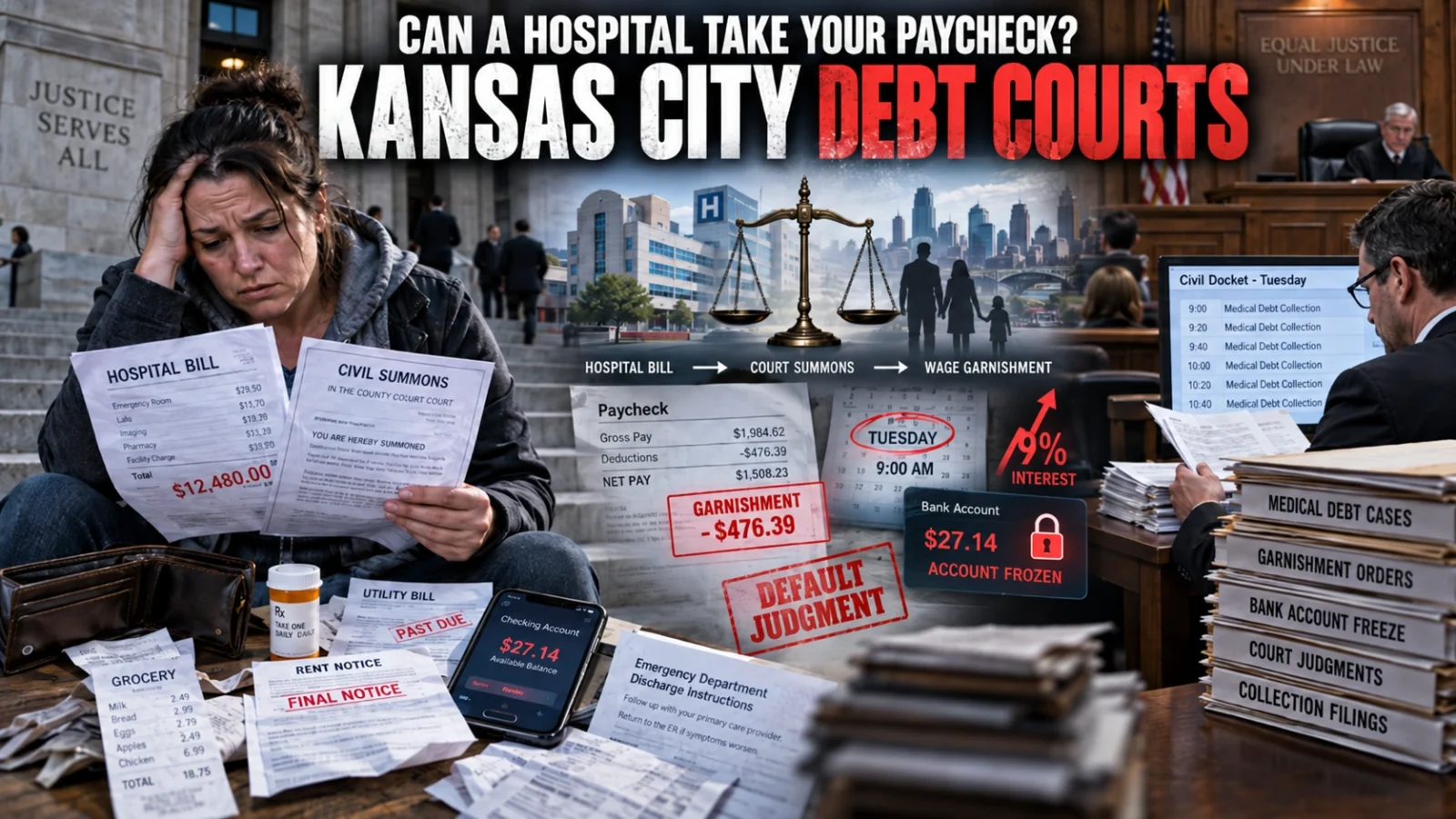
Every Tuesday morning at 9 a.m., Jackson County Circuit Judge R. Travis Willingham presides over a crowded civil collections docket in downtown Kansas City1. While many files involve commercial credit cards and overdue auto financing, dozens feature area residents facing formal lawsuits over unpaid emergency room treatments and routine medical care1. These courtroom proceedings have increasingly turned regional healthcare providers into aggressive debt collectors targeting people whose financial distress stems entirely from unexpected illness1.
The crisis has intensified across the Kansas City metropolitan area as insurance deductibles climb, coverage protections erode, and automated filing platforms accelerate legal actions1. Nationally, approximately 20 million adults collectively owe an estimated $220 billion in medical debt, transforming civil courthouses into collection mills for non-elective healthcare1. In Missouri and Kansas, this financial machinery routinely subjects working families to court judgments, frozen bank accounts, and aggressive wage attachments1.
This legal pipeline falls heaviest on hourly workers, single parents, and underinsured patients who assumed their nonprofit community hospitals would provide financial protection1. Patient advocates warn that dragging insolvent individuals before judges inflicts lasting financial trauma while generating a fraction of a percent of hospital operating revenues1. As civil dockets expand across both sides of the state line, the boundary between charitable medical care and corporate debt recovery continues to erode1.
The Tuesday Morning Assembly Line in Jackson County
Civil Dockets Operating as Hospital Billing Desks
In Division 26 of the Jackson County Courthouse, hospital debt claims move swiftly through a legal framework originally built for commercial contract disputes1. Because civil defendants are not entitled to court-appointed attorneys, low-income patients must navigate complex procedural rules without legal representation1. As a consequence, hospital attorneys and collection agencies secure binding legal judgments with minimal judicial scrutiny1.
The advocacy group Care Over Collections has documented 3,378 medical debt lawsuits filed across seven Missouri court jurisdictions since 20231. According to co-founder Mary Shannon, those filings produced approximately $4.7 million in civil judgments against local patients1. Roughly 64 percent of the cataloged cases concluded in automatic default judgments because intimidated or uninformed patients failed to appear in court1.
Over 70 percent of those default judgments led directly to wage garnishments that divert earnings out of worker paychecks before families can buy groceries1. This high-volume litigation is not confined to downtown Kansas City, as surrounding rural jurisdictions face similar dockets1. In southeast Missouri’s Madison County, the circuit court maintains a recurring docket dedicated entirely to hearing roughly 100 medical debt cases on the third Wednesday of every month1.
A Metropolitan Divide in Hospital Aggression
Litigating Systems Versus Institutions That Refuse to Sue
Hospital collection practices across the Kansas City region diverge sharply because neither Missouri nor Kansas enforces statutory restrictions on medical litigation1. In the Kansas City metropolitan area, the vast majority of patient debt lawsuits and wage attachments originate from two specific institutions: The University of Kansas Health System and NKC Health5. By contrast, several of the region’s largest private and faith-based healthcare networks have completely renounced taking patients to court1.
Between January and September 2026, KU Health System and NKC Health filed more than 400 debt collection lawsuits across Missouri and Kansas1. KU Health System initiated roughly 218 medical debt actions in Missouri, including 124 in Jackson County, alongside 114 filings in Kansas courts1. NKC Health, an independent municipal nonprofit hospital operating 451 staffed beds, lodged at least 92 debt collection suits in Missouri during the same nine-month period1.
| Healthcare System | Ownership & Facility Scale | Initiates Lawsuits | Garnishes Wages | Property Liens | Metro Lawsuits in 2026 |
|---|---|---|---|---|---|
| The University of Kansas Health System | Public Nonprofit (1,003 staffed beds)1 | Yes1 | Yes1 | No1 | ~332 (218 MO / 114 KS)1 |
| NKC Health | Public Nonprofit (451 staffed beds)1 | Yes1 | Yes1 | Yes1 | 92 (MO)1 |
| Saint Luke’s Health System | Nonprofit / BJC Health (460 staffed beds)1 | No1 | No1 | No1 | 01 |
| AdventHealth Shawnee Mission | Nonprofit (430 staffed beds)1 | No1 | No1 | No1 | 01 |
| University Health | Public Safety-Net Nonprofit (569 staffed beds)1 | No1 | No1 | No1 | 01 |
| HCA Healthcare | For-Profit Corporation (1,258 staffed beds)1 | No1 | No1 | No1 | 01 |
In sharp contrast, systems such as Saint Luke’s Health System, AdventHealth Shawnee Mission, and safety-net provider University Health refuse to sue patients or garnish compensation1. Even national for-profit giant HCA Healthcare, which operates Research Medical Center and Overland Park Regional Medical Center, ended the practice of taking patients to court1. KU Health System revenue cycle vice president Colette Lasack defended lawsuits as an essential measure of last resort to cover operational expenses, while NKC Health chief financial officer Austin Jones stated extraordinary collection measures remain rare1.
The Anatomy of Default and Paycheck Seizure
Defective Service and Compounding Statutory Interest
Most patients caught in hospital litigation never receive a meaningful opportunity to explain their financial hardships to a judge1. Legal aid attorneys observe that many defendants remain completely unaware of pending lawsuits until their wages disappear or their bank accounts are frozen1. In Platte County Circuit Court, a local resident contacted regarding an upcoming hearing for a $2,800 NKC Health claim reacted with shock, having received no prior court notice1.
This frequent lack of notice often stems from defective process service, a systemic problem known among consumer attorneys as sewer service4. When process servers fail to reach patients directly, summonses are routinely tacked to former addresses or delivered to distant family residences4. For economically vulnerable workers who move frequently, this administrative failure converts medical charges into unchallengeable default judgments before patients know they are being sued4.
The experience of Mariana Villegas, a 27-year-old mother in Topeka earning $14,500 annually at McDonald’s, illustrates the severe impact of this machinery4. Following an emergency room visit that resulted in a $2,184 bill, Stormont Vail Health sued her and obtained an automatic default judgment when court documents were delivered to her mother’s house4. Consecutive $300 wage garnishments were deducted from her paycheck before she discovered the lawsuit, forcing her to scrape together change to feed her children4.
Under Missouri law, judgment creditors can garnish up to 25 percent of a worker’s disposable earnings, or 10 percent if the debtor qualifies as head of a household7. State statutes also attach a 9 percent annual post-judgment interest rate to unpaid medical claims, causing debt balances to compound steadily over time9. Once garnishment orders take effect, low-income families frequently fall behind on rent, utilities, and prescription medications1.
Automated Legal Mills and Algorithmic Claim Denials
Technological Acceleration in Civil Debt Extraction
The volume of medical debt proceedings in local courts is driven by automated collection platforms that streamline mass legal filings3. Rather than conducting individualized reviews of patient accounts, specialized software ingests delinquent electronic records and automatically generates batch legal summonses3. These automated tools allow third-party law firms to file dozens of hospital lawsuits within minutes at minimal operational cost3.
David Freeman Engstrom, an expert in civil litigation at Stanford Law School cited by Pew Charitable Trusts, observed that institutional plaintiffs have effectively turned civil courts into automated debt mills3. Data from Pew indicates that debt collection lawsuits rose from 29 percent of civil court dockets in 2013 to 42 percent by 2021 across states with public court data3. Digital automation has lowered filing costs so substantially that hospital collection departments can profitably litigate over unpaid balances under $1,0001.
This courthouse automation operates alongside artificial intelligence systems deployed by health insurers to systematically deny medical claims14. As commercial insurers use automated algorithms to deny reimbursement, hospitals shift larger deductibles and coinsurance charges onto patients1. Trapped between automated insurer claim rejections and automated court debt filings, patients bear the full financial fallout of healthcare digitization1.
The Nonprofit Paradox and Community Benefit Deficits
Tax Exemptions Dwarfing Financial Assistance Outlays
Aggressive hospital litigation exposes an institutional contradiction at the center of American nonprofit healthcare1. Under Section 501(r) of the Internal Revenue Code, nonprofit health networks receive tax-exempt status in exchange for providing measurable community benefits, including subsidized emergency care1. Federal rules require these hospitals to publicize financial assistance policies and make active determinations of charity eligibility before taking extraordinary collection actions1.
However, national research from the Lown Institute reveals that tax-exempt hospitals regularly fail to match their public subsidies with charitable care1. A study evaluating 1,773 hospitals discovered that more than 75 percent spent less on dedicated charity care than the financial value of their tax breaks, creating a $14.2 billion national deficit1. Financial disclosures demonstrate that Kansas City health systems initiating lawsuits maintain substantial annual revenues while recording comparatively limited charity care outlays5.
In fiscal year 2025, The University of Kansas Health System reported $5.4 billion in operating revenue and $120 million in operating income, while providing $150.5 million in charity care5. In the same period, NKC Health generated $788 million in net patient service revenue and delivered $20 million in charity care, even as it wrote off nearly $45 million in uncollected patient debts5. Allison Sesso, chief executive of Undue Medical Debt, pointed out that using legal apparatuses to collect from insolvent individuals is functionally an ineffective and punitive act1.
What Happens Next: Legal Resistance and the Push for Reform
Courtroom Pushback and the Uncertain Policy Horizon
In response to widespread litigation, legal aid attorneys and grassroots organizations are challenging hospital collection practices across the region1. In mid-2026, Kansas Legal Services negotiated a landmark settlement with Stormont Vail Health that cleared nearly $162,000 in debt and refunded over $7,000 in garnished wages for 11 working patients4. The legal defense argued that the hospital violated federal tax standards by garnishing the wages of patients who clearly qualified for free care under the hospital’s own published guidelines4.
At the federal level, comprehensive protections for indebted patients remain tangled in regulatory and judicial challenges15. The Consumer Financial Protection Bureau finalized regulations barring medical debt from consumer credit reports in early 2025, but financial industry lawsuits delayed implementation15. Consumer attorneys note that removing medical debt from credit reports could inadvertently accelerate courthouse filings, as formal lawsuits remain the sole mechanism for hospitals to secure enforceable liens and wage garnishments7.
Advocacy groups including Care Over Collections are lobbying Missouri and Kansas lawmakers to enact statutory limits on medical wage garnishments and mandate charity care screening before any lawsuit is filed1. Until statutory protections are passed, regional health systems maintain unilateral authority to choose whether to offer charity care or dispatch process servers1. For hundreds of working families around Kansas City, that unchecked discretion ensures the courthouse docket will remain full next Tuesday morning1.
Unpaid medical bills land hundreds of patients around KC in court each year. It’s only getting worse
https://www.kcur.org/health/2026-10-02/hospitals-medical-debt-university-kansas-health-system-nkc-health
https://www.hppr.org/hppr-news/2026-07-16/a-kansas-hospital-garnished-wages-of-patients-who-qualified-for-free-care-then-they-fought-back
https://www.kansaslegalservices.org/page/2666/kansas-courtroom-hospital-dominates-docket
These Health Centers Are Supposed to Make Care Affordable. One Has Sued Patients for as Little as $59 in Unpaid Bills.
U.S. Senator Roger Marshall Sued Hundreds, Jailed Dozens of Women Over Medical Debt
https://www.beckersasc.com/asc-news/81-arrest-warrants-tied-to-physician-lawmakers-patient-debt-cases/
Medical Debt Banned From Credit Reports
https://unduemedicaldebt.org/solutions-to-buy-medical-debt/
https://www.nolo.com/legal-encyclopedia/missouri-wage-garnishment-laws.html
Works cited
Medical debt lands hundreds of patients around KC in court,
Class Notes – Alumni and Giving – School of Law | UMKC,
In This Kansas Courtroom, the Hospital Dominates the Docket,
A Kansas hospital garnished wages of patients who qualified for free,
These 2 Kansas City hospitals garnish patients’ wages for unpaid,
Missouri Judge Retention 2022 Election Guide – Metro Voice News,
Missouri Wage Garnishment Laws and Limits – Nolo,
How To Handle Debt Problems | Missouri Legal Services,
Garnishing Wages to Collect a Judgment in Missouri,
Wage Garnishment in Missouri – Upsolve,
11 Best Debt Collection Software 2026 – HES FinTech,
Automated Bulk Legal Notice for Digital Lenders | Fast Dispatch,
Missouri and Kansas hospitals sue patients over unpaid bills,
AI Healthcare Claim Denial Lawsuits and Patient Harm,
Medical Debt Banned From Credit Reports,
Consumers with medical debt stuck in the middle as ban from credit,
Getting care shouldn’t mean getting sued, but countless Missourians,
KC Fans – Welcome To Kansas City Thrive!,




Leave a Reply