



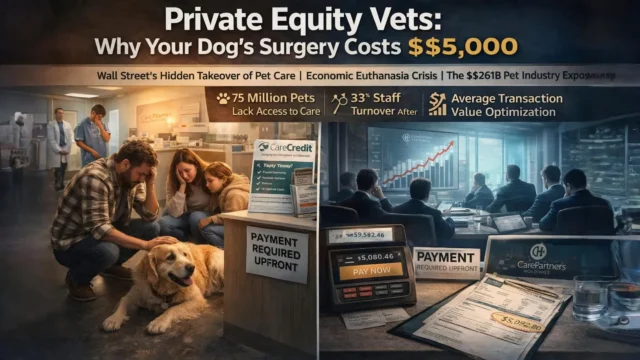
Emergency veterinary clinic waiting room with distraught family facing economic euthanasia decision, private equity corporate consolidation of local vet practices, $5000 surgery bill reality

Private Equity’s Veterinary Takeover: Why Your Dog’s Emergency Surgery Costs $5,000

Private equity firms control 75% of emergency veterinary practices, forcing families to pay $5,000 upfront for life-saving pet surgery or choose “economic euthanasia”—killing medically curable animals due to corporate payment policies. Mars Corporation owns 2,000+ clinics (Banfield, VCA, BluePearl) while maintaining the “illusion of independence,” keeping local names to hide Wall Street ownership. Independent practices experience 18.7% revenue decline within 6 years of corporate entry. Negative accrual compensation traps force veterinarians to upsell desperate clients to clear corporate-imposed debt. 87% of vets suffer burnout costing the industry $1-2 billion annually. By 2030, 75 million pets may lack access to care as corporate consolidation prices working families out of pet ownership entirely.


Active seniors playing pickleball on outdoor court showing health benefits and community engagement, smiling elderly players exercising together

Pickleball Seniors Revolution: How the Fastest-Growing Sport Is Saving Lives While Destroying Property Values

Pickleball seniors are driving the fastest-growing sport in America to 24.3 million players, and the health benefits are life-saving. Eighty-year-old Arthur stabilized his blood pressure and improved cardiovascular health through daily play. Research shows senior isolation increases dementia risk by 50%, heart disease by 29%, and stroke by 32%—pickleball provides the community solution. Medicare Advantage plans deliberately subsidize the sport through programs like SilverSneakers because preventative fitness is cheaper than catastrophic care. But explosive growth creates conflict: 78.2-decibel noise destroys property values, triggering litigation. The sport cures isolation while fracturing neighborhoods, revealing the collision between public health imperatives and suburban infrastructure never designed for senior fitness revolution.

Professional businessman applying concealer makeup for video conference call, modern office setting showing men's grooming career strategy

Breaking the Masculine Mold: Why More Men Are Embracing Makeup

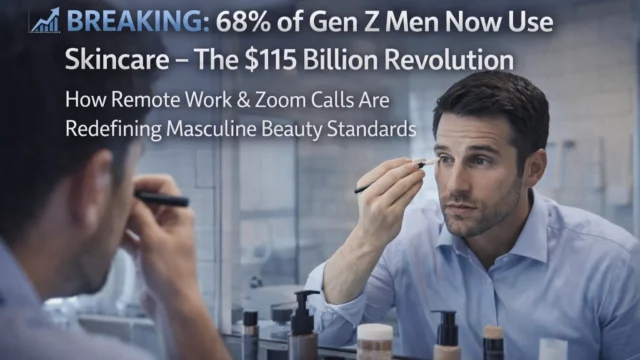
Professional men are secretly using makeup—not for beauty, but survival. Realtor Ben Dixon credits an $18 concealer for closing a $30 million deal, calling it his “digital armor” for video calls. Publicist Gabriel Reyes, 60, applies foundation as his professional “mask” before meetings. This isn’t vanity—it’s economic reality. The men’s grooming market exploded from $61.3 billion to a projected $115.3 billion by 2028, driven by “Zoom dysmorphia” and workplace aesthetic pressure. In the high-definition economy, appearance has become mandatory human capital. While 68% of Gen Z men now use facial skincare, the shift reveals a hidden professional tax: those who can’t afford aesthetic enhancement face systematic career disadvantage.

White-collar professional worker at computer looking stressed about AI job displacement, office setting showing career uncertainty and pay cuts

How AI Is Quietly Destroying White-Collar Careers: The Hidden Pay Cuts and Job Degradation Workers Face

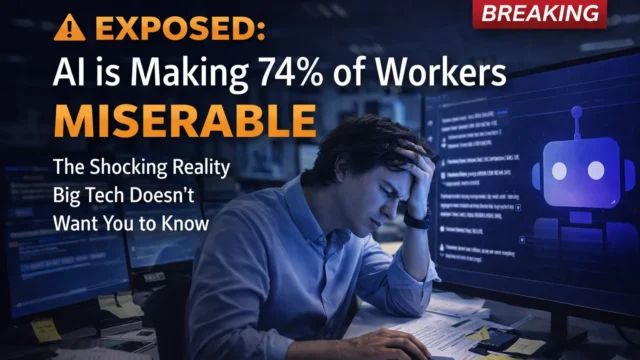
AI isn’t replacing white-collar jobs instantly—it’s degrading them through brutal pay cuts and deskilling. Professional writer Jacqueline Bowman saw her salary slashed 50% after being demoted to “AI editor,” spending twice the time cleaning up algorithmic errors. Journalist Mateusz Demski was fired and replaced by synthetic AI avatars. This is “AI workslop”—a purgatory where knowledge workers become digital janitors. Companies grow revenue 15% while freezing headcount, eliminating entry-level positions that built the middle class. The real crisis isn’t mass unemployment tomorrow—it’s the structural erosion of professional careers happening right now, creating a “silicon ceiling” that traps workers in precarious, low-paid AI supervision roles while executives enrich shareholders.