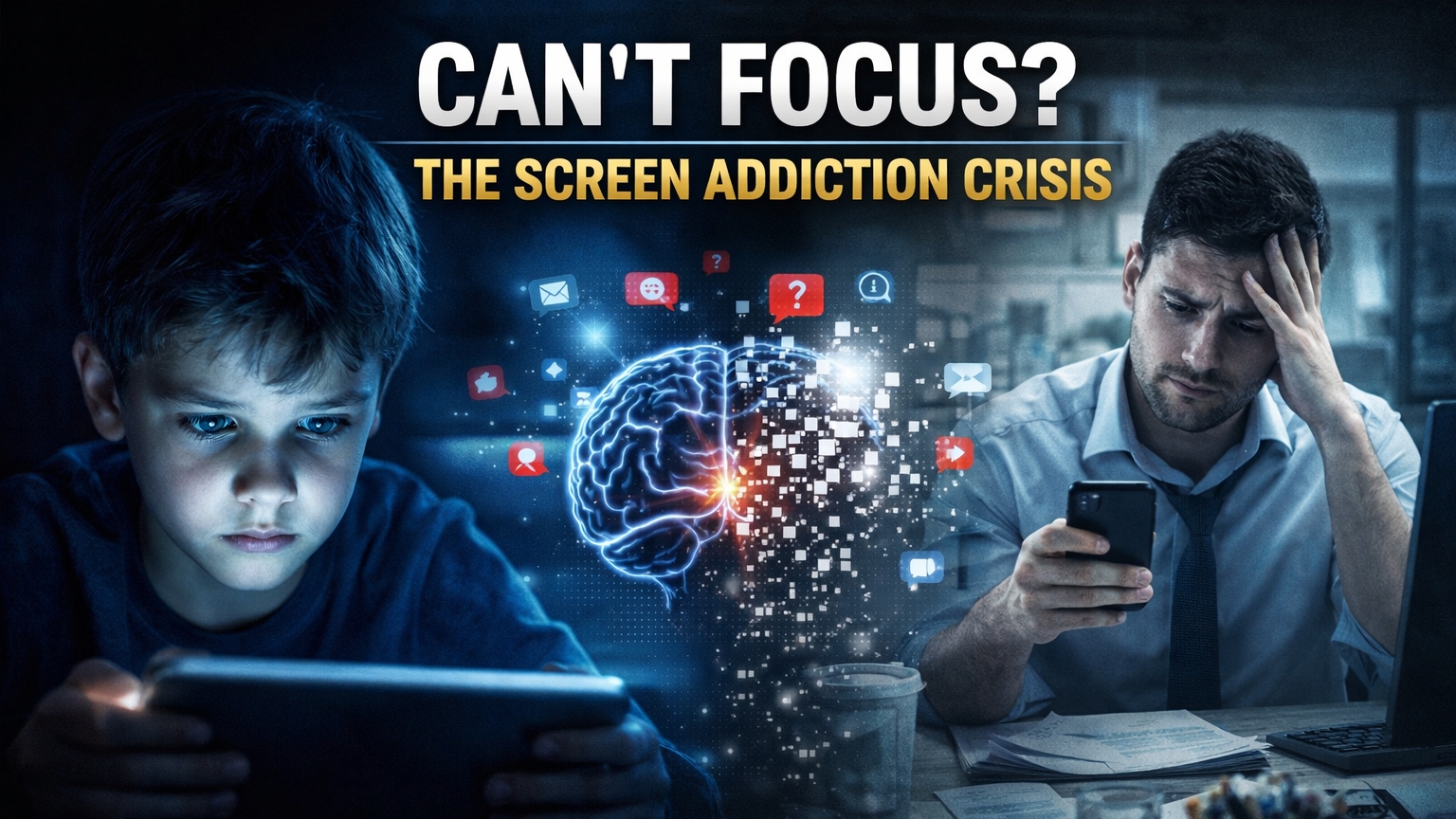
Imagine sitting in a meeting where a simple document needs to be reviewed, but no one in the room has the patience to read beyond the first few lines. Notifications buzz. Eyes drift to screens. Focus disappears within seconds. Think about how this could become the norm instead of the exception. This isn’t a problem for the future. It is already happening. The next generation entering the workforce isn’t just inexperienced—they are struggling to concentrate, to read, to think deeply. And you are quietly paying for that mistake.
At this time, 40% of fourth graders in the United States can’t read at a basic level. Think about that for a moment. Almost half of a generation doesn’t have the basic reading skills needed to understand the main idea of a simple text.
I am an HR executive with 17 years of experience in the corporate banking and financial sectors. These numbers really scare me. The middle class in the US is already fighting a lot of battles. Things are very hard for us because of inflation. Toxic workplaces make us tired. We are really tired. And very soon, the professionals who are currently holding the line will have to do the work of new employees who can’t even read a normal internal memo without getting distracted. As an HR executive who spent 17 years working in the corporate banking and financial sectors, I watch these numbers with pure dread. The middle class in the United States is already fighting on many fronts. Inflation is hurting us badly. Toxic corporate cultures are wearing us out. We’re tired. And very soon, the professionals who are already on the line will have to pick up the slack for new workers who can’t even read a regular memo.
Kids who grew up with iPads live in this world. Teenagers in the US can’t think clearly because they spend too much time on screens. This isn’t just an issue for parents. It is a ticking time bomb for the economy. If schools and parents don’t keep an eye on how much time kids spend online, the business world will eventually make you pay for it by making you work harder and lose productivity.
The Cognitive Slot Machine and the End of Hard Work
We’re not just giving kids toys. We are giving them very precise cognitive slot machines that are meant to make people lose their patience.
Kids ages 0 to 8 will spend about two and a half hours a day on screens by 2025. What matters is how you spend that time. For this age group, the number of people who watched short-form videos on TikTok and YouTube Shorts skyrocketed by an incredible 14 times between 2020 and 2024. Almost half of all preschoolers in the US now have a tablet. The immersion is complete by the time they get to high school.
| Age Group | Daily Screen Time | Key Digital Behaviors |
| 0–2 years | 1 hour 3 minutes | 40% of two-year-olds own a tablet; frequent use for emotional regulation. |
| 5–8 years | 3 hours 28 minutes | 58% own a tablet; sharp rise in gaming and short-form video consumption. |
| 13–18 years | 8 hours 39 minutes | 41% engage with screens over 8 hours daily; widespread TikTok addiction. |
I learned one thing for sure in my 17 years in HR. Deep work is what makes things worth it. The economy runs on the ability to sit still, look at a complicated financial model, and carry out a strategic vision without getting sidetracked. Short-form media, on the other hand, trains the brain to look for constant stimulation and quick dopamine rewards, which makes it much harder for a person to stay focused for a long time.In my 17 years of HR, I learned one absolute truth. Deep work creates real value. The ability to sit still, analyze a complex financial model, and execute a strategic vision without distraction is what drives the economy. But short-form media conditions the developing brain to seek constant stimulation and immediate dopamine rewards, significantly diminishing a person’s tolerance for sustained focus.
This kills cognitive endurance. I’ve seen great junior analysts burn out because they can’t think for long periods of time. They get scared when they aren’t constantly stimulated.
For the average worker, the practical use is to stay alive by being apart. You need to physically separate yourself from your devices during deep work hours. Think of your ability to focus as a rare, highly profitable edge over your competitors. When everyone else is waiting for their next notification, the employee who can sit still and think for two hours becomes very important.
The Reading Collapse is Bad for the Economy
The fact that so many people can’t read is a huge financial burden on the US economy.
The neurological effects of excessive screen time are becoming painfully evident. The 2024 National Assessment of Educational Progress (NAEP) showed that reading comprehension had dropped to an all-time low. Reading scores for 12th graders fell 10 points from 1992, reaching their lowest point in 20 years. Only 35% of seniors in high school can read well.
This means huge losses of money. Low literacy levels cost the United States up to $2.2 trillion per year in lost earnings, reduced workplace productivity, and downstream social costs. Specifically, employees’ low literacy skills cost the company $46 billion in lost revenue each year.
For years, I was in charge of hiring pipelines for big banks. We are already seeing entry-level applicants who can’t read a long document. They skim. They don’t understand simple directions. They depend on others to make things clear.
This makes middle management, who are already stretched too thin, babysit adults. It makes people very angry. You probably feel this way about your own teams right now. You are reading for people who don’t want to do it themselves.
For business leaders, the practical use is a big change in how they train their employees. We need to switch from teaching people new technical skills to helping them with basic cognitive problems. You need to make sure that a new hire can read a long, three-page policy document and accurately summarize it before you teach them how to use your company’s software. Don’t assume that everyone can read and write. Check it.
The Fallacy of the “Digital Native”
Being addicted to screens doesn’t mean you know how to use technology well. It turns you into a buyer.
The business world loves to think of Generation Z and Generation Alpha as digital geniuses. The data tells a different story. A survey of hiring managers in 2025 found that 66% think that new hires are completely unprepared for the job. They say that 20% of recent graduates need a lot of micromanagement, 23% are late, and 20% have bad communication skills.
This comes directly from how they deal with information. The “Screen Inferiority Effect” is a neurological phenomenon that has been proven. People understand and remember much less when they read on screens than when they read on paper. A meta-analysis from 2024 found that reading on a screen makes people do more than one thing at once and scroll quickly, which makes it impossible to really understand what they’re reading.
| Feedback on Recent Graduates | Percentage of Hiring Managers |
| Lack strong work ethic | 33% |
| Described as “entitled” | 29% |
| Unprepared for the workforce | 24% |
| Require constant micromanagement | 20% |
What stands out to me is the big difference between HR theory and practice. We advocate for “skills-based hiring” while disregarding the fact that these young adults lack the requisite executive function to acquire hard skills initially. They have been wired for quick interactions by constant digital stimulation, which has ruined their ability to solve problems.What strikes me is the profound disconnect between HR theory and reality. We push “skills-based hiring” while ignoring that these young adults lack the underlying executive function to learn hard skills in the first place. Constant digital stimulation has wired them for quick interactions, ruining their problem-solving stamina.
The practical use of this is very simple. Bring back print. Don’t always use digital onboarding modules. Give your new hires a real binder. Books in physical form give the reader spatial cues that help them remember things and make them slow down. If an employee can’t read a physical text, they aren’t ready to deal with complicated, abstract business strategy.
The Business Tax for Remedial Attention Training
Companies are secretly paying for the fact that the school system doesn’t keep an eye on screens.
In 2025, US companies spent an incredible $102.8 billion on training. It now costs $874 on average to train one employee. A lot of these budgets now go to training in basic management and interpersonal skills. We’re even seeing the rise of “attention span training” for businesses, which is meant to help people get their mental focus back after spending too much time on screens.
The math is very hard. We are paying billions of dollars in taxes to fix short attention spans. I saw training budgets in the banking industry go through the roof. The work didn’t get any harder. The workers became softer.
A company has to pay thousands of dollars to teach a 23-year-old how to keep eye contact and sit still for a 45-minute meeting without looking at their smartwatch. That money comes from somewhere. It comes from the bonus pool. It cuts into the profit margins that could be used to give raises to middle-class workers. Your pay isn’t going up because your boss is too busy running a preschool for adults.
In the workplace, we need strict rules about digital boundaries. Keep deep work hours safe. In strategic meetings, don’t let anyone bring any devices. If an employee can’t put their phone down for an hour, they are a risk. Think of attention as a limited and valuable resource for your business. Be harsh with it.
A few states are waking up. Seventeen states had “bell-to-bell” phone-free school policies by 2026, which meant that students had to live without digital pacifiers. Early data shows that the number of failing grades is going down and the number of social interactions is going up. It’s a step in the right direction. But the business world can’t wait for the school system to fix its problems.
We are dealing with a generation whose cognitive baseline has been broken by algorithms. They are joining a workforce that doesn’t forgive anyone. The American middle class is taking on the full weight of this crisis. They are expected to train, manage, and pay for coworkers who can’t keep a thought for more than fifteen seconds.
Who is really making money off the digital revolution if we have to spend billions of dollars teaching the next generation how to read a document and sit still?

Leave a Reply