
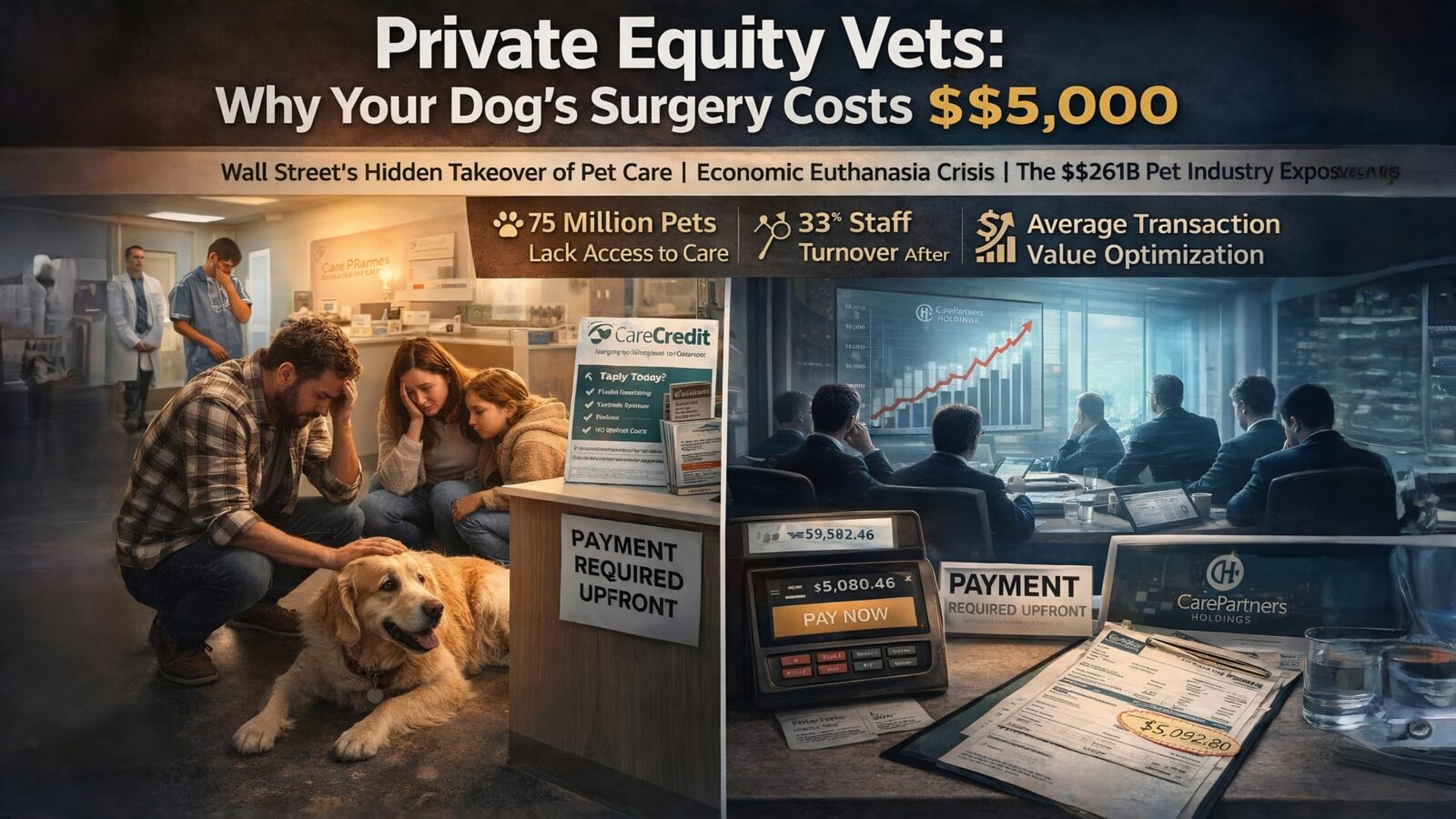
In the waiting room of a suburban emergency veterinary clinic, a family sits in quiet, agonizing devastation. Their dog, a beloved golden retriever, has ingested a foreign object—perhaps a chicken bone from the kitchen counter or a child’s small plastic toy—and requires an emergency gastrotomy to survive. The veterinarian, looking visibly exhausted and carrying the weight of systemic burnout, delivers the clinical prognosis alongside a rigid financial ultimatum. The life-saving surgery will cost $5,000, and it is payable immediately and upfront. The family is swiftly presented with a suite of financing options through third-party credit services, carrying deferred but ultimately exorbitant interest rates. If they cannot secure the funds, or if they are denied the credit line, they face the devastating alternative of “economic euthanasia”—the intentional termination of a pet’s life not due to an incurable medical prognosis, but strictly due to an inability to meet the corporate price tag.
From the outside, this clinic appears to be a local, community-rooted healthcare institution. The original founder’s name remains on the illuminated sign above the door, the waiting room is decorated with familiar local community bulletin boards, and the staff wear the same scrubs they have worn for years. However, the operational reality behind the reception desk is entirely different. The clinic is no longer an independent medical practice; it is a highly optimized financial asset owned by a multi-billion-dollar private equity firm. The $5,000 price tag, the aggressive promotion of on-the-spot credit applications, and the rigid clinical protocols are not driven solely by medical necessity or localized inflation. They are driven by corporate mandates designed to maximize “Average Transaction Value” (ATV) for distant shareholders who view the human-animal bond as an inelastic commodity.
This scene is playing out with alarming frequency across the United States. What was once a community-based, independent healthcare service is undergoing a brutal, systemic economic takeover. Wall Street has identified the unconditional love between humans and their pets as a highly exploitable vulnerability, transforming veterinary care into a ruthless arbitrage opportunity. The consequences are profound and far-reaching: soaring healthcare costs for ordinary consumers, skyrocketing emotional and physical burnout among medical professionals, and a profound, agonizing crisis of care in the animal welfare system.
Defining the Core Problem
The core issue fundamentally destabilizing the veterinary industry is the rapid, stealthy, and highly aggressive corporatization of veterinary medicine. Over the last decade, massive private equity (PE) firms and corporate consolidators have executed a systematic “roll-up” strategy—quietly buying up thousands of independent, local veterinary clinics across the country. Once these clinics are acquired, they are immediately subjected to aggressive revenue optimization tactics. Prices are hiked to levels that vastly outpace standard economic inflation, staffing is streamlined to the absolute breaking point to reduce overhead, and veterinarians are placed under complex, punitive compensation structures that financially penalize them for failing to meet corporate production quotas.
This matters deeply because it exploits a fundamental psychological and sociological shift: the phenomenon of “pet humanization”. Over the past two decades, the cultural status of pets has transitioned from outdoor companions to integrated, deeply loved family members. According to industry data, there are over 94 million households in the United States that own at least one pet, and these owners increasingly celebrate milestones, purchase premium products, and view their pets’ health with the same urgency as human healthcare. Corporate entities deeply understand this dynamic. They know that when a beloved family member’s life is on the line, the consumer is under extreme emotional duress, rendering them virtually immune to standard price sensitivity. The market is defined by a state of emergency that makes rational consumer choice impossible, allowing corporations to dictate terms without facing the traditional checks and balances of a free market.
The issue is widely misunderstood because it is intentionally obscured by the corporate entities executing the takeover. The industry relies heavily on the “illusion of independence”. When a massive holding company purchases a neighborhood clinic, they rarely rebrand it. In fact, data indicates that fewer than 15% of consolidators rebrand the practices they acquire. They keep the local name, the local signage, and the appearance of a small business, leaving consumers to mistakenly blame the local veterinarians and front-desk staff for sudden price gouging. The public remains entirely unaware that the pricing algorithms, the inventory markups, the restrictive payment policies, and the aggressive upselling scripts are being dictated by corporate boardrooms thousands of miles away. I have spent 17 years in corporate Human Resources, analyzing how large institutions structure incentives and manage public perception. I can confidently state that maintaining this facade is not an oversight; it is a calculated, strategic deception designed to shield the parent company from consumer backlash while extracting maximum financial yield from the community.
Historical Context: The Evolution of a Corporate Takeover
To understand how veterinary medicine became a prime target for Wall Street, one must examine the economic, regulatory, and cultural shifts of the past three decades. The current crisis was not an overnight phenomenon; it is the culmination of long-term economic policies intersecting with shifting social behaviors.
Historically, veterinary medicine was a cottage industry comprised almost entirely of independent businesses owned by single practitioners or small partnerships. These independent practices operated with a focus on providing a viable living for the veterinarian while fulfilling a powerful emotional mission to care for animals within their specific local communities. The initial wave of consolidation began slowly over 30 years ago with companies like Veterinary Centers of America (VCA), which recognized early on that independent clinics were highly profitable, remarkably resilient during economic downturns, and broadly undervalued by the broader financial markets.
However, the rapid acceleration of corporate takeovers occurred in the wake of the 2008 financial crisis. The subsequent era of Zero Interest Rate Policy (ZIRP) instituted by central banks provided private equity firms with access to unprecedented pools of incredibly cheap capital. These firms needed places to deploy this capital to generate returns, and veterinary clinics presented an absolutely ideal target. They generated consistent, predictable cash flow, required relatively low capital expenditure compared to human healthcare facilities, and operated in a highly fragmented market that was perfectly ripe for consolidation.
Simultaneously, the cultural phenomenon of pet humanization began to alter consumer spending habits permanently. The willingness of owners to spend on premium health products, specialized diets, and advanced medical procedures grew exponentially, transforming the pet care sector into a multi-billion-dollar economic engine. By 2017, corporate practices represented roughly 10% of general companion animal practices. Fast forward to 2021, and the landscape had violently shifted: corporate consolidators had seized control of nearly 50% of the nationwide veterinary market share by revenue, including 25% of general primary care practices and a staggering 75% of specialty and emergency practices.
The COVID-19 pandemic acted as the final, explosive catalyst. A massive surge in pet adoption during the lockdowns created a pandemic-era deal frenzy, with private equity pouring an astonishing $51.6 billion into the veterinary sector, viewing companion animal practices as a safely lucrative, “recession-proof” asset class. It was only recently, as inflation set in and the Federal Reserve raised capital costs and interest rates, that the pace of acquisition began to encounter friction. This macroeconomic shift has not stopped the exploitation; rather, it has intensified it. Because higher interest rates threaten the underlying private equity business model—which depends on low-cost cash to grow and sell businesses—these firms are now being forced to extract even more aggressive revenue growth from the clinic portfolios they already own to satisfy their immense debt obligations. This translates directly to the sudden, steep price hikes pet owners are currently experiencing.
The Structural Mechanism: How the System Actually Works
The mechanics of this industry takeover are deeply systemic. They rely on specific financial engineering, psychological manipulation of both the consumer and the employee, and rigid institutional levers to extract community wealth. To dismantle the facade, we must look at how the system actually operates beneath the surface.
The Arbitrage of the “Roll-Up” Strategy
Private equity firms typically operate on a rigid, short-term investment horizon, usually expecting to hold an asset for only 3 to 5 years before selling it for a massive profit. Their primary operational strategy in highly fragmented markets is the “roll-up.” A firm will purchase a local clinic based on a multiple of its EBITDA (Earnings Before Interest, Taxes, Depreciation, and Amortization). A single, independent clinic might sell for a modest multiple of its earnings. However, by acquiring dozens or hundreds of these clinics, the firm creates a massive regional or national network.
Because larger corporations command significantly higher valuations in the financial markets than single clinics, the private equity firm can bundle these practices and sell the entire portfolio to an even larger consolidator—or another private equity firm—at a massively inflated multiple. This process, known as recapitalization, requires the firm to aggressively inflate the portfolio’s overall EBITDA prior to the sale event. This rapid inflation of value is almost never achieved by organically improving the quality of medical care. Instead, it is achieved by ruthlessly slashing operational costs, centralizing administration, standardizing care protocols, and instituting steep, immediate price increases that often double the rate of national inflation. In some cases, individual practices are “flipped” to new owners within months of being acquired, simply to boost the revenue metrics of the parent portfolio ahead of a major recapitalization event.
The Weaponization of Human Resources and Compensation
In my 17 years of corporate HR, I have witnessed countless compensation models designed to align employee behavior with shareholder goals. However, the structures currently being deployed in corporate veterinary medicine are among the most manipulative I have analyzed, fundamentally shifting the financial risk of running a business entirely onto the backs of the medical labor force.
To drive the required revenue growth, corporate consolidators fundamentally alter how veterinarians are paid. While many independent practices historically paid a straight, predictable salary, corporate entities heavily rely on a production-based compensation model known as “ProSal” (a base draw plus a percentage of production).
Originally developed as a fair incentive system by industry consultant Mark Opperman, true ProSal guarantees a base salary and pays a bonus strictly on excess production without punitive carryovers. However, private equity has perverted this model by heavily instituting a highly punitive contractual mechanism known as “negative accrual”. Under a negative accrual system, a veterinarian is given a monthly draw, but they must generate enough clinic revenue to “earn” that draw based on their contracted production percentage. If they fall short—due to a slow week, a clinic closure for a holiday, a personal vacation, or taking sick leave—the difference is recorded as a deficit.
| The Financial Anatomy of Negative Accrual |
| Monthly Draw (Base Pay provided to Veterinarian) |
| Contracted Production Percentage |
| Required Monthly Revenue to Break Even |
| Actual Revenue Generated in a Slow Month |
| Earned Production Value ($27,000 x 22%) |
| Negative Accrual Deficit ($8,000 – $5,940) |
| Outcome: The $2,060 deficit is carried forward as a debt. When the veterinarian overproduces in the future, the corporation deducts this debt from their paycheck before paying any bonuses. |
This mechanism operates as a psychological trap. It places intense, unyielding pressure on veterinarians to continually up-charge clients, run extra, sometimes marginal diagnostics, and push expensive procedures simply to clear their negative accrual debt and avoid seeing their future take-home pay clawed back by the corporation. It is a system mathematically designed to manufacture upselling under the guise of “performance incentives,” directly tying the veterinarian’s financial survival to the maximum extraction of cash from the pet owner. Furthermore, consolidators routinely use the “fine print” of these contracts to exclude certain high-volume items (like pharmacy refills or specific lab tests) from the production calculation, effectively cutting the doctor’s pay without altering their workload.
Revenue Optimization and the “Preventive Care” Subscription
The structural extraction extends beyond employee compensation into sophisticated operational software. Corporate clinics utilize advanced practice management and revenue optimization software—such as VetlinkPRO, Profit Solver, or Covetrus Pulse—to algorithmically track and maximize Key Performance Indicators (KPIs).
One of the most heavily pushed operational levers for corporate margin expansion is the “preventive care plan” or wellness subscription. These plans bundle vaccines, routine exams, and basic diagnostics into a recurring monthly payment. While they are marketed to consumers using the language of budgeting convenience and holistic health, the underlying corporate objective is deeply financial. By transitioning a client from an episodic payer (visiting only when the pet is sick) to a subscription payer, the corporation locks the consumer into a recurring revenue stream.
| Corporate Key Performance Indicators (KPIs) and Revenue Optimization |
| Average Transaction Value (ATV): The total invoice amount per visit. Corporations push upselling and capture “missed charges” (like anesthesia line items) to constantly drive this number upward. |
| Revenue per DVM Clinical Hour: Tracks the exact dollar amount a veterinarian generates per hour of scheduled time, used to justify scheduling density and evaluate doctor performance. |
| Forward Booking Rate: The percentage of clients who schedule their next visit before leaving the clinic, ensuring future pipeline revenue. |
| Payroll % of Gross Revenue: A strict metric keeping labor costs suppressed, typically targeting 40-45%. If it rises, staffing hours are brutally cut. |
Data clearly demonstrates that clients enrolled in wellness plans visit clinics significantly more often—sometimes nearly twice as frequently as non-plan patients—drastically increasing the lifetime value (CLV) extracted from the consumer. Every additional visit presents a new opportunity for cross-selling and upselling, driven by the veterinarians who are desperately trying to outpace their negative accrual deficits.
Evidence and Data: The Reality of Market Concentration
The empirical data surrounding the corporatization of veterinary medicine reveals a market that is increasingly dominated by a handful of mega-corporations, resulting in the systemic, calculated destruction of independent competitors and an unprecedented crisis of professional burnout.
The Major Corporate Consolidators
The illusion of local choice completely evaporates when examining the ultimate ownership structures of veterinary clinics across the country. The market is controlled by massive conglomerates heavily backed by private equity and generational wealth:
| Consolidator Brand | Corporate / Private Equity Owner | Estimated Practice Count |
| Banfield, VCA, BluePearl | Mars Corporation (Wealthy Family) | 2,000+ |
| NVA (National Veterinary Associates) | JAB Holding Company / JAB Consumer Partners | 1,000+ |
| VetCor | Harvest Partners & Cressey & Co. | 900+ |
| Thrive Pet Healthcare | TSG Consumer Partners | 380+ |
| PetVet Care Centers | KKR | 450+ |
| Southern Veterinary Partners | Shore Capital Partners | 300+ |
(Data sourced from industry tracking and private equity watchdog databases, revealing the immense concentration of market power )
The Empirical Destruction of Independent Practices
The narrative that corporate consolidation improves market efficiency is definitively shattered by empirical economic research. A landmark 2023 study by economist Sandro Steinbach, published in the Journal of the Agricultural and Applied Economics Association, rigorously quantified the devastation wrought by corporate market entry. By analyzing practice-level longitudinal data covering all United States veterinary practices from 2000 to 2021, the research demonstrated a clear causal link between corporate expansion and independent practice collapse.
Steinbach’s main results show that when a corporate practice enters a local market, incumbent independent practices are 1.9% more likely to exit the business entirely. Furthermore, independent practices experience a 5.7% reduction in employment and a 6.9% decrease in revenue shortly after corporate entry.
| Sandro Steinbach’s Empirical Findings on Independent Practice Exits (Six Years Post-Corporate Entry) |
| Urban Independent Practice Revenue Drop: -18.7% |
| Rural Independent Practice Revenue Drop: -13.3% |
| Co-location Benefits: Largely disappeared since 2010, indicating immense corporate market power. |
The event study analysis revealed that the response is delayed but brutal. One year after corporate entry, the effects appear minimal, but six years later, the adverse revenue effects become statistically highly significant and catastrophic, reaching an 18.7% revenue decline for independent clinics in urban census tracts. The data indicates that corporate consolidators use their vast capital reserves and volume purchasing power to engage in aggressive price competition initially, starving out local independents before eventually monopolizing the market and hiking prices for consumers without fear of local competition.
The Human Toll: A $2 Billion Burnout Crisis
The relentless, structural pressure to generate revenue and process high volumes of patients under corporate ownership is actively destroying the veterinary workforce. Burnout—defined by the World Health Organization as a syndrome resulting from chronic workplace stress that has not been successfully managed—is rampant across the sector. Studies report that up to 87% of U.S. veterinarians experience moderate to high burnout, with 31% reporting high burnout, particularly among younger practitioners carrying immense student debt. Data shows that 21% of medical directors in corporate practices report experiencing “high” or “very high” levels of burnout, compared to relatively low levels among independent practice owners who retain autonomy over their clinical decisions.
According to comprehensive economic research from the Cornell Center for Veterinary Business and Entrepreneurship, this epidemic of workplace burnout is costing the US veterinary industry between $1 billion and $2 billion annually in lost revenue. This financial hemorrhage is driven by severe staff turnover, reduced working hours, and an increase in medical errors resulting from exhaustion. The corporate model views clinical staff as highly depreciable assets, chewing through enthusiastic young doctors who enter the field out of a profound love for animals, only to be psychologically broken by an institutional system that demands they function primarily as aggressive sales representatives.
Real-World Case Studies: The Human Consequences
To truly understand the severity of this system, we must move beyond the macroeconomic data and observe how these institutional behaviors inflict trauma on individuals and communities on the ground.
Case Study 1: The Trap of the Corporate “Acqui-Hire”
Consider the trajectory of Dr. A, an independent practice owner who built a successful, community-trusted clinic over forty years. Approaching retirement, he wished to secure his legacy and attempted to sell the practice to a younger, trusted associate. However, the associate, burdened by hundreds of thousands of dollars in educational debt, simply could not match the massively inflated, debt-backed buyout offer from a private equity consolidator.
The corporate entity approached Dr. A with promises of a seamless transition, assuring him that the clinic’s local name, its dedicated staff, and its community-focused culture would remain perfectly intact while the corporation simply handled the “back office” administration. It sounded like an ideal solution. Upon closing the acquisition, however, the reality shifted instantly. Sellers rarely inform their staff until the final hours, leading to immediate shock. The onboarding process initiated by the private equity firm was ruthless. According to industry research, 33% of employees of acquired veterinary companies leave within the first year of a transition. The acquisition was, in reality, an “acqui-hire”—the corporation was buying the local patient list and the labor force, not the culture.
Corporate management implemented sweeping price hikes across all services, despite no corresponding increase in local overhead costs, simply to boost their profit margins. The clinical staff were heavily pressured to increase transaction values, and the clinic’s culture devolved into a toxic, metric-driven environment focused exclusively on daily revenue targets. The younger associate veterinarians, who had hoped to one day own the practice, found themselves trapped. To protect their newly acquired asset, the corporate consolidator enforced strict non-compete clauses, banning the doctors from practicing veterinary medicine within a 10-mile radius of any clinic owned by the massive parent company. They were financially tethered to a corporate entity they despised, forced to choose between uprooting their lives to move to a different city or continuing to generate wealth for a distant private equity firm.
Case Study 2: The Agony of Economic Euthanasia
For consumers, the brutal reality of corporate consolidation culminates at the triage desk of the emergency clinic. Consider the widespread, devastating phenomenon of “economic euthanasia”—the agonizing decision to euthanize a beloved pet solely because the owner cannot afford the cost of life-saving care that has a highly favorable medical prognosis.
Following the corporate acquisition of local emergency clinics, standard, life-saving procedures like a gastrotomy for a swallowed object or surgery for gastric dilatation-volvulus routinely exceed $3,500 to $5,000. Corporate operational policies strictly mandate full payment upfront before treatment begins. Front-desk staff are trained to aggressively steer panicked, distraught pet owners toward high-interest medical credit cards like CareCredit, which offer deferred interest that skyrockets if the balance is not paid within a promotional window.
If the owner is declined for credit, and lacks thousands of dollars in liquid savings, the rigid corporate protocol leaves no room for compassionate billing, community-supported funds, or long-term clinic-held payment plans. The family is presented with an impossible, traumatizing ultimatum: surrender the companion animal to a rescue, or opt for immediate euthanasia. The animal is euthanized not because it cannot be saved, but because the corporate profit margin dictates that it must be. This dynamic inflicts severe moral distress and moral injury on the attending veterinarians, who are forced by unyielding corporate policy to administer lethal injections to perfectly curable animals. This moral injury is a direct, causal factor in the tragic rates of suicide and severe mental illness currently plaguing the veterinary profession.
Comparative Perspective: The Global Regulatory Response
The rapid, predatory consolidation of the veterinary industry has not gone entirely unnoticed by regulators. However, comparing the response of the United States to that of other Western nations—specifically the United Kingdom—reveals stark contrasts in policy design, institutional courage, and the prioritization of consumer protection over corporate autonomy.
The United States: Fragmented, Reactive Antitrust Interventions
In the United States, regulatory pushback has been largely reactive, piecemeal, and arguably insufficient to halt the broader systemic trend. The Federal Trade Commission (FTC) has begun intervening, but primarily only in the largest, most egregious mega-mergers to prevent outright, absolute regional monopolies. For example, when JAB Consumer Partners (the massive holding company owning NVA and Compassion-First) attempted a $1.1 billion acquisition of competing clinic operator SAGE Veterinary Partners, the FTC identified severe anticompetitive threats. The agency noted that the merger would harm consumers seeking emergency and specialty care in specific geographic markets across Texas and California.
The FTC ordered JAB to divest a handful of clinics and imposed strict prior approval requirements, forcing the private equity firm to seek FTC permission before acquiring any specialty or emergency clinic within 25 miles of its existing footprint in several states for the next 10 years. While this signifies a growing institutional awareness of the dangers of the rollup strategy, it treats the symptom rather than the disease, leaving thousands of existing corporate-owned clinics entirely unregulated regarding their pricing and HR practices.
At the state level, tentative legislative efforts are just beginning to emerge. New York recently introduced Assembly Bill A9042, which would require formal notice and Attorney General review of “material changes” in veterinary practice ownership, attempting to pierce the veil of stealth private equity acquisitions. Similarly, Texas lawmakers have proposed bills (SB 613) aimed at better defining and regulating business entities, including private equity firms, operating within the veterinary space. However, these efforts face immense corporate lobbying resistance and remain largely unpassed or untested.
The United Kingdom: Comprehensive, Structural Market Reform
In sharp contrast, the United Kingdom offers a masterclass in systemic, proactive regulatory oversight. Recognizing that the market was failing consumers, the UK’s Competition and Markets Authority (CMA) launched a comprehensive, formal market investigation into the household pet veterinary sector in 2024, concluding in late 2025 that there were “significant and widespread problems” causing severe harm to pet owners. The CMA identified that six Large Veterinary Groups (LVGs)—including CVS, IVC, and VetPartners—were dominating the market and limiting consumer choice.
Rather than simply blocking individual, future mergers like the US FTC, the UK’s CMA mandated sweeping, legally binding structural reforms targeting the root mechanics of the exploitation.
| Comparative Regulatory Frameworks: US vs. UK |
| United States (FTC & State Level) |
| • Reactive interventions blocking only the largest mega-mergers. |
| • Focus on geographic divestitures rather than operational price controls. |
| • Slow, state-by-state attempts to track private equity acquisitions. |
| United Kingdom (CMA) |
| • Mandatory Branding: Large groups must clearly brand their clinics so consumers know exactly which corporation owns the practice, destroying the “illusion of independence”. |
| • Standard Price Lists: Clinics are legally required to publish standard price lists for defined services and common medications, restoring market transparency. |
| • Prescription Fee Caps: Legally capping the fees corporations can charge to write a prescription, preventing them from holding patients hostage to their in-house pharmacies. |
| • Independent Price Comparison: The creation of a government-backed price comparison website to drive competitive pricing down. |
The UK approach demonstrates clearly that predatory pricing, corporate obfuscation, and the exploitation of the human-animal bond are not inevitable forces of nature. They are policy choices that can be rapidly dismantled through robust, consumer-focused market regulation.
Broader Implications: The Commodification of Empathy
The corporatization of veterinary medicine is not an isolated industry phenomenon; it is a glaring microcosm of a much larger, highly destructive macroeconomic trend: the extreme financialization of essential, empathy-driven services. When private equity enters a sector deeply rooted in care—whether it be human nursing homes, child care, or veterinary medicine—the fundamental incentives of that sector are permanently, and often tragically, altered.
1. The Transformation of Pet Ownership into an Exclusive Luxury As veterinary prices rise at double the rate of national inflation, the demographic reality of pet ownership in the United States is fundamentally shifting. The corporate model is steadily, systematically pricing the working and middle classes out of the ability to care for an animal. By 2030, systemic studies estimate that an astounding 75 million pets in the US may lack access to vital veterinary care due to insurmountable financial barriers. Pet ownership, which provides proven psychological and physical health benefits to humans across all socioeconomic strata, is being structurally transformed from a universal human joy into a luxury good reserved exclusively for the affluent.
2. Institutional Brain Drain and Systemic Collapse The veterinary profession is facing an existential, structural crisis. The toxic combination of crushing educational student debt and the grueling, metric-driven demands of corporate practice has led to a severe retention crisis. Brilliant, deeply empathetic veterinarians are fleeing the profession entirely to escape the moral injury of practicing “wallet biopsies” on clients and participating in economic euthanasia. Without the restoration of viable, independent practice models that prioritize community care and medical autonomy over private equity returns, the systemic shortage of veterinary professionals will only accelerate, leading to further consolidation, longer wait times, and even higher prices.
3. The Deep Erosion of Public Trust The deceptive, systemic practice of hiding multi-billion-dollar corporate ownership behind the carefully maintained facade of a friendly, independent neighborhood clinic deeply erodes public trust in societal institutions. When a consumer inevitably discovers that their trusted, long-time local veterinarian is actually an exhausted employee of a Wall Street holding company—and that the sudden, exorbitant $300 routine exam fee is funding leveraged buyouts and shareholder dividends rather than better medical equipment or fair staff wages—the resulting cynicism is profound. It poisons the vital relationship of trust between the public and the medical community, fostering a society where consumers view every medical recommendation not as a health necessity, but as a predatory sales tactic.
Conclusion
The $5,000 emergency gastrotomy is not an anomaly of standard inflation, nor is it the result of inherently greedy local veterinarians looking to exploit their neighbors. It is the precise, calculated, and mathematically optimized outcome of a systemic structure designed by private equity to extract maximum wealth from a captive, emotionally vulnerable audience.
By aggressively utilizing the rollup strategy, hiding their immense market power behind the carefully curated illusion of independent local branding, and manipulating complex HR compensation models to force medical professionals to act as commissioned sales agents, Wall Street has fundamentally broken the social contract of veterinary medicine. The empirical data and the human stories make it undeniably clear: corporate consolidation destroys independent businesses, drives deeply empathetic medical professionals to severe psychological burnout, and forces everyday families into the agonizing, morally indefensible position of economic euthanasia.
Reclaiming the veterinary industry from this financialization requires immediate, systemic intervention. It demands aggressive, proactive antitrust enforcement to halt the stealth rollups before they monopolize regional markets. It requires mandatory transparency laws—mirroring the UK’s CMA mandates—that force corporate owners to put their corporate logos explicitly on the clinics they control. Finally, it necessitates the legal elimination of predatory non-compete clauses that trap talented veterinarians in corporate servitude, preventing them from launching the independent, community-focused practices the market so desperately needs. Until these structural incentives are realigned to strictly prioritize medical outcomes over quarterly EBITDA multiples, American pet owners will continue to be ruthlessly exploited for their empathy, and the true cost of caring for an animal will remain artificially, and tragically, out of reach.



Leave a Reply