
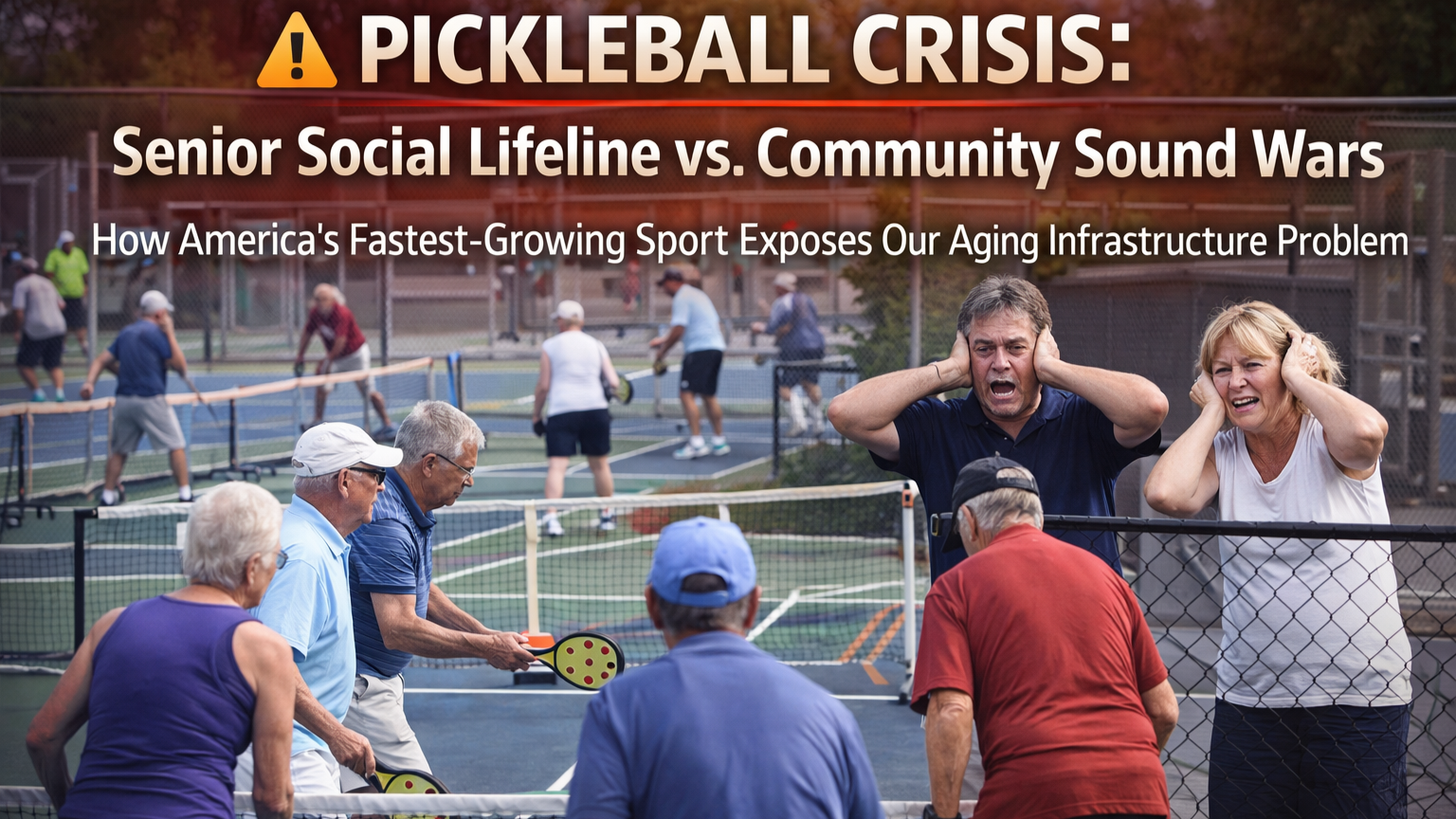
The Opening Observation: Two Sides of the Chain-Link Fence
In the affluent coastal enclave of Sagamore Beach, Massachusetts, a recently retired couple is watching the financial equity of their lifetime slowly evaporate due to an acoustic phenomenon measuring exactly 78.2 decibels. Their million-dollar property, characterized by meticulous gardens and expansive views of Cape Cod Bay, has languished on the real estate market for months. Despite severe, repeated price reductions and dozens of viewings, prospective buyers consistently reach the backyard, listen to the relentless, high-pitched “pop” echoing from the adjacent private club, and walk away from the transaction. The homeowners describe the persistent sound of the hard composite paddle striking the perforated plastic ball as an auditory intrusion akin to a perpetually running garbage disposal, an inescapable noise that has fractured the tranquility of their retirement. Driven to desperation, they have hired specialized legal counsel to litigate the neighboring courts out of existence.
Simultaneously, mere feet away on the other side of that chain-link fence, an entirely different human reality is unfolding. For the older adults occupying the court, the sharp crack of the paddle does not represent property devaluation; it represents a physiological and psychological lifeline. Arthur, an eighty-year-old retired dentist, is experiencing a stabilization of his blood pressure and an improvement in his cardiovascular capacity. More importantly, the rotating cast of doubles partners provides him with a structured, daily social network that directly combats the severe isolation that frequently accompanies the cessation of a professional career. For the players, the court is a vital “third place”—a communal hub that actively delays the onset of cognitive decline and physical frailty.
This immediate juxtaposition—vibrant, life-extending communal activity occurring synchronously with bitter, litigious neighborhood warfare—perfectly encapsulates the structural paradox of the modern pickleball phenomenon. A game invented in a backyard has inadvertently become the fastest-growing sport in the United States, adding nearly 4.5 million players in a single year to reach a staggering 24.3 million participants by 2025. Yet, this rapid expansion has laid bare a profound municipal failure. The sport is actively curing an epidemic of senior isolation, but it is doing so by hijacking suburban infrastructure never designed to accommodate its unique acoustic and demographic footprint.
Defining the Core Problem: The Public Health Solution that Fractured Suburbia
To comprehend the severity of the localized conflicts erupting in municipal parks and homeowners associations, one must first define the foundational public health crisis driving the overwhelming demand for the sport. The developed world is currently navigating a severe, often invisible epidemic of social isolation among its aging population. Current epidemiological data indicates that approximately one in four older adults in the United States experiences profound social isolation or loneliness.
The physiological consequences of this isolation are not merely abstract emotional states; they are devastating medical conditions. A lack of robust social connection is correlated with a 29 percent increase in the risk of heart disease, a 32 percent increase in the risk of stroke, and a staggering 50 percent increase in the risk of developing dementia. Traditional public health institutions have historically struggled to deploy scalable interventions to combat this crisis. Standard clinical approaches—such as one-on-one counseling or formal support groups—are heavily resource-intensive, frequently suffer from low engagement, and carry a persistent social stigma that prevents older adults from labeling themselves as isolated.
Pickleball spontaneously filled this massive societal void by providing an intrinsically motivating, accessible, and destigmatized intervention. Because the sport utilizes a smaller court than tennis, features a slower-moving wiffle ball, and mandates underhand serving, it neutralizes the vast physical disparities that typically exclude older individuals from competitive athletics. It allows for moderate-intensity cardiovascular exercise without subjecting aging joints to high-impact trauma. Furthermore, the physical proximity of the players on the smaller court and the inherently conversational nature of the doubles format forge rapid, durable community bonds.
The core problem, therefore, arises when this highly effective social cure intersects with an inflexible built environment. Municipalities, eager to capitalize on the sport’s popularity without committing substantial capital, engaged in a systemic infrastructural shortcut: they repurposed existing tennis courts by simply painting secondary lines and deploying portable nets. This decision ignored critical differences in player density and acoustic output. Up to sixteen pickleball players can occupy the exact same square footage required for four tennis players. The pace of play ensures the ball is actively in motion for nearly thirty minutes per hour, resulting in at least eight times as many paddle strikes compared to tennis. Consequently, quiet residential neighborhoods zoned for low-density activities were transformed overnight into high-density acoustic hubs. The ensuing conflict is not a petty dispute over a game; it is a fundamental clash over the allocation of public space, pitting collective public health imperatives against individual property rights.
Historical Context: From Bainbridge Island to the Institutional Juggernaut
The evolution of the sport provides critical context for how the current systemic pressures developed. The game was invented organically in the summer of 1965 on Bainbridge Island, Washington, by three friends—Joel Pritchard, Bill Bell, and Barney McCallum. Seeking a way to entertain their bored families with a disparate collection of sports equipment, they improvised a game on an asphalt badminton court using table tennis paddles and a perforated plastic wiffle ball. The rules they formalized prioritized accessibility and extended rallies over raw athletic dominance, establishing the inclusive cultural foundation of the sport.
For decades, the sport remained a regional niche. Throughout the 1970s and 1980s, it slowly permeated physical education programs, local recreation centers, and select retirement communities, particularly in the Pacific Northwest and the American Sunbelt. However, a pivotal technological shift occurred in 1984 when Arlen Paranto, an industrial engineer, invented the first composite paddle. By utilizing fiberglass and honeycomb core panels originally designed for commercial Boeing aircraft, Paranto vastly improved the durability and kinetic performance of the equipment. This material innovation, however, fundamentally altered the acoustic signature of the game, transforming the dull thud of a wooden paddle into the sharp, resonant “pop” that now characterizes the modern noise dispute. In the same year, the United States Amateur Pickleball Association was founded, laying the institutional groundwork for standardized rules and national expansion.
The trajectory of the sport remained a steady, linear climb until the confluence of shifting demographics and global events triggered an exponential explosion. As the massive Baby Boomer generation transitioned into retirement, they actively rejected the sedentary models of previous generations, seeking out active leisure pursuits that offered both physical exertion and social engagement. This demographic readiness met an unprecedented exogenous shock: the COVID-19 pandemic. In 2020 and 2021, as indoor recreational facilities shuttered and the devastating risks of social isolation compounded, pickleball offered a highly visible, outdoor, socially distanced mechanism for human interaction.
The sport grew by 14.8 percent between 2020 and 2021 alone, and the subsequent normalization of the activity triggered a staggering 171.8 percent growth rate over the following three years. Simultaneously, the commercialization of the sport accelerated dramatically. The establishment of professional leagues, such as the PPA Tour and Major League Pickleball in 2019 and 2021, injected venture capital, broadcast rights, and celebrity endorsements into the ecosystem. Despite this mainstream push toward younger demographics, the core identity of the sport remains deeply entrenched in the senior demographic, which continues to drive the localized infrastructural demands that generate both immense economic value and intense community friction.
The Structural Mechanism: Physics, Economics, and Identity
To understand why pickleball has become a permanent, disruptive fixture of the socio-economic landscape, the specific structural mechanisms—psychological drivers, economic incentives, and acoustic physics—must be rigorously deconstructed.
The Psychological Dynamics of Retirement Identity
Beyond the measurable physical health metrics, the sport fulfills a profound psychological void created during the transition into retirement. The cessation of a professional career frequently triggers a severe identity crisis; individuals abruptly lose the structured routines, built-in peer networks, and sense of measurable progress that defined their adult lives. Psychological literature indicates that maintaining involvement in meaningful, structured activities is instrumental in reconstructing an individual’s identity framework, thereby facilitating a successful transition into later life.
Pickleball operates as a highly efficient engine for this identity reconstruction. Unlike solitary activities like swimming or purely social gatherings, the sport offers a structured, competitive outlet with a highly visible gradient of skill acquisition. Because the initial learning curve is exceptionally brief—novices can engage in functional rallies within an hour of instruction—players receive immediate psychological reinforcement. As they progress, the nuanced strategies of the “soft game” (dinking and kitchen-line positioning) allow older adults to leverage cognitive anticipation, spatial awareness, and precise motor control to defeat younger, more athletically gifted opponents. This continuous cycle of learning, competing, and socializing restores a profound sense of purpose and agency, effectively replacing the workplace as the primary venue for achievement.
The Economic Incentives of Healthcare Financialization
The most profound, yet structurally obscured, driver of the sport’s integration into the senior demographic is the deliberate financial subsidization by the Medicare Advantage industry. Healthcare conglomerates operate on a fundamental economic premise: preventative maintenance and social integration are vastly less expensive than treating the catastrophic physical and cognitive failures associated with sedentary isolation.
Entities such as Humana have explicitly recognized pickleball as a high-yield public health asset. By actively promoting the sport through major advertising campaigns and executing formal sponsorships of organizations like U.S. Senior Pickleball (USSP), the Association of Pickleball Players (APP), and the Pro Tour of Pickleball (PPA), healthcare providers are strategically engineering behavioral changes within their insured risk pools.
At the local level, this strategy is operationalized through programs like SilverSneakers. SilverSneakers is a specialized fitness benefit included in many Medicare Advantage and Supplement plans, offering eligible seniors access to participating fitness locations nationwide at no additional out-of-pocket cost. Facilities ranging from local YMCAs to premium corporate health clubs utilize the SilverSneakers reimbursement model to offset the costs of constructing and maintaining pickleball courts. By subsidizing the cost of entry, these insurers effectively remove the financial barrier to participation, transforming a leisure activity into a widely accessible prescription for longevity.
However, the economics of operating dedicated commercial pickleball facilities remain challenging. An analysis of a modern, multi-court indoor facility indicates a required monthly revenue benchmark of approximately $100,000, driven by court fees, memberships, and clinics. Operating expenses—including substantial commercial rent, property taxes, specialized staffing, and ongoing maintenance—consume roughly $80,000, leaving a tight net profit margin. To achieve profitability, facilities must maximize operating hours and densely pack courts, an economic reality that severely exacerbates the potential for localized noise disturbances if the facility is not perfectly insulated.
The Physics of Acoustic Annoyance
The hostility from adjacent homeowners is not rooted in hypersensitivity; it is grounded in the objective mechanics of sound propagation and human auditory processing. The impact between a rigid composite paddle and a hard plastic wiffle ball generates a sound that averages between 70 and 78.2 decibels (dB) at the source. By comparison, a tennis ball striking a strung racket produces a sound of approximately 45 to 55 dB, roughly equivalent to the volume of a quiet office or a normal conversation.
While 70 decibels is not physiologically dangerous to human hearing, it crosses the critical environmental threshold where noise transitions from a dismissible background hum to an active psychological stressor. The issue is severely exacerbated by the specific nature of the sound. The pickleball strike is an “impulsive sound,” consisting of a concentrated burst of acoustic energy lasting approximately two milliseconds. The human auditory system integrates this brief physical pulse over a 30-millisecond neurological window, perceiving a sharp, high-pitched crack.
Acoustic engineering studies reveal that human annoyance is highly correlated with both pitch and impulsiveness. The high frequency of the pickleball impact allows it to easily penetrate standard residential windows and walls. Because the sound is unpredictable and impulsive, the human brain cannot acclimate to it or “tune it out” as it would with the steady-state drone of nearby highway traffic. When municipal zoning boards assess these noise complaints, they frequently rely on outdated ordinances that measure noise using time-averaged decibel limits (Leq). Because the pickleball impact is so brief, a court producing hundreds of 75 dB spikes per hour might technically average out to 50 dB over a continuous hour, thus passing municipal code while simultaneously destroying the psychological peace of the homeowner. This specific regulatory loophole is the structural failure point driving the explosion in civil litigation.
The Evidence and Data Behind the Crisis
The systemic impact of the sport is quantifiable across demographic, acoustic, and economic domains. A review of institutional data reveals the sheer scale of the phenomenon and underscores the divergent metrics of growth and conflict.
Table 1: United States Pickleball Participation and Infrastructure Growth
| Metric | 2022 | 2023 | 2024 | 2025 | 3-Year Growth Rate |
| Total US Participants | ~8.9 Million | ~13.6 Million | 19.8 Million | 24.3 Million | 171.8% |
| New Players Added Annually | N/A | ~4.7 Million | ~6.2 Million | ~4.5 Million | N/A |
| Total Known Court Locations | ~10,000 | ~11,800 | 15,910 | 18,258 | 82.5% |
The data indicates that while infrastructure is expanding rapidly—reaching over 18,258 known locations by 2025—it fundamentally lags behind the explosive surge in human participation. This infrastructural deficit forces the hyper-utilization of existing courts, driving the conflict with adjacent communities.
Furthermore, the data regarding the acoustic differences between racquet sports isolates why the conversion of legacy tennis courts has proven so catastrophic for community relations.
Table 2: Comparative Acoustic Profile of Racket Sports
| Sport | Decibel Level at Source | Acoustic Characteristic | Player Density per Standard Area | Impacts per Minute (Average) |
| Tennis | ~45 – 55 dB | Low-frequency, steady, muted | 2 to 4 players | ~15 to 25 |
| Pickleball | ~70 – 78.2 dB | High-frequency, impulsive, sharp | Up to 16 players | ~70 to 100+ |
The evidence is unambiguous. It is not merely that pickleball is louder by 15 to 20 decibels—a massive increase given the logarithmic nature of the decibel scale—but that the density of players and the frequency of impacts create a saturated acoustic environment.
This acoustic reality heavily influences real estate economics. In the Short-Term Rental (STR) and vacation home market, adding a pickleball court can generate significant revenue, but it carries a distinct return-on-investment profile compared to traditional amenities.
Table 3: Amenity ROI Comparison for Residential/STR Properties
| Amenity Type | Installation Cost Range | Break-Even Timeline | Guest Appeal |
| Hot Tub | $5,000 to $10,000 | 6 to 12 months | Broad, consistent |
| Pickleball Court | $25,000 to $50,000 | 7 to 18 months | Niche, group-focused (corporate/family) |
| Swimming Pool | $50,000 to $100,000+ | 24 to 36 months | Broad, high-maintenance |
While a pickleball court offers a faster break-even timeline than a swimming pool, property managers report that the amenity only provides a true ROI when properly marketed to multi-generational families or corporate groups. If poorly situated, the noise invalidates the amenity, turning a $50,000 investment into a localized liability.
Real-World Case Studies: The Utopia and the Battleground
The theoretical mechanics of policy, economics, and acoustics are most clearly understood when observed in real-world environments. The divergent outcomes of municipal planning are starkly illustrated by communities that have engineered successful integrations versus those that have descended into litigious conflict.
The Architectural Utopia: Sun City Palm Desert
Sun City Palm Desert, a premier retirement community in the Coachella Valley of California, represents the apex of successful architectural and cultural integration. Unlike municipalities that engaged in the reactive, cheap conversion of tennis courts, Sun City undertook a proactive, capital-intensive strategy to build dedicated infrastructure.
The community constructed twelve permanent courts specifically engineered for the sport, completely separating them from conflicting legacy infrastructure. Recognizing the environmental and physical realities of their aging demographic, the planners installed a central shaded breezeway equipped with commercial misting systems running directly through the court complex, allowing older adults to safely regulate their core temperatures between matches in the severe desert heat. LED lighting was installed to extend play into the cooler evening hours, safely accommodating the intense demand and distributing the acoustic footprint over a longer duration.
Crucially, the governance structure of the community proactively managed the acoustic threat. The Sun City Grand Board of Directors contracted an independent sound study firm to evaluate the specific acoustics of various paddles. Based on this empirical data, the community implemented a strict “Green Zone/Red Zone” equipment mandate. Players are exclusively permitted to use technologically advanced, noise-dampening paddles that fall within the acceptable decibel range, entirely mitigating the high-frequency impulsive noise that plagues other communities.
Socially, the club operates as a comprehensive integration engine. New residents are immediately funneled into structured “Newbie” clinics that teach fundamental mechanics and court etiquette, ensuring safety and lowering the psychological barrier to entry. The overarching ethos explicitly demands that players yield to integrity on disputed line calls, emphasizing social cohesion and mutual respect over cutthroat competition. Sun City demonstrates that when infrastructure is purposefully designed, and governance is proactive and data-driven, the sport yields maximum health dividends with zero community friction.
The Suburban Battlegrounds: Sagamore Beach and Presidio Wall
Conversely, when communities fail to account for the physical externalities of the sport, the resulting collapse of social cohesion is rapid and severe. In Sagamore Beach, Massachusetts, a couple’s inability to sell their home due to the 78-decibel noise from adjacent courts forced them to retain legal counsel. Their requests for the private club to install sound attenuation barriers or mandate the use of quiet paddles were ignored, prioritizing the recreation of club members over the property rights of adjacent citizens.
A remarkably similar dynamic unfolded in the affluent Presidio Wall neighborhood of San Francisco. In what became known locally as “The Battle at Presidio Wall,” wealthy homeowners launched a petition citing ecological concerns, noise pollution, and plummeting property values, successfully pressuring the municipal government to shutter six of the twelve public courts. This triggered intense backlash from the local player community, who staged protests and demanded the return of their public recreational space, arguing that the wealthy elite were monopolizing public assets.
These case studies expose a glaring failure in urban planning. By allowing high-density, high-impact activities to operate within the narrow buffer zones required for residential tranquility, local governments are inadvertently pitting the physical and social health of their senior populations against the financial security and psychological wellbeing of adjacent property owners.
Comparative Perspective: Global Solutions to Demographic Aging
The American iteration of the pickleball phenomenon—characterized by rapid commercialization, decentralized municipal decision-making, heavy reliance on private healthcare incentives, and fierce litigation—is not the only model for managing the intersection of an aging population and community infrastructure. Observing how global systems approach this demographic imperative provides a critical comparative perspective.
The Asian Model: Dense Infrastructure and the “Ikigai” Adaptation
In rapidly aging Asian societies, the sport is being absorbed into entirely different cultural and urban frameworks. In Japan, where 28.1 percent of the population is elderly and senior isolation is designated as a critical crisis by the Ministry of Health, the sport is being deliberately integrated into the concept of “Ikigai”—a profound socio-cultural framework translating to a “reason for being” or a sense of life purpose. Japanese clinical studies utilizing the biopsychosocial model demonstrate that maintaining Ikigai is highly correlated with reduced depressive symptoms, preserved cognitive function, and lower mortality rates among the elderly.
To foster this, Japanese municipalities utilize state-funded “senior clubs” to drive participation. The biomechanical execution of the game in Japan also reflects a distinct regional sporting heritage. Whereas the American playstyle is heavily derived from tennis—emphasizing baseline power, aggressive topspin drives, and raw force—the Southeast Asian and Japanese approach is deeply rooted in the regional dominance of badminton and table tennis. Players in these regions prioritize hyper-fast reflexes, precise touch, soft “dinking” strategies, and meticulous footwork. This softer, precision-based style is inherently less physically destructive to aging joints and marginally quieter, aligning seamlessly with the cultural prioritization of harmony over aggressive individualism. Furthermore, the intense regional focus on the Dynamic Universal Pickleball Rating (DUPR) provides Japanese seniors with a highly structured, measurable system of progression, fulfilling the psychological need for mastery and purpose intrinsic to Ikigai.
In land-scarce Singapore, the governmental approach to infrastructure is dictated by extreme urban density. The state operates “Recreational Centres” tailored for older adults, but physical space is at an absolute premium. Rather than engaging in localized zoning battles over existing parks, the Singaporean government is executing a centralized, top-down strategy through its Sports Facilities Master Plan. To meet surging demand, the government is actively retrofitting underutilized urban spaces, such as the areas beneath concrete highway viaducts. In a brilliant display of adaptive urbanism, active bus terminals are dynamically converted into multi-purpose pickleball courts during off-peak weekend hours. Furthermore, the integration of these courts into designated “Silver Zones”—residential areas engineered specifically for senior safety with reduced traffic speeds, barrier-free access, and extended pedestrian crossing times—ensures that the infrastructure serves the target demographic securely.
The European Model: Padel, Social Prescribing, and State Intervention
In Europe, the response to senior isolation operates through highly formalized, state-sponsored healthcare channels rather than the decentralized, commercial Medicare Advantage model seen in the United States. The United Kingdom utilizes a public health framework known as “Social Prescribing”. Under the UK’s Universal Personalised Care system, primary care physicians actively screen older adults for loneliness utilizing electronic health records and natural language processing algorithms. Upon identifying an isolated patient, the physician does not prescribe a pharmaceutical antidepressant; instead, they issue a formal “social prescription,” utilizing referral pathways to link the patient directly with subsidized community sports leagues, volunteer organizations, or befriending services.
While pickleball is growing in Europe, the dominant parallel sport is Padel—a squash-tennis hybrid played within an enclosed glass and mesh court. Padel serves the exact same socio-demographic function as pickleball: it is highly accessible, socially dense, and physically forgiving. However, because Padel courts are enclosed and typically require substantial initial capital investment to construct, they are primarily built in dedicated, commercial, or state-funded facilities rather than retrofitted into open public parks. This structural reality inadvertently shields European municipalities from the pervasive noise disputes fracturing American suburbs, as the sport is contained within controlled, acoustically insulated environments from inception.
Furthermore, Nordic countries emphasize holistic, state-directed urban planning to combat isolation. Municipalities like Stavanger, Norway, mandate that corporate developers build accessible, community-oriented housing as a strict condition for purchasing municipal land. In Turku, Finland, state-sponsored “Move Close” groups orchestrate low-intensity outdoor exercise, resulting in 87 percent of participants reporting the formation of new, durable friendships. The European model demonstrates that when the state assumes direct responsibility for engineering the social and physical environments of its aging population, the reliance on spontaneous, unregulated grassroots movements—and their attendant negative externalities—is significantly reduced.
Broader Implications: The Financialization of Public Infrastructure
The analysis of this phenomenon extends far beyond the boundaries of a recreational court; it forces a critical reckoning with how modern societies balance demographic shifts, public health, and private property.
First, the crisis exposes the terminal obsolescence of mid-century suburban zoning laws. American residential codes were designed under the assumption that the home was a sanctuary insulated from commercial and high-density acoustic intrusion. The failure of municipal governments to update these codes to differentiate between steady-state background noise and highly annoying, impulsive acoustic shocks has eroded public trust in local institutions. When a city council permits a 78-decibel activity mere feet from a taxpayer’s bedroom window based on a flawed, averaged decibel reading, it actively sanctions the destruction of that citizen’s psychological peace and financial equity. Moving forward, urban planners must adopt proactive, acoustically informed zoning that requires substantial physical buffers, mandatory sound-attenuation fencing, or indoor-only mandates for impulsive-noise sports situated near residential zones.
Second, the involvement of entities like Humana and SilverSneakers highlights the increasing privatization and financialization of public health and community space. While the subsidization of senior fitness is unequivocally beneficial for individual longevity, it effectively transforms municipal parks into cost-saving mechanisms for massive insurance conglomerates. If private healthcare networks reap billions in savings through delayed medical interventions facilitated by public park infrastructure, a broader policy debate must occur regarding who bears the cost of maintaining, upgrading, and acoustically insulating that infrastructure.
Finally, the situation underscores a profound issue of health equity and spatial inequality. In affluent communities like Sun City or strictly managed private country clubs, residents possess the capital to engineer flawless environments: dedicated courts, sound-dampening technology, shaded breezeways, and strict governance. The health benefits are maximized, and the negative externalities are entirely neutralized. In middle-class and working-class municipalities, however, the public is forced to rely on hastily repurposed, unmitigated public courts, resulting in endless civil conflict and the pitting of neighbor against neighbor. The ability to age healthily, socially, and quietly is increasingly becoming a luxury commodity dictated by zip code.
Conclusion: Re-architecting the Aging Society
The meteoric rise of pickleball is not a superficial cultural aberration; it is a highly logical, systemic response to a civilization that has successfully extended the human lifespan but failed to build the social infrastructure necessary to make those additional years meaningful. The sport provides a brilliant, low-cost, highly effective antidote to the catastrophic physical and psychological consequences of senior isolation. It restores the vital “third places” that evaporate upon retirement, offering older adults a venue for physical vitality, continuous cognitive challenge, and the reaffirmation of identity through deep community bonds.
However, the explosive friction the sport has generated in residential neighborhoods is a stark indictment of reactive, negligent municipal governance. The relentless acoustic intrusion that tortures adjacent homeowners is not the fault of the players seeking health, nor is it an unavoidable consequence of the game itself. It is the direct result of institutional shortcuts—the painting of lines on inappropriate surfaces without regard for basic acoustic physics, the reliance on outdated zoning ordinances, and the refusal to invest the necessary capital into dedicated, properly situated infrastructure.
As the global population continues to skew older, the demand for accessible, high-density social recreation will only intensify. Societies must evolve past the paradigm of attempting to force modern demographic behaviors into mid-century urban footprints. Whether through the adaptive reuse of urban space seen in Singapore, the clinical integration of social prescribing in the United Kingdom, or the construction of dedicated, acoustically engineered facilities in the United States, the built environment must be fundamentally reimagined. The objective is clear: to construct a society where the pursuit of health, longevity, and community by one demographic does not structurally require the sacrifice of peace, property, and sanity by another.
Leave a Reply